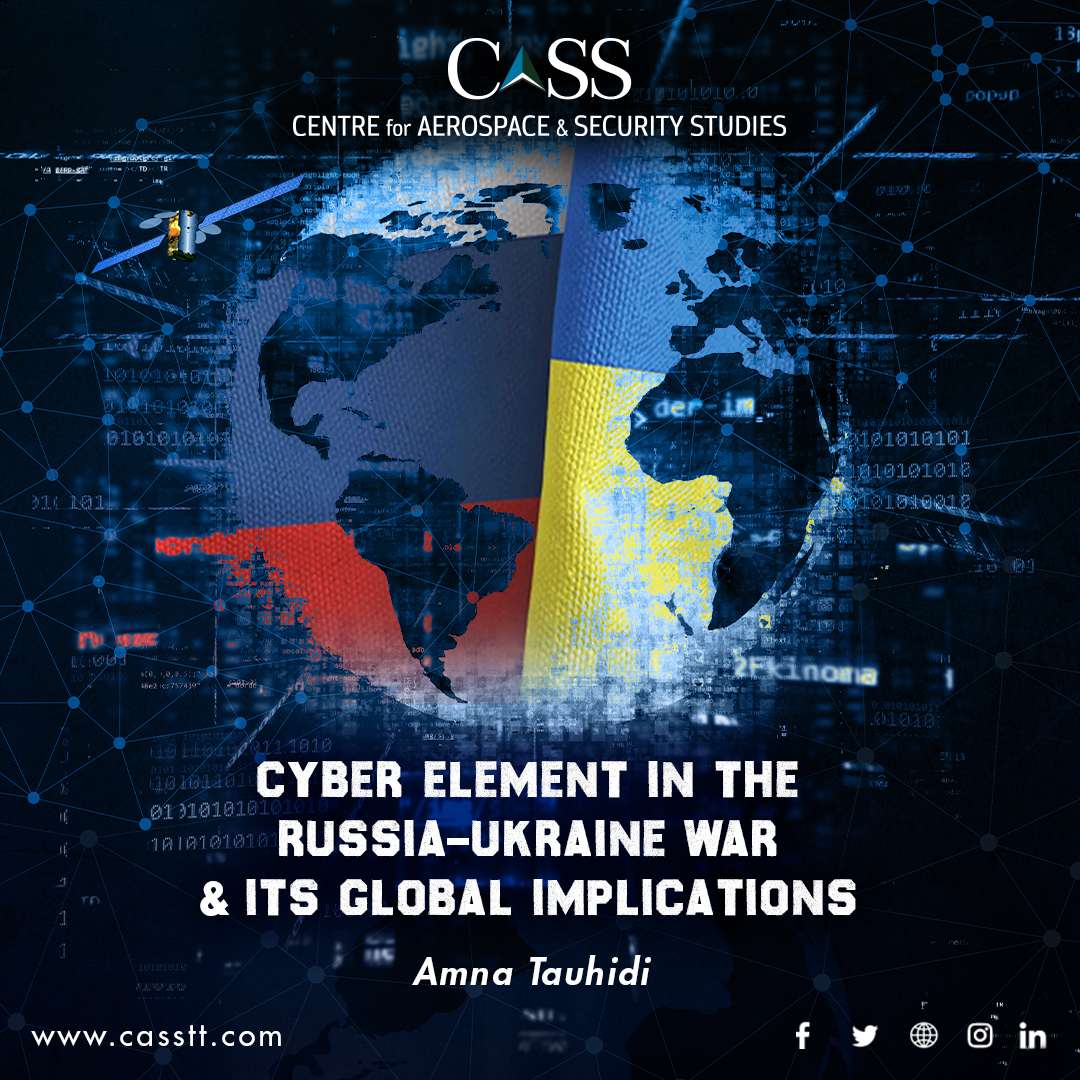
Cyber has become a focal point in the conduct of both civil and military operations. Given its emerging destructive potential, it has now become an independent ‘domain’ like land, sea, air, or space in the national military strategy of the United States (US). Besides being a new battle space, this domain serves as a force multiplier to increase or decrease the effectiveness of kinetic operations in terms of its ability to conduct surveillance, espionage, criminal activities; launch disinformation campaigns/propaganda; impact recruitment/planning; incite attacks; crush enemy morale and will to fight; gain insight into the latter’s planning and capabilities; and to mislead the public in order to secure strategic objectives.
Exploitation of the cyber domain in the ongoing Russia-Ukraine war is a perfect illustration of timing cyber-attacks to gain an upper hand in ground operations. However, this use of cyber also raises serious concerns not only for the warring states’ national security apparatus, institutions and critical infrastructure but is equally a threat to the international community due to the nature of cyber interconnectivity. This means that the threat posed by cyber is overarching and needs to be addressed seriously to avoid any unintended consequences. The article attempts to highlight the scope of cyber in the Russia-Ukraine conflict and its implications for the region and the rest of the world.
The cyber element was in full swing even before Moscow’s ground operation was launched. According to some open sources, a cyber-attack was launched on Viasat KA-SAT before the launch of kinetic operations. In fact, Microsoft’s Digital Security Unit has issued a report covering the cyber aspect of this war. According to the report, several cyber-attacks have been launched on Ukraine’s critical infrastructure, government, and business agencies. On the opposite side, Ukraine has also been active both on the offensive and defensive fronts. On the offensive front, it has set up an IT Army – a cyber operations force backed by a decentralised hacktivist group – ‘Anonymous’. The IT Army has been successful in launching cyber-attacks against Russia’s critical information infrastructure and other targets of strategic importance, e.g., Russian satellites. ‘Anonymous’ was also able to access important Russian documents regarding Kremlin’s invasion by hacking into the Roskomnadzor system. On the defensive front, Ukraine has strengthened its defence system against cyber-attacks. Paul Chichester, Director of Operations at the UK’s National Cyber Security Centre described the use of cyber-operations in the ongoing Russia-Ukraine war as ‘the most sustained set of cyber operations coming up against the best collective defense we have seen.’
Cyber-attacks have not been limited to Ukraine alone. Indeed, the conflict is escalating beyond borders. This aspect was highlighted by Google’s Threat Analysis Group (TAG). Russian hackers have also attempted to penetrate the networks of NATO and militaries of several eastern European countries as well. These attacks are an attempt to dissuade the countries supporting Kyiv militarily and economically, and ongoing NATO membership negotiations. Keeping in view Russia’s cyber potential, there are chances that Moscow (through non-state actors) could hack international banking systems to mitigate the economic damage caused by Western sanctions. Keeping in view an expected threat of attacks on energy and financial infrastructure, the US cyber security agency CISA issued its ‘Shields Up’ warning back in early February, urging increased cyber readiness.
The deployment of non-state actors by both parties (Russia and Ukraine) has blurred the lines between ‘cyber war’ and ‘cyber terrorism’. This ambiguity between state and non-state actors has increased the chances of unintended escalation or spread of this conflict. The link to escalation was made in Russia’s 2020 nuclear declaratory policy wherein the state holds the right to use nuclear weapons under a range of contingencies, such as attacks on critical governmental or military sites. The statement of Dimitry Rogozin, Head of the Russian Space Agency also made it clear that ‘hacking satellites would constitute an act of war.’
The precedence (set by the US) upholds that a cyber-attack on nuclear Command, Control, and Communication (NC3) facilities can constitute a non-nuclear strategic attack, and therefore, will justify the use of nuclear weapons as a response. NATO also reiterates the same approach by reserving the right to respond with conventional weapons if subjected to a powerful cyber-attack. These policy directives show that cyber-attacks could result in aggravating the risk of kinetic escalation, including a nuclear one.
It has, therefore, become clear that cyber remains an important strategic domain in the ongoing Russia-Ukraine war as well as future conflicts. Given the complicated nature and evolving dynamics of cyber warfare, it is vital for the global community to form a broader international security regime and frame a code of conduct for states which are actively involved in this domain. This can be done by identifying critical infrastructures that are crucial to national security which either remain beyond the ambit of a cyber-attack or are placed in the maximum retaliation category. Warring countries and their supporters should be fully aware of the disruptive potential of technologies like cyber and ‘shield up’ their defences accordingly. Moreover, states should adopt responsible behaviour in the application of such technologies. Otherwise, the risk of inadvertent escalation would significantly increase, and may be beyond the control of warring states and the international community once it starts.
Amna Tauhidi is a researcher at the Centre for Aerospace & Security Studies (CASS), Islamabad, Pakistan. The article was first published in Modern Diplomacy. She can be reached at [email protected]
Image Credit: Online Sources