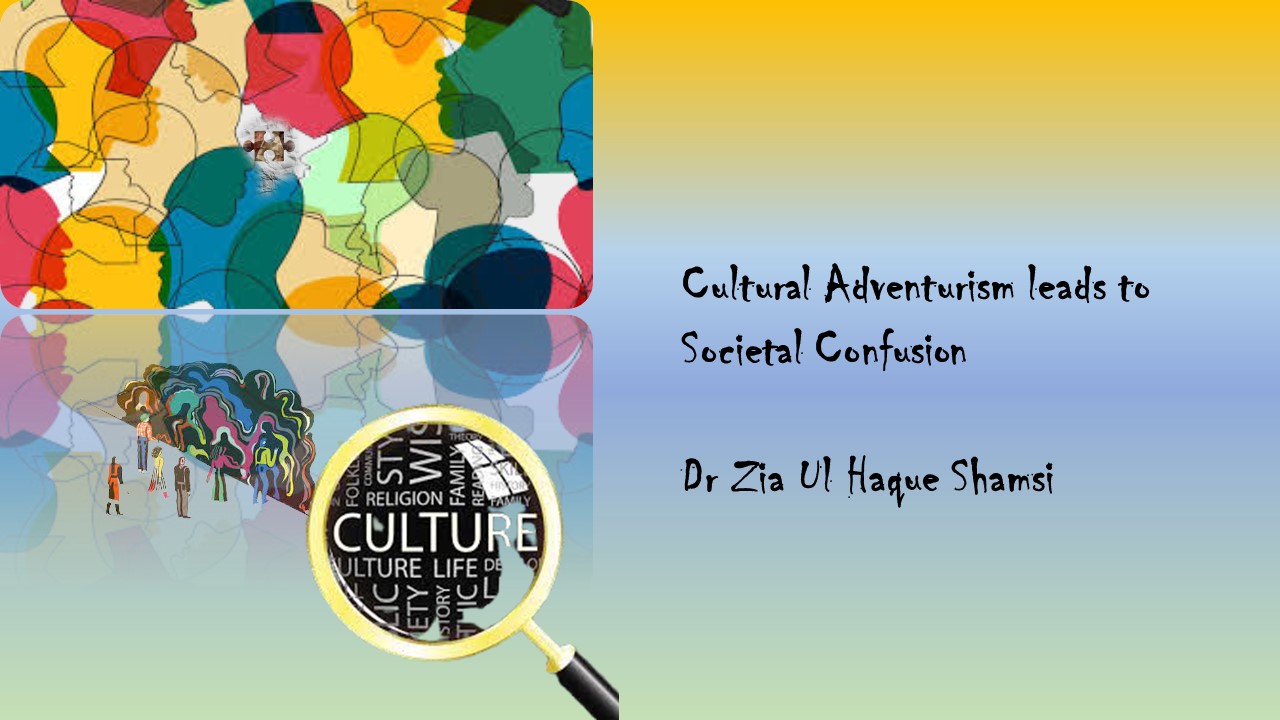
At the outset, let me explain my definition of cultural adventurism and how it is different from cultural invasion. The phenomenon of cultural invasion is as old as the process of colonization. It was given birth to by colonial powers as and when they entered any new area during the age of colonialism. Whereas, cultural adventurism denotes a phenomenon prophesied by local zealots who are deeply impressed by external influences, imposing unnatural cultural features into the members of the middle class. The phenomenon of cultural adventurism is more damaging to society than cultural invasion as it comes from within and is at times part of hybrid war.
Pakistan is a victim of both: cultural invasion as well as cultural adventurism. Being a multi-ethnic, and multi-cultural society, Pakistan absorbed multiple cultures since its inception. The common cultures that have influenced Pakistani society include Afghan, Arab, Persian, English, and Indian. The people of Pakistan are living with a combination of all these cultures alongside local cultures without any serious societal degeneration. The cultural diversity came to this land not only through invaders and traders but also because of newer religions. Present-day Pakistan is the birthplace of at least three religions: Hinduism, Buddhism, and Sikhism, and therefore, it is natural that the cultural practices associated with these religions would be visible in our societal practices. However, of late, cultural adventurism has made inroads into our society where unpopular and unrealistic ultra-modern features of outside cultures are being promoted by inside forces as part of hybrid war. Unfortunately, this cultural adventurism is being prompted through electronic media in the forms of TV plays, and social media campaigns. Certain socio-cultural concepts, which may be considered normal in western society, are being promoted by private TV channels and social media gurus including intra-family affairs and unmarried couples living together. This is certainly in sharp contrast to either an Islamic culture or a Pakistani culture.
Indian Congress leader Sonia Gandhi has been quoted on various occasions that by introducing Indian culture into Pakistani society, India has won a war that could not be won by weapons. Gandhi termed this as a cultural invasion. Whereas, in my opinion, nothing new was introduced by Indians into Pakistani society, which was non-existent before. And, if Gandhi was referring to a few cultural rituals practiced in social events in Pakistan, only a fraction of the population practiced it. However, what present-day electronic and social media has done is cultural adventurism that has largely confused the younger generation. On the one hand, the government of the day is trying to enforce a common curriculum at the primary and secondary levels with an emphasis on Islamic values and history. But on the other hand, the media is promoting an ultra-modern outlook of our society. Most of the time, such projections are highly objected to by the right-leaning populace, which even overrides the state’s authority.
Moreover, cultural adventurism is seen through the prism of an outside agenda, and perhaps, as a part of the hybrid war on Pakistan. However, in my opinion, that was an attempt on cultural invasion, which Pakistani society was able to absorb and did not affect our youth as much as cultural adventurism is affecting due to its synchronised execution through social media. This phenomenon of cultural adventurism is far more damaging because it is from within and it is spreading fast due to the effective use of social media. Its adverse impact on society is reflected by increased numbers of societal crimes, mostly against women who already face multiple challenges in their lives.
The proponents of cultural adventurism are often blamed for foreign assistance and following the agenda, which may be toeing the line of Pakistan’s enemies. That may not be entirely true and needs further inquiry. However, it has certainly created confusion in the minds of our youth because it is prophesied by our people at different levels and from different platforms. The campaigns like “Geo Aur Jeenay Do,” “Mera Jism Meri Marzi” and “Pakistan Ka Matlab Kiya” certainly do not reflect the popular culture that Pakistani society is accustomed to.
The cultural norms and practices run far deeper into the psyche of people than even the religion and are far more appealing particularly to the middle class of any society. Therefore, there is a need for the state organs responsible for sustaining a viable society that adheres to our value system to take certain safeguards against the perpetrators of cultural adventurism to avoid degeneration of the society, which would have an adverse effect of the national security of the state.
Dr. Zia Ul Haque Shamsi is Director Peace and Conflict Studies at the Centre for Aerospace & Security Studies (CASS), Islamabad, Pakistan. The article was first published in Daily Times. He can be reached at [email protected].
Image Source: Etfa Khurshid Mirza