The launch of National Aeronautics and Space Administration’s (NASA) Europa Clipper on 14th October was a milestone for space exploration. It is one of the largest interplanetary satellites launched till now with an estimated staggering cost of USD 5.2 billion! However, just a week before that, the European Space Agency (ESA) launched two CubeSats to study an asteroid. While the Europa Clipper represents the grandeur of space exploration, CubeSats showcase the power of innovation on a smaller scale. So, what exactly are CubeSats, and how are these tiny satellites carving a niche in space exploration?
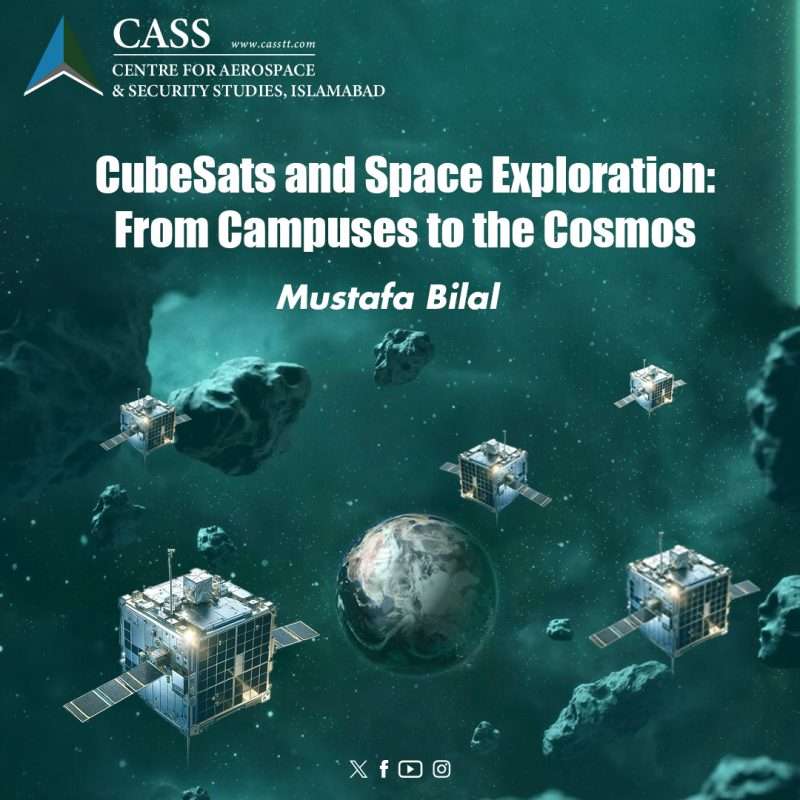
A CubeSat is a compact satellite roughly the size of a Rubik’s cube, measuring 10 cm per side. Despite their small size, these mini satellites are packed with advanced technology. Lightweight and efficient, a single unit, or 1U CubeSat, weighs only 1.33 kilograms. What makes CubeSats special is their modular design, similar to building blocks like Lego. This allows scientists and engineers to easily customise and combine units to suit different space missions. For more demanding space missions, a larger CubeSat might be needed. For example, a 16-unit CubeSat (16U) can carry much more advanced equipment compared to a smaller 3-unit CubeSat (3U). Its bigger size allows it to handle more complex tasks and meet tougher mission requirements.
Moreover, even larger CubeSats are far more affordable compared to traditional satellites. While the exact cost depends on the mission and equipment they carry, the difference can be staggering. For example, NASA’s lunar reconnaissance orbiter, launched in 2009, cost nearly USD 600 million. In contrast, the 10 CubeSats NASA sent in 2022 to detect and map water on the moon cost just USD 13 million, highlighting their incredible cost-effectiveness.
One might think that an invention like the CubeSat would come from the world’s top engineering minds. Surprisingly, its origins are far more modest. CubeSats began in 1999 as a project to educate students, but over the last 25 years, they have revolutionised access to space. By significantly lowering the cost and complexity of satellite launches, CubeSats have enabled countries like Switzerland, Hungary, Colombia, and Vietnam to send their very first satellites into orbit. Pakistan launched its first CubeSat in 2013 and its second one earlier this year. Both CubeSats were developed by faculty members and students at the Institute of Space Technology (IST).
The CubeSat revolution took off because of the shrinking of advanced electronics and their increasing commercial availability. Additionally, the modular design of CubeSats cut development costs by enabling simplified testing and rapid prototyping. Similarly, the standardised dimensions of both the CubeSats and deployer mechanisms significantly brought down launch costs as they could hitch a ride on launch vehicles as secondary payloads which could be easily integrated. As a result, CubeSats have ventured deeper into space, from relaying communication from Mars to detecting exoplanets.
However, CubeSats have encountered many technical issues in the past, with almost one out of every two CubeSats launched until 2016 experiencing total or partial mission failure. The technical hurdles forced human ingenuity to push through, as the size and power constraints spurred innovations in fitting cutting-edge sensors and software inside a small cube. For instance, in 2016, the Russian space agency (Roscosmos) developed the world’s first 3D-printed CubeSat. The following year, ESA also developed 3D-printed CubeSat structures using an electrically conductive material called PEEK. Similarly, considering size constraints, in the same year, NASA devised a creative solution of folding the parabolic antennas inside its CubeSats by leveraging the Japanese art of origami.
On a related note, space agencies like ESA and NASA have spearheaded innovations in CubeSats and pioneered space education programmes to encourage university students to develop CubeSats. ESA’s Fly Your Satellite! and NASA’s CubeSat Launch Initiative allowed thousands of students to acquire hands-on experience developing aerospace technologies. Facilitated development and launch cycles also gave academic communities more control over specific scientific problems they wanted to address.
Support from space agencies accelerated commercialisation of CubeSats. The alumni of such programmes went on to create notable companies in the CubeSat industry, such as NanoAvionics Corp and ISISpace. Spire is another leading CubeSat company that uses a constellation of CubeSats to track ships globally and monitor weather patterns and wildfires. However, applications focused on earth observation have rapidly captured the commercial CubeSat market. For instance, since 2014, Planet has launched a constellation of almost 130 CubeSats to capture images worldwide every day. Earth observation via CubeSats has various civil and commercial applications, such as monitoring environmental changes, urban planning, rural development, mineral prospecting, and disaster management. Future projections for the trajectory of commercial CubeSats show an upward trend, with the global CubeSat market expected to grow nearly fivefold to almost USD 1682.39 million by 2033.
The growing commercialisation of CubeSats has attracted a surge in customers, driving demand to new heights. However, this rising demand is also exposing the physical limitations of smaller CubeSats, prompting a shift toward larger models that are gaining popularity in the commercial space sector. At the same time, the increasing number of CubeSats in Low Earth Orbit (LEO) is raising concerns about their vulnerability to space debris and the heightened risk of collisions with other satellites.
Both public and private space firms have been driving advancements in CubeSat technologies to address such challenges. Notably, developing inter-satellite laser communication links is expected to be a game changer. Optical links are resistant to jamming and will assist in optimising coordination within and among CubeSat constellations. Advancements in AI will also enable autonomous diagnostics and constellation management to avoid collisions with space debris and other satellites. Hence, CubeSats will be more than just data collectors; they will also have the capacity for decision-making. This is no longer hypothetical, as underscored by ESA’s launch of an AI-enabled CubeSat a few months ago on August 17. This CubeSat featured real-time data analysis, ensuring that only the most relevant information was transmitted back to Earth. It could also process large volumes of raw data into actionable insights, providing valuable support to policymakers, businesses, and scientists.
Over the past two decades, CubeSats have transformed space exploration by democratising access and driving innovation in satellite design. From humble beginnings as university projects, they now play a vital role in advancing science and technology, even venturing into deep space exploration. While their potential seems boundless, physical constraints remain a challenge. However, ongoing advancements in miniaturised electronics and nano technologies in addition to the integration of AI are steadily overcoming these limitations, paving the way for CubeSats to achieve even greater feats in the future.
Mustafa Bilal is a Research Assistant at the Centre for Aerospace & Security Studies (CASS), Islamabad. He can be reached at [email protected]