India has long aimed to establish itself as a key player in the global arms market, supported by the ‘Made in India’ drive for defence self-sufficiency officially launched in 2014. Although its defence exports, ranging from body armour and avionic components to cruise missiles, have increased by 34-fold in absolute terms since then, it has yet to match the export reach of many of the mid-tier suppliers in the global arms market. According to SIPRI estimates, countries such as Iran, Ukraine, the United Arab Emirates (UAE), Jordan, Czechia, Brazil, and South Africa, with shares between 0.3% and 0.4%, all outpace India.
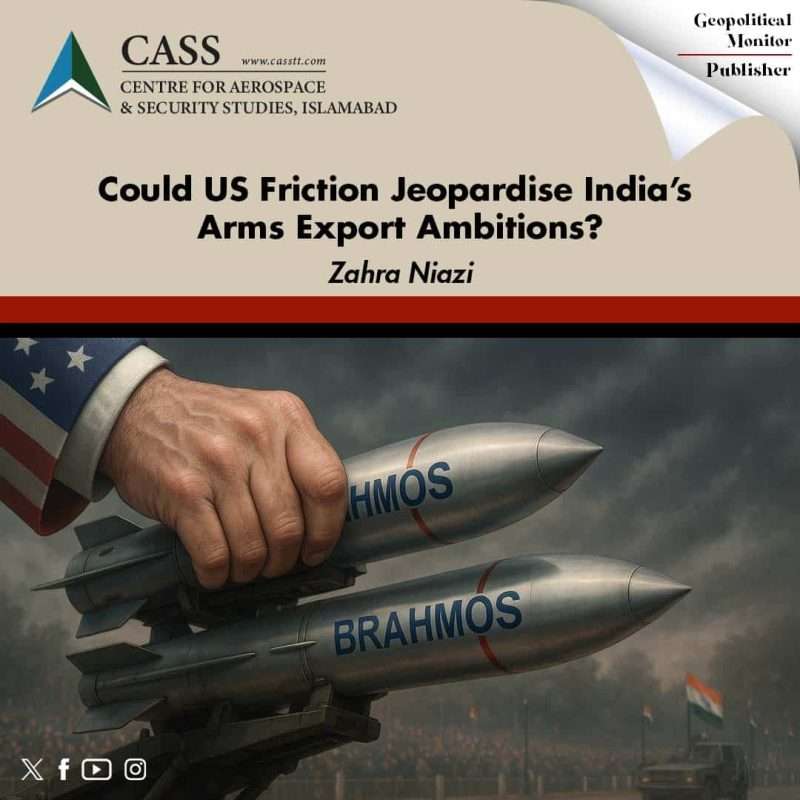
Following the May 2025 Operation Sindoor, involving a series of missile strikes on targets inside Pakistan, the ambition has picked up momentum, as Indian officials claim that India’s now ‘war-tested’ indigenous defence systems are better positioned to attract foreign buyers. Reports also claim that after the operations, the BrahMos supersonic cruise missile system, jointly developed by India and Russia, drew interest from at least 15 countries from Asia to South America.
However, this trajectory now faces a major risk, as the drastic shift in US policy introduces new challenges for Indian arms exports in an already competitive market.
The administration under President Donald Trump has issued an executive order imposing a 25 per cent tariff on goods from India, effective from August 27, as a penalty for importing Russian oil (and military equipment). This is in addition to the previously imposed 25 per cent tariff in response to the country’s high monetary and non-monetary trade barriers and participation in the BRICS—a group he called ‘anti-United States.’ Beyond these central justifications, the policy shift also appears to be an indirect response to New Delhi’s repeated dismissal of US mediation efforts in the ceasefire deal between India and Pakistan in May.
While the US is not among the primary buyers for Indian-made finished weapon systems, and tariffs do not directly target weapon sales, they reflect broader diplomatic friction that could spill over into other areas of cooperation.
One clear example of Washington’s leverage over the Indian defence ecosystem lies in the industrial partnerships and supplier agreements, supporting domestic defence indigenization drive—the backbone of its arms export ambition. Boeing’s partnership with Hindustan Aeronautics Limited (HAL) for the production of the AH-64E Apache and CH-47F Chinook helicopters in India, or GE Aerospace’s supplies of engines for the Tejas platform, are some notable examples.
Such partnerships and arrangements, however, remain dependent on regulatory clearances from Washington under export control laws, such as the International Traffic in Arms Regulations (ITAR), which govern the transfer of defence components, technology, or technical data to foreign partners. Reports suggest that cooperation between Washington and New Delhi on space launch technologies and unmanned aerial combat systems in the past have been delayed or frustrated due to these laws.
If unresolved, the present diplomatic rift could slow permits and clearances for defence projects and component supplies, prolonging the manufacturing timelines of several Indian weapon platforms, including Tejas fighter jets, which India is actively seeking to export in the global market. Slow engine supplies by GE Aerospace earlier have already been associated with delays in India’s fighter jet production. As a result, HAL has struggled to meet delivery timelines for even domestic Tejas aircraft orders, potentially raising concerns among foreign buyers. While New Delhi has recently announced the plan to work with a French company to develop and manufacture fighter jet engines in the country, this may not serve as an immediate replacement for existing US engine supplies.
Beyond influencing domestic manufacturing, these export control laws also determine whether systems incorporating US components can be exported to global markets. Potential delays in export authorisation may particularly be the case if New Delhi reconsiders the procurement of aircraft and weapons from the US. Indian officials have denied plans of any such reconsideration, yet the emergence of these claims in foreign media, citing Indian officials, suggests that the matter could possibly be under review.
Another lever Washington holds is the US federal law CAATSA (Countering America’s Adversaries Through Sanctions Act), which allows secondary sanctions on entities transacting with sanctioned parties, including Iran, Russia, and North Korea, influencing the export potential of Russian-linked projects, notably the BrahMos missile system. New Delhi has to date secured a BrahMos export deal from the Philippines only, despite advanced talks with multiple nations, such as Vietnam, Indonesia, the UAE, Argentina, Brazil, and South Africa. Fears of CAATSA sanctions have been among the key obstacles, and the recent penalty on New Delhi over Russian arms purchases risks increasing buyer reluctance toward Russian-linked projects.
Even for systems unrelated to Russia, friction with the US can deter potential customers from choosing Indian platforms, especially when multiple alternative suppliers are available.
For New Delhi, the challenge of securing a place in this saturated market became evident well before the present crisis. For instance, despite New Delhi’s proposal to adapt Tejas to Argentinian requirements, Buenos Aires in 2024 opted for US-supplied F-16, winning out over both China and India. More recently, the Brazilian government cancelled a deal for the purchase of India’s Akash surface-to-air missile system in favour of the NATO-proven Enhanced Modular Air Defence Solutions System (EMADS). Should the present political climate persist, it risks increasing the likelihood of such an outcome. The same may also apply to potential co-production or co-development arrangements.
India’s Foreign Minister has confirmed that talks with the US are still ongoing. Analysts, however, are careful about raising high hopes, given the diversity of underlying motivations driving the rift and the Modi government’s assertion to take ‘all actions necessary’ to protect its national interests. From the standpoint of defence exports, this may remain the most unfavourable scenario, for all the reasons stated above. In a second scenario or a middle path, even if the current diplomatic friction eases, Russian-linked projects may continue to face buyer resistance or New Delhi, as a condition, may have to reduce reliance on defence partnerships with Russia gradually. The best-case scenario would be a thaw in US-India ties and a softer US stance on Russia, should there be progress on the Ukraine ceasefire, boosting markets and easing New Delhi’s supply chains. The future thus hinges on the outcomes of the geopolitical conflicts just as much as it does on New Delhi’s ability to balance alliances and interests.
Zahra Niazi is a Research Associate at the Centre for Aerospace & Security Studies (CASS), Islamabad. The article was first published in The Geopolitical Monitor. She can be reached at: [email protected].