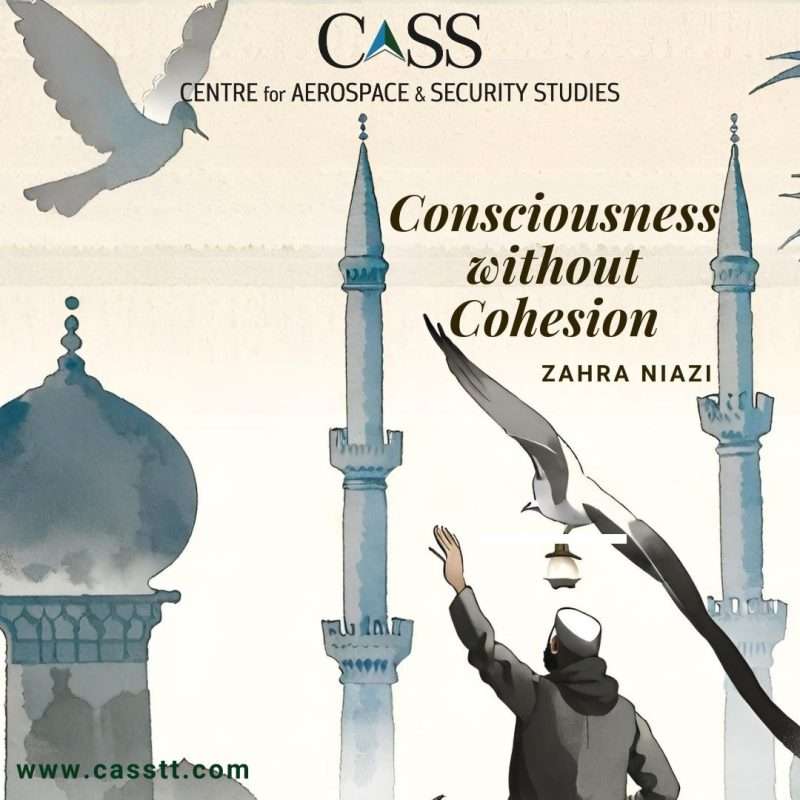
In 1996, Samuel P. Huntington suggested that Islamic ‘consciousness without cohesion’ was one of the defining features of the Muslim world and a weakness to Islam. He questioned whether this condition would persist. Upon reflecting on events that have transpired since then, it becomes evident that the answer to this question is a resounding and unfortunate ‘yes.’ Recent events in the Middle East only serve as another reminder of Huntington’s assessment.
In the aftermath of the most recent Israel-Palestine escalation, the response from the Arab and Islamic world has been anything but cohesive. The reaction has remained divided, particularly between countries that have called for general restraint and those that have held Israel solely responsible for the escalation of violence because of its treatment of the Palestinians. The most sympathetic response for Hamas came from Iran as President Ebrahim Raisi praised the resistance efforts of Hamas and Islamic Jihad. On the other end of the spectrum, the United Arab Emirates (UAE) described the actions by Hamas as ‘a serious and grave escalation,’ and called for an immediate ceasefire. Even before this event, a notable division within the Arab and Islamic world was evident, as countries like the UAE, Bahrain, and Morocco established diplomatic ties with Israel in 2020, in addition to Egypt and Jordan, which had done so in 1979 and 1994, respectively.
The lack of cohesion in responses from the Muslim world sidelines the Palestinian cause and perpetuates a distorted image of the Israel-Palestine conflict. This is evident in the rhetoric of politicians, public sentiment, and Western media coverage. Hamas’ actions and decades of Palestinian resistance are a direct consequence of Israel’s systematic exercise of the crimes of apartheid and persecution against the Palestinians over the past several decades, and their desperation to be heard. In recent days, questions about the ‘morality’ of Hamas’ actions have been brought up, although the latter has long justified its actions on the basis of the principles of ‘necessity’ and ‘reciprocity.’ Regardless, none of these arguments, for or against, can negate and overshadow the inconvertible realities that Palestinians have been the oppressed and besieged and Israel has been the oppressor, committing slow-motion genocide against indigenous Palestinians for decades without any regard for the principles of international law, let alone the principles of morality.
While damaging the Palestinian cause, such lack of cohesion in the Muslim Ummah becomes a weakness for Islam by feeding into and providing legitimacy to the rhetoric in the Western world that falsely associates Islam with terrorism. Following the escalation of conflict, this rhetoric has been vociferously reiterated as a general opinion and a means to manufacture a case for genocide in Gaza. It is unfortunate that the word ‘Islam’, which is from the root SLM, meaning ‘to submit’ and ‘to make peace,’ has been so widely identified with belligerence. Similarly, the concept of Jihad, which means ‘striving for a worthy and ennobling cause,’ has come to be associated with a perpetual ‘holy war’ against all unbelievers without any authentic injunction from Holy Quran. The groups from the Arab and Islamic world who then engage in offensive terrorist activities draw their legitimacy from the distortions of Islam based on the wrong interpretation of the Quran and Sunnah, are motivated by self-serving interests, and exploit the vacuum created by the states to recruit cadres. Several scholars, including religious scholars, have penned down many expositions over decades to explain what lies at the heart of Islam and provide strong counter-narratives to these distorted worldviews shared by the West and a significant proportion within Islamodom. The intellectual efforts of these scholars could have yielded greater results if Muslim nations had united long ago to offer a stronger defence of their religion based on these scholarly expositions and authentic Islamic teachings. The present events must serve as a reminder for the Muslim nations to firmly unite, set aside their differences, and formulate and act upon a clear way forward to provide a stronger response to the decades-long brutality of Israel against Palestinians.
Huntington emphasised the significance of strong Muslim core states in fostering unity among Muslim nations under their leadership. However, he suggested that no single state had all the prerequisites to become an effective core state, including military power, economic resources, organisational competence, commitment, and Islamic identity. This fact has remained an enduring reality. In these circumstances, all Muslim nations, in their respective capacities, must foster cohesion which the Muslim world desperately needs and the Palestinians yearn for more than ever today. In the words of a Palestinian from Gaza, ‘We don’t want food or fuel from the Arab countries. Just stop this genocide.’
Zahra Niazi is a Research Assistant at the Centre for Aerospace & Security Studies (CASS), Islamabad, Pakistan. She can be reached at [email protected]
Design Credit: Mysha Dua Salman