
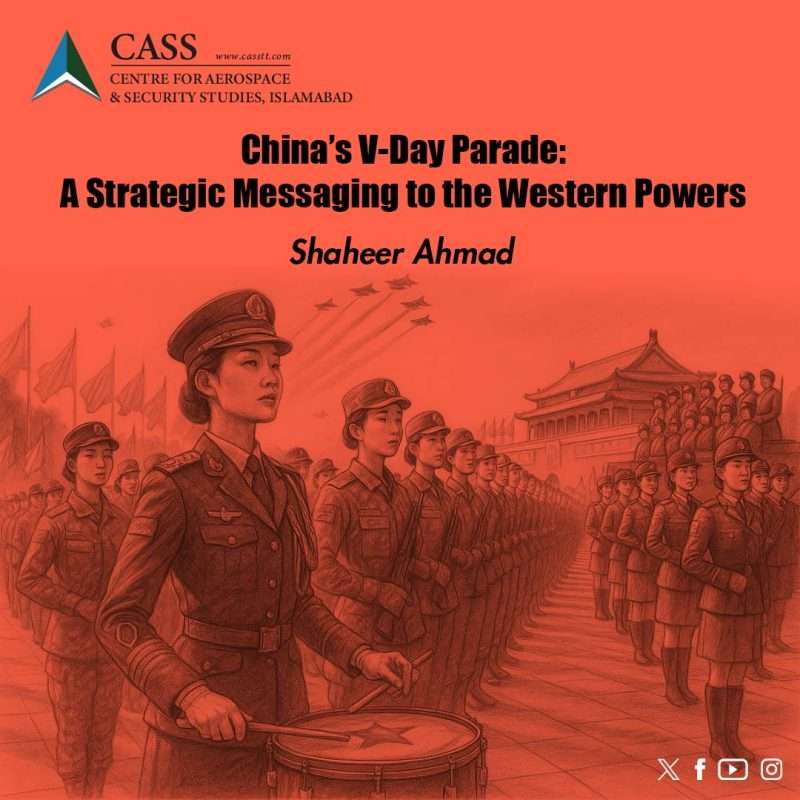
Flanked by the columns of advanced tanks, armoured formations, and mobile missile launchers, a solid military brute force of 10,000 soldiers cavalcaded across the pavilion at Tiananmen Square, marking 80 years of Chinese victory against the fascist forces. In the presence of more than 50,000 spectators, the parade was a startling display of stealth fighters, nuclear-capable missiles, Hypersonic and Directed Energy Weapons (DEW), undersea drones, doomsday intercontinental ballistic missiles (ICBM), and several variants of cruise missiles. The show came as a surprise to the Western military observers, who had regarded the People’s Liberation Army (PLA) as a ‘paper tiger’, a ‘Potemkin army’, and a colossal entity that is deeply centralised and is not sufficiently seasoned in problem-solving, innovation and adaptive thinking.
Generally, the Chinese PLA is branded as a bureaucratic behemoth and overly centralised force which lacks actual combat experience. A recent report from RAND Corporation describedthe PLA as a monolithic entity incapable of decentralised innovation. It highlighted the challenges PLA faces in attracting the top-tier talent from China’s best universities. Similarly, PLA’s subordination to the Chinese Communist Party (CCP), which comes at the cost of diminished combat readiness, was a synopsis of another report. In conjunction with this, Timothy R. Heath, a RAND researcher, articulated similar concerns at the June 13 hearing of the US-China Economic and Security Exchange Commission, positing that despite ample evidence of the PLA’s warfighting preparations, little evidence suggests the national leadership’s will to fight a war anytime soon.
This view is consistent with the consensus that innovation and greater patenting are more associated with democracies than authoritarianism. Less political intervention and decentralisation foster the creation of a robust ecosystem, which is otherwise lacking in authoritarian systems. West, in particular, views centralisation as archetypal evidence against creative problem-solving. Critics argue that China’s state-owned, tightly controlled and ideologically motivated apparatus thrives on technological imitation rather than actual innovation. Moreover, an obsession with the quantity of scientific publications, with a bleak focus on quality, misleads the outside world about the potency of the Chinese military.
Nonetheless, sociological reading of China’s organisational culture says otherwise. Despite the state’s tight grip over organisational agency, the Chinese military considerably enjoys a horizontal degree of flexibility in interpreting and internalising government policies. In other words, PLA’s tactical flexibility cohabits with CCP’s centralised controls. Doug Guthrie termed this phenomenon ‘direct improvisation’, which allows Chinese entities to adapt and innovate rapidly within the realms of central directives.
Besides this, China has established a robust and interlinked cobweb of civilian and military institutions to accomplish its research and development goals. Central to this ecosystem is the Military-Civil Fusion (MCF) strategy, where a combination of small and large-scale institutions has enabled China to lead in 57 of 64 critical technologies. In addition to this, the PLA leverages the strength of China’s Defence Science Ecosystem, where civilian universities play a sizable role in developing critical areas such as stealth missiles and low altitude technologies coupled with modular satellite systems.
Similarly, the Chinese military has transformed its training manuals accordingly. Contrary to West’s assumptions, the PLA employs realistic wargaming scenarios, practising the contingencies it is expected to fight in its strategic backyard. Moreover, the political commissars, who were traditionally viewed as enforcers of Party ideology and discipline, are employed to boost morale and foster cohesion among various ranks. This, in turn, results in the formation of a command structure that supports rapid adaptation in high-speed and rapidly evolving environments.
These trends demonstrate that relying on caricatured judgements of the PLA leads to fatal misjudgements. Turning a blind eye to Chinese strategic culture, classic military texts and how China’s cultural and historical legacies guide the PLA’s contemporary operational art results in a disoriented picture of the Chinese military. In other words, China’s monumental advancements in cutting-edge military technologies underpin its burgeoning military industrial capabilities. Hence the outdated frameworks of the Cold War misinform the Western military watchers about the PLA’s military readiness and operational capabilities. Shaheer Ahmad is a Research Assistant at the Centre for Aerospace & Security Studies, Islamabad. He can be reached at [email protected]



