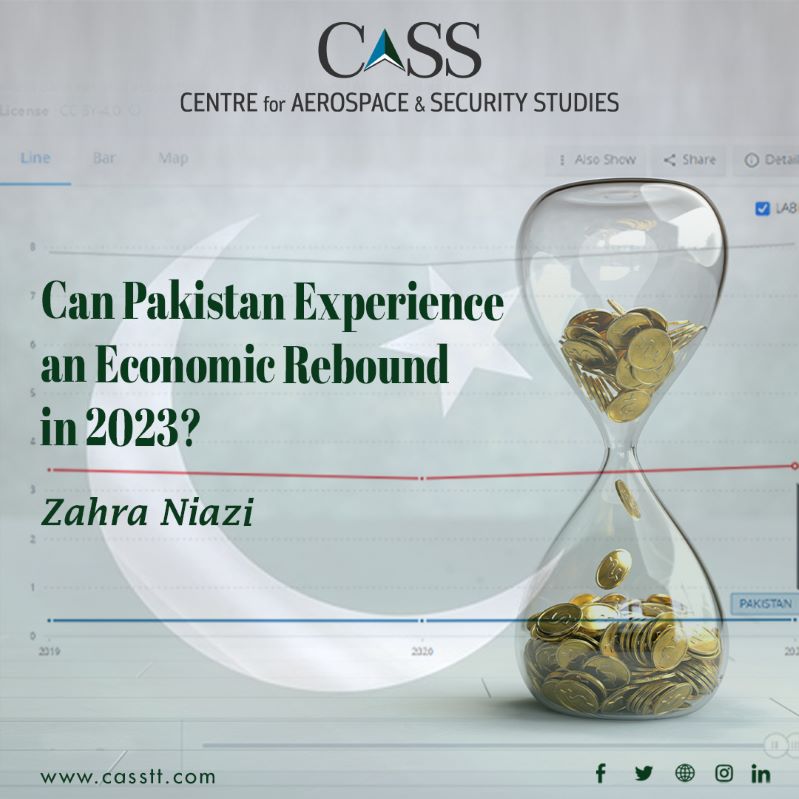
The past year has clearly been challenging for Pakistan from an economic point of view, defying initial expectations. As the COVID-19 pandemic appeared to be slowing down, there was optimism that the year 2022 would be characterised by the country’s recovery from COVID-induced shocks. According to the World Bank’s ‘Global Economic Prospects Report, 2022,’ Pakistan’s economy was expected to grow by 3.4 percent in the fiscal year 2021-2022 and 4 percent in the fiscal year 2022-2023. The report also revised and increased the growth projections for the overall South Asian region since June 2021 owing to ‘better prospects in Pakistan, India, and Bangladesh.’
However, the expectations did not stand the test of time. By the end of the year, Pakistan’s economy appeared to be teetering on the verge of a crisis. This manifested in the form of excessive inflation, business and industry closures, unemployment, a massive decline in central bank reserves, a substantial reduction in exports and remittances, and a historic depreciation of the Pakistani Rupee. Revised projections now estimate the country’s economy to grow by just 2 percent in the fiscal year 2022-2023, which can be attributed to a number of internal and external factors.
The Russia-Ukraine conflict beginning in early 2022 led to the largest commodity price shock after the 1973 oil crisis, giving an unwelcome blow to countries across the world. Pakistan’s fate was particularly hard due to the country’s heavy reliance on imported fuel and limited fiscal resources. As if this wasn’t enough, the country was soon overwhelmed with its worst flooding catastrophe in decades, washing away crops, roads, livestock, and infrastructure and inflicting aggregate economic damage of USD 30 billion.
Furthermore, the inflationary shock of 2022 translated into a global interest rate hiking spree that was led by the US Federal Reserve. This led to the depreciation of a number of developing countries’ currencies against the major currencies, which worsened their debt problems and prompted their central banks to increase domestic interest rates. Pakistan was no exception. By the end of 2022, Pakistan’s interest rate hike, which began in April, amounted to 6.25 percentage points, increasing the cost of financing investments and reducing the demand for goods and services.
To top it all off, the year witnessed one of the worst domestic political crises. In April, the sitting Prime Minister was ousted from power resulting in large number of people taking to the streets. The political chaos further intensified following his attempted assassination in early November. Some also tend to argue that the incumbent government’s poor management of the economy compounded Pakistan’s economic turmoil. Moreover, the year witnessed a surge in militant acts in the country, further threatening economic stability. Given these factors, the trajectory of the economic situation continued spiralling throughout the year.
As we step into 2023, a big question is whether the economy can experience a rebound during the year. Arguably, a dramatic rebound is unlikely, at least in the near future. Global commodity prices are expected to remain elevated in 2023, despite recording a slight decline, and interest rates are anticipated to continue rising. Likewise, the domestic political crisis does not appear to abate, at least in the first few months, and one can only hope that the security situation will improve.
The above must not convey the impression that the present economic circumstances are only driven by exogenous factors or unmanageable internal ones, but any negligence now can have dire consequences as Pakistan today stands at a critical juncture.
The policy leaders must understand that recurrent tweaks and manipulations will not work. What Pakistan requires right now is policy stability guided by a set of urgently developed short- and medium-term strategies outlining coherent and realistic goals to reverse the economic slowdown. All political entities – federal and provincial – need to think beyond their political stakes to develop a national strategy while also considering the inputs from experts in relevant fields, the private sector, and the business community to ensure that policy implementation enjoys viable support.
Acquiring the general public’s support to implement some drastic measures will also be critical, necessitating the development of a communication unit dedicated to communicating the constantly changing economic outlook to all sectors through easily accessible channels to help them comprehend the enormity of the economic crisis. All stakeholders, including the public, must realize that some measures would be painful but necessary to ward off a full-blown financial crisis. However, this is only possible for as long as it is not just the common man who has to bear the brunt of those ‘painful measures.’
The way ahead for Pakistan is undoubtedly challenging, but it is through determined efforts that one can expect the country’s economic prospects to soften gradually, if not immediately.
Zahra Niazi is a Research Assistant at the Centre for Aerospace & Security Studies (CASS), Islamabad, Pakistan. She can be reached at [email protected].