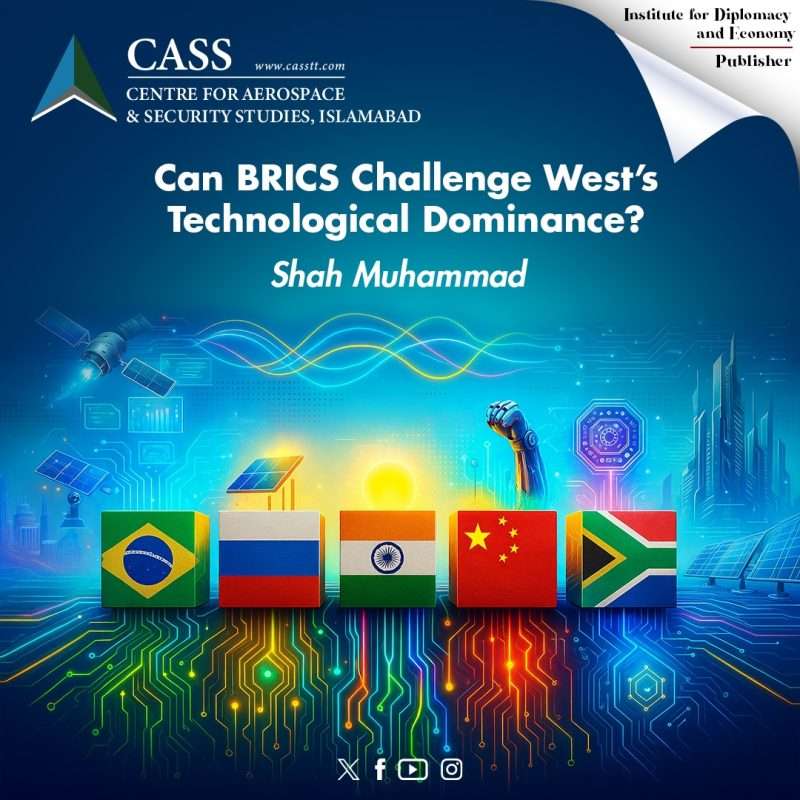
When technological determinism intersects with realpolitik, Cold War-era modalities of power projection are replaced by a new foundation of dominance – one built on emerging technologies and digital ecosystems. Over the years, BRICS countries have come to terms with the fact that control over critical technologies is crucial for securing as well as asserting power on the international stage. It was for the ‘first time’ that the joint declaration of the 17th BRICS Summit at Rio de Janeiro, on 6 July 2025, mentioned Artificial Intelligence (AI) as a prominent area of collaboration. Yet, whether the bloc’s digital transformation can translate into a meaningful challenge to the West’s enduring technological dominance remains uncertain.
Earlier, the 13th BRICS Science, Technology and Innovation (STI) ministerial dialogue, on 25 June 2025, focused on forging closer ties among member states to elevate the Global South’s standing in the global digital economy through collaboration in AI, quantum technologies, and industrial innovation. The STI setup currently includes 13 working groups covering areas ranging from joint research, technology transfer, infrastructure, to student exchange. Brazil’s Minister of Technology Luciana Santos asserted, ‘We are fighting to prevent the concentration of technology in just a few countries and to ensure it can be shared.’ The STI communique also established BRICS Innovation Action Plan 2025-2030, envisaging the consolidation of tools and resources required for the digital transformation of Global South countries.
The widening North-South gap could be attributed to the phenomenon of digital colonialism, effectively preventing inclusivity and fair access in the digital ecosystem. The dominance of Global North is allegedly pushing the developing nations further down the global digital hierarchy. Despite hiccups, Western countries continue to lead in AI research and investment. As per Global AI Index 2025, US exceeded its peer competitors by developing 40 AI models in 2024, compared to 15 by China. Additionally, the private AI investment in the US surged to $109.1 billion, which is approximately 12 times higher than China’s $9.3 billion. Moreover, the US leads global data centre concentration with a whopping 5375 units, followed by Germany, the UK and China, having 522, 517 and 448 data centres respectively.
Although the West leads in AI quantity, the Global AI Index credits China for making significant breakthroughs in the quality of AI models. Additionally, China has globally topped the maximum number of AI research and publications. Both Russia and China have significantly minimised market access to Western Big Tech companies, while actively opting for local alternatives. Data localisation is being actively pursued by BRICS members to build indigenous data centres and monetise data as a strategic resource for both economic gain as well as geopolitical clout. Being a prominent voice in BRICS, Brazil is leading data localisation overtures among developing countries. Most importantly, China’s grip on rare earth minerals – essential for smartphones, military tech and electric vehicles – is a strategic weapon that could keep the West in check. China controls 60% of the production and 90% of the refining of global rare earth minerals.
However, BRICS’s endeavours to attain South-South tech cooperation and, thereby, contend against the West’s technological preponderance could be hard to materialise, at least in the short run. US President Trump has threatened BRICS with additional tariffs should the members proceed with what he views as anti-American policies. Although the bloc’s de-dollarisation agenda is the major simmering issue, the technological tussle cannot be ruled out as another contentious dimension. Hence, the bloc will have to navigate a highly complex geopolitical chessboard in pursuit of its ends. Additionally, inability of some its member states to align their foreign policies would weaken its overarching goals. The Sino-Indian fissures are noticeable in this regard, as Russian Foreign Minister Sergey Lavrov stated that ‘West is trying to pit India against China.’ Trump has upped the pressure on New Delhi by increasing tariffs by 25% to dissuade it from purchasing Russian oil. Although this is said to be unfolding in the context of Russia-Ukraine war, any potential pro-US change in New Delhi’s foreign policy may hurt its commitment to BRICS.
Apart from that, the institutional composition of BRICS is not as mature as that of European Union, requiring cohesion and a deeper hierarchical structure to turn ‘declarations’ into reality. The BRICS Innovation Action Plan 2025-2030 is an ambitious attempt that would require not only institutional prowess but also a well-crafted strategy to circumvent Western sanctions and technological barriers. Admittedly, the bloc still lacks a comprehensive data governance mechanism to materialise data localisation endeavours across all member countries. In this regard, it could build on national laws such as Brazil’s General Data Protection Law. China’s attempt to leverage the Digital Silk Road for digital integration of BRICS members is prudent but it has yet to yield noticeable outcomes vis-á-vis digital transformation of the bloc.
For BRICS to emerge as a potent counterweight against the technological dominance of the West, it would require a robust structural foundation, seamless digital integration among members and the agile ability to navigate the geopolitical barriers. Yet, the bloc still lacks the cohesion needed to realize its ambitions to challenge the West.
Shah Muhammad is a Research Assistant at the Centre for Aerospace & Security Studies (CASS), Islamabad, Pakistan. The article was first published in Institute of Diplomacy and Economy. He can be reached at: [email protected]