The world has witnessed an unrelenting series of climate-related disasters in 2025. The year began with the unprecedented Los Angeles (LA) wildfires in January, which destroyed over 18,000 structures and claimed 30 lives. Then in March 2025, Bolivia experienced heavy flooding caused by prolonged rains, affecting the lives of around 590,000 people. Then, record high temperatures reaching 46° Celsius were recorded in multiple European countries including Spain, England, Portugal and France, resulting in over 2000 deaths. These events clearly show how climate-related disasters are no longer an anomaly, but a regular occurrence and the consequences are more immediate in South Asia, especially in Pakistan.
Summers in Pakistan began with an intense and protracted heatwave with temperatures reaching as high as 52° Celsius and a death toll of around 1200. On the other hand, a freak hailstorm struck the twin cities of Islamabad and Rawalpindi in April. Hailstones, the size of tennis balls, severely damaged houses, cars and other critical infrastructure. The situation became worse due to several episodes of flash and urban flooding that devastated multiple northern and urban centres. These incidents of flooding were triggered by Glacial Lake Outburst Floods (GLOFs), cloudburst and torrential monsoon rain. According to National Disaster Management Authority (NDMA), 281 people lost their lives and 675 people were injured in rain-related incidents from 26 June to late July 2025. While emergency response mechanisms are put into action in the aftermath of such disasters, the solution does not lie in managing catastrophes after they have struck but in preventing them through timely prediction.
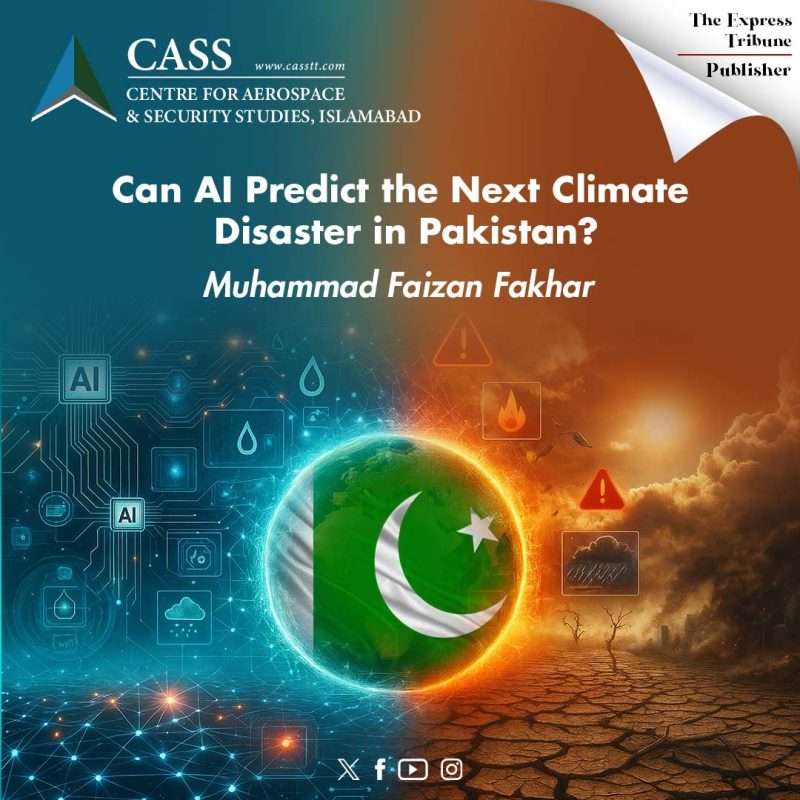
The Pakistan Meteorological Department (PMD) serves as the primary authority for issuing warnings and advisories related to potential climate and weather-related events. PMD does, in fact, issue general advisories outlining not only the intensity of the rainfall but also the cities and districts that may be affected. However, these advisories lack hyperlocal precision, which is crucial for timely response to any natural disaster. A hyperlocal forecast means providing accurate prediction about a possible weather phenomenon that go beyond the level of cities and districts and focuses on real-time updates about sectors, zones, blocks, wards and union councils. This is where emerging technologies, such as Artificial Intelligence (AI), play a key role. AI-based weather forecasting systems use a wide range of statistical data to accurately predict future weather patterns. Such systems could easily collect and process data from satellite imagery, weather stations, radars, traffic controls, drainage management authorities, and urban Internet of Things (IoTs) to accurately predict and warn about the next climate disaster before it strikes.
If implemented, an AI-based weather forecasting system would be cheaper than the traditional statistical forecasting models that Pakistan currently employs. By integrating data and inputs from PMD, NDMA, Water and Sanitation Authority (WASA), Rescue 1122, and district authorities, an AI-based weather system could serve as a ward-level early warning architecture. AI based forecasts alone are not enough as they are only effective if they are disseminated through mass communication channels in a timely manner. Similarly, authorities also need to take timely and coordinated actions based on these AI based forecasts. Such systems are already being developed and integrated in other regional countries including India and Bangladesh. Google is currently providing forecasting services in both using AI models under its Flood Forecasting Initiative. These systems use real time data to provide forecast up to 48 hours in advance and it covers around 360 million people across the two states. In contrast, Pakistan is yet to leverage emerging technologies to predict and prevent natural disasters with precision. Weather forecasting here remains largely manual. Local authorities in Pakistan continue to rely on conventional statistical and time taking models for weather forecasts.
The difference between normal and extra-ordinary weather conditions is eroding fast due to climate change. Freak weather phenomenon is swiftly becoming a regular occurrence in Pakistan. Therefore, disaster prevention must precede management. To realise this vision, Pakistan needs to mandate integration of data between weather, health, drainage, and municipal authorities. Moreover, development and integration of AI-based forecasting systems is urgently needed. Public-Private Partnerships (PPPs) could play a critical role in development of such systems. AI startups and research centres with a capacity of training locally-developed models for weather forecast must be supported. Without these measures, the country’s response will remain reactive, focused solely on post-disaster management rather than proactive risk reduction.
Muhammad Faizan Fakhar is a Senior Research Associate at the Centre for Aerospace & Security Studies (CASS), Islamabad, Pakistan. The article was first published in The Express Tribune. He can be reached at: [email protected]