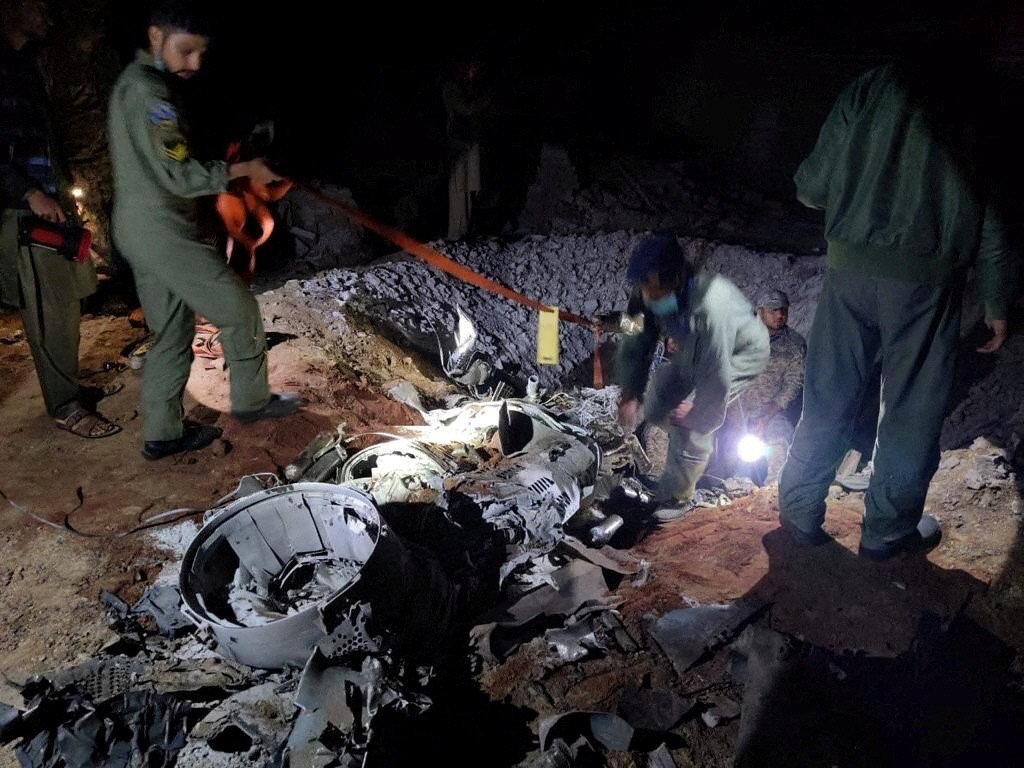
In the complex contemporary global, regional, and domestic environment, dominated by the Russia-Ukraine War, post-US withdrawal Afghanistan, growing internal security challenges and political dynamics in Pakistan, the recent incident of the Indian cruise missile crashing into Pakistan’s territory has shocked many strategic thinkers. On 9th March 2022, an Indian supersonic cruise missile, which according to some experts was ‘BrahMos’, entered Pakistan’s air space and crashed in Mian Channu. The Indian Ministry of Defence expressed its ‘regret’ and maintained that it was an accidental launch caused by technical malfunction during routine maintenance activity. The government also announced a high-level Court of Enquiry.
Pakistan’s Foreign Office gave a cautious response to the Indian statement by terming the Indian stance as a ‘simplistic explanation’ of a very serious matter. Pakistan also demanded a joint probe in order to establish the facts and urged the international community to take serious notice of such a grave incident and play its due role in promoting strategic stability in the region. The Chinese Foreign Ministry has called on both countries to thoroughly look into the incident and promptly establish a reporting mechanism to avoid misunderstanding and miscalculation.
The Indian claim of ‘accidental launch’ is suspicious and independently unverifiable. Cruise missiles, regardless of their land, sea, and air-launched versions, are guided missiles that follow a specific flight trajectory. It is difficult to accept the Indian explanation that the cruise missile was accidentally launched and entered Pakistan’s air space on its own.
Furthermore, even if it was an accidental or unauthorised launch, it raises serious questions about the credibility of the Indian nuclear command and control system, operational protocols of her strategic delivery systems in general and the safety of the Indian missile arsenal in particular. These safety and security issues pose grave risks to regional stability because India has been pursuing extensive and all-encompassing military modernisation, including the development of nuclear-capable supersonic cruise missiles. In addition, since India’s nuclear and missile arsenal is one of the fastest-growing programmes in the developing world, such incidents imply that the Indian nuclear and missile arsenal is poorly managed and faces a great risk of miscalculation and unauthorised launch.
Serious incidents like these raise important questions about the overall credibility of Indian military planning, operationalisation, and safety mechanisms related to its expanding missile forces. For instance, during the 2019 Pulwama-Balakot episode, when Pakistan responded to New Delhi’s misadventure under operation ‘Swift Retort’, Indian military professionalism and missteps were badly exposed. After all, India ended up destroying its own Mi-17 helicopter within Indian Illegally Occupied Jammu & Kashmir (IIOJK), resulting in the loss of lives of her own military personnel. This recent incident, involving BrahMos supersonic cruise missile, is another evidence of the Indian inability to maintain and safely operate state-of-the-art military equipment and sophisticated missile technologies.
Another critical aspect of this whole scenario is Pakistan’s response options. Pakistan’s air defence system was able to detect and track the incoming supersonic missile, from the time of its launch inside India and entry into the country’s airspace. It is indeed fortunate that the missile was not carrying any warhead and there was no loss of life on the ground. However, this incident makes one wonder: what if the missile was armed with a conventional warhead or even a nuclear weapon?
Some experts have said that India could have deliberately launched the missile to test the readiness and response options available to Pakistan to help improve her internal plans for future scenarios. However, Pakistan’s mature, calculated, restrained and responsible reaction based on its commitment towards regional peace and stability has prevented further escalation, despite the inadequate Indian explanation of the cause of this incident.
Such disturbing and irresponsible Indian strategic behaviour deserves urgent and proactive international attention and review of all defence cooperation with New Delhi because such incidents indicate that the Hindu extremist government currently ruling India and its unprofessional military cannot be trusted with such lethal missile technology. Notwithstanding Indian objectives, Pakistan must consider giving a strong and clear strategic signal to India that in future any such irresponsible act will not go un-responded. It is equally important to further enhance our air defence system, particularly against the growing threat of India’s supersonic cruise missiles.
Haris Bilal Malik is a researcher at the Centre for Aerospace & Security Studies (CASS), Islamabad, Pakistan. The article was first published in Strafasia. He can be reached at [email protected]