
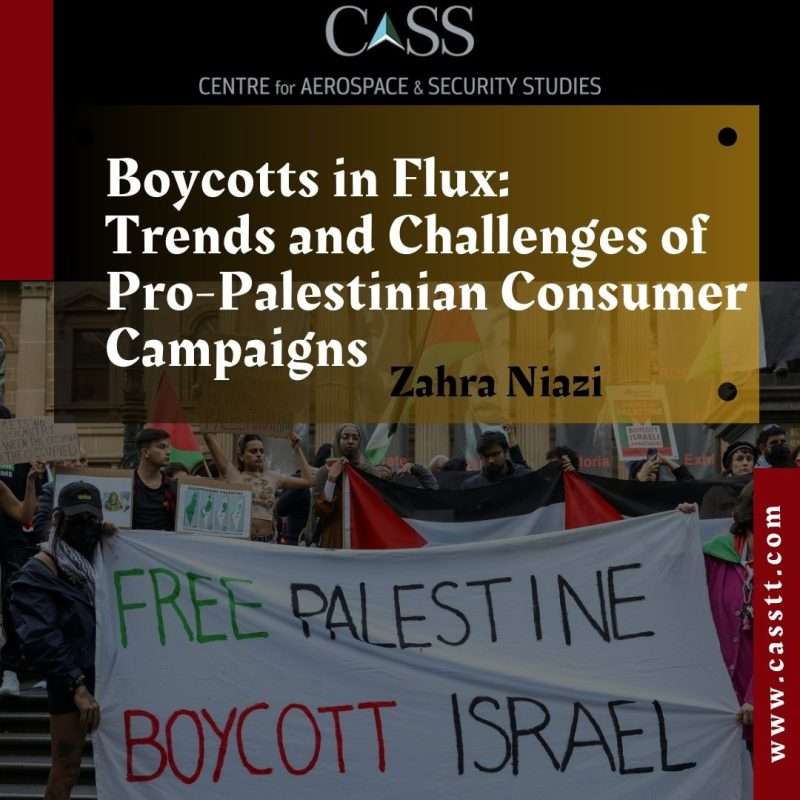
In the wake of Israel’s ongoing genocidal aggression in Gaza, Pakistanis have rallied in solidarity with the Palestinians in large numbers through street demonstrations, digital activism, and by responding to the calls for a boycott of products belonging to companies complicit in Israel’s violation of Palestinian rights.
In a November 2023 survey conducted by Pulse Consultant across Pakistan’s 12 major cities, a compelling 83% of respondents expressed agreement with boycotting products from multinational companies (MNCs) complicit in Israeli actions. Among them, a notable 79% confirmed active participation in the boycott. Initially, as the boycott campaign gained renewed and intensified traction post-October 7, discussions with one’s social circle or interactions with salespersons at a neighbourhood supermarket would bear witness to the widespread enthusiasm among people making conscious purchasing decisions. In response, supermarkets were quick to increase dedicated spaces for local products, while netizens shared multiple directories of Pakistani alternatives to Western products on social media platforms to help consumers purchase products more wisely.
Nevertheless, the late November iteration of the survey disclosed a decline in support for the boycott, registering at 78%, with active engagement dwindling to 69% among its supporters. In a subsequent assessment nearly two weeks later, the backing for the boycott further decreased to 60%, yet 68% of participants affirmed their continued active involvement. This shift in consumer sentiment reflects an overall waning enthusiasm for boycotting, underscoring a diminishing emotional pulse among consumers. However, the steadfast commitment of those who persist in the campaign signals unwavering determination to support it
In psychology, research has repeatedly shown that people start becoming emotionally desensitised to an event, such as a genocide, as the number of individuals affected by it increases. As a corollary, the initial intensity of sentiments driving actions in any capacity to resist more death and destruction due to that event may also diminish as the event gets prolonged.
Past instances have also suggested that consumers may encounter challenges, such as availability, low quality, or a high cost of other/local alternatives, after joining a boycott, forcing some to revert to old purchasing practices. In Pakistan, a grocery run or visit to any nearest food court would demonstrate that local alternatives are now available for a majority of the items, many at lower prices, although exceptions exist. However, there persists skepticism among individuals regarding the quality of certain local products. Additionally, skepticism about boycott efficacy can also affect consumer participation in such campaigns. This may be especially true when people link efficacy with immediate and major outcomes. When those expectations are not met, enthusiasm for participating in boycotts may begin to fade.
While the global boycott wave against Israel has not yielded a significant financial impact, its influence is not entirely negligible. Market summary data indicates that the stock market performance of some, if not all, targeted companies, such as Nestlé, Starbucks, or PepsiCo, is not faring well, which can be attributed, at least partly, to the boycotts. In recent days, the CEO of McDonald’s categorically acknowledged a ‘meaningful business impact’ due to these boycotts.
Such campaigns also offer additional, intangible means of supporting the cause. They amplify the voices of the oppressed, catalyse policy discussions, empower activist movements, and challenge prevailing narratives. The recent shift in narrative favouring Palestinians has played a role in compelling even some of Israel’s allies in the West to reconsider and soften their positions.
And if history is any teacher, it tells us that collective and selective boycotts, coupled with other non-violent actions, work in significant ways when sustained over a long period.
Gaza today stands as a test case of our morality and shared humanity. As it continues to face one of the most brutal genocidal onslaughts in history, we must not let our actions in solidarity with the Palestinians lose their momentum. And as consumers attempt to make conscious purchasing decisions, it will be equally important that they are facilitated in embracing the shift to indigenous alternatives. Support mechanisms, such as technical assistance or training, should be offered to assist local manufacturers in improving their products and bringing them at par with international products. For some firms and businesses in Pakistan, a relatively larger domestic market than before for absorbing indigenous products may even be an opportune moment to invest in product quality. ‘Economies of scale’ suggests that an increase in the number of units produced leads to a fall in the unit cost of production, providing businesses the opportunity for cost-saving. This can then be passed on to consumers by enhancing product quality.
We must all remember and internalise that each of us has a role to play when it comes to striving for the end of Israel’s genocide and apartheid in Palestine, for ‘little by little, a little becomes a lot’.
Zahra Niazi is a Research Assistant at the Centre for Aerospace & Security Studies (CASS), Islamabad, Pakistan. The article was first published in Pakistan Today. She can be reached at [email protected].
Design Credit: Mysha Dua Salman



