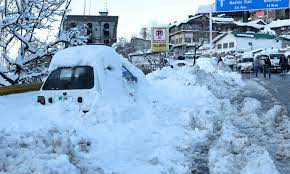
The recent tragedy during a blizzard in Murree involving many stranded domestic tourists is illustrative of an industry that took the free market ideology a bit too closely to heart. 22 citizens, including 10 small children, died from the cold or asphyxiation while stuck in their cars during the blizzard, unable to seek warm shelter in time. According to eyewitness accounts that became viral on social media, the local hotel industry sought to profiteer from the desperation of the stranded families. They were asking for up to Rs.70,000 or more for a room during the desperate conditions, and very few people in this country carry such money on their persons in normal circumstances.
The heavy snowfall had led to road blockages, uprooting trees and creating other hazards, while an influx of tourists had come to enjoy the unusually rich snow levels. The glut of tourists that came were voluntary market participants, one might surmise, and the hotels were voluntary sellers of a service. They simply couldn’t arrive at an agreeable price, and so were turned away into the cold. Is the problem with that? Not for the free market ideologue; but our social norms and values were shaken by the lack of sympathy and generosity in Murree’s hotels during the snowstorm.
The hotels did not, at the time, entertain considerations such as people’s safety – they simply saw a useful transaction opportunity, and those that could not afford it were turned away to sleep in their cars and risk death by asphyxiation. In response, the Rawalpindi district administration has sealed fifteen hotels for overcharging citizens thus far, not least because of pressure due to the widespread outrage generated on social media. The hotels are on Abu Dhabi Road, Kuldana Road, Upper Jhika Gali Road and Bank Road.
What one sees, therefore, is an economic logic running contrary to ethical standards and values of mutual aid and solidarity, as well an insufficient ex-ante deterrent to violation of such standards by a regulatory body. The basis for assuring quality assurance in the hotel industry already exist on the books, including in the Pakistan Hotels & Restaurants Act (1976), and the Travel Agencies Act (1976). Instead, the mushrooming of third-rate enterprises in scenic areas of Murree (and indeed further north) has been done in an ad-hoc manner where standards for everything have been ignored: building codes, zoning laws, room quality, amenity provision, and indeed room charges. One of the most beautiful areas of the country has therefore taken on a grotesque every-man-for-himself aura with unplanned human encroachment.
The philosopher Achilles Mbembe has posited the idea of a necroeconomy, where capitalist structures can turn death itself into a commoditizing process. The necroeconomy of Murree is in full swing, and it bodes ill for the domestic tourist industry which requires standardization and best practices to flourish. One has heard much (especially before the pandemic) about the tourism potential of the country, particularly for foreigners to come and appreciate the rich natural and human tapestry of Pakistan.
Yet from an economic standpoint, international tourism’s foreign exchange potential notwithstanding, a healthy domestic tourist market would be an even bigger boon for the economy, as citizens from around the country could flock to appreciate the beauty of the North in a manner that is safe, comfortable, reliable, and still lucrative. What one sees booming in the hotels of Murree, however, is Mbembe’s foreboding of a necroeconomy: pay the scalping prices or go sit in your car to die.
One needn’t even build a hotel to participate in profiteering for misery. The Rawalpindi police has arrested a man recently for swindling stranded tourists under the pretense of helping them in Murree, first throwing hefty amounts snow onto the road to create blockades, and then as a police tweet indicates: “when vehicles would get stuck, he would ask for a significant amount of money in return for towing the car with the help of his jeep.”
While the public mourns the plight of tourists who died while seeking to spend a nice day with families in the snow-covered hills and mountains, there are deeper ethical-economic considerations at play which one must consider. Without such society-wide reflection, one risks falling prey not just to blizzards of snow, but to blizzards of wickedness and greed. Those are the blizzards that are certain to cause our collective asphyxiation.
Dr. Usman W. Chohan is the Director for Economic Affairs and National Development at the Centre for Aerospace & Security Studies (CASS), Islamabad, Pakistan. He can be reached at [email protected].
Image Source: Ali, Kalbe. 2022. “Met Office’S Heavy Snowfall Warnings Went Unheeded”. DAWN.COM. https://www.dawn.com/news/1668392/met-offices-heavy-snowfall-warnings-went-unheeded.