
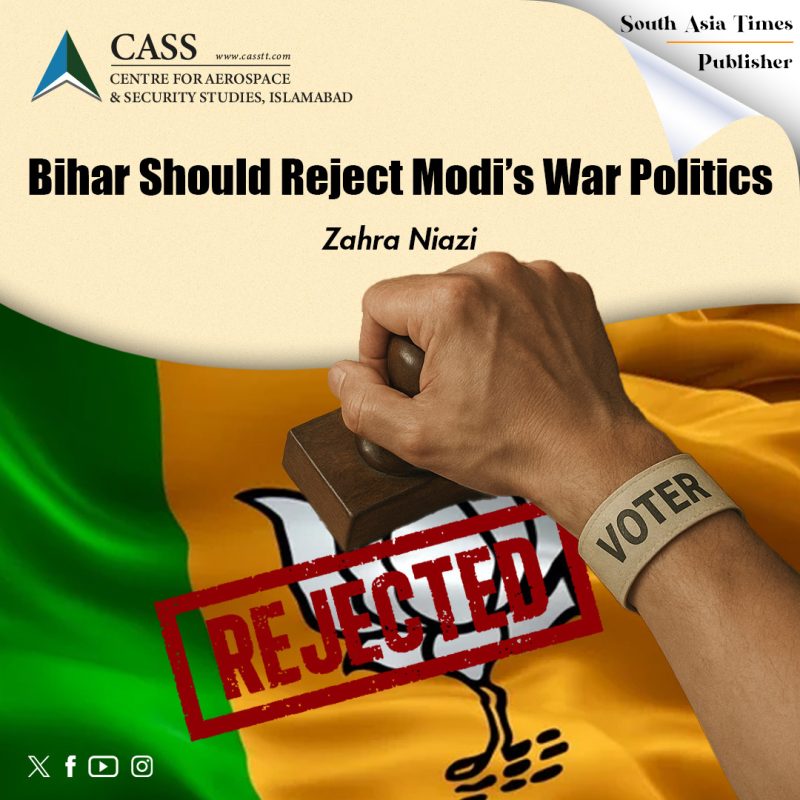
India is set for a high-stakes electoral battle as Bihar heads to the polls on November 6 and 11 – a contest that could serve as a key test of Modi’s militarised electoral strategy.
Bihar, with its 243 constituencies and vast population, is regarded as a political bellwether and remains the only North Indian state where the Bharatiya Janata Party (BJP) depends heavily on alliance formation to retain power. However, the alliance’s leader now faces severe anti-incumbency sentiments among voters, fuelled by frustration over governance and growing concerns about his age and fitness as he seeks a tenth term as Chief Minister. Meanwhile, a new party led by a former election planner has joined the political race, with surveys showing the main opposition leader as the most preferred choice for the next Chief Minister, followed by the new political entrant. Overall, public dissatisfaction with the BJP, particularly over economic issues and corruption, has been rising, according to a recent Mood of the Nation survey.
For Modi, therefore, the contest is far from easy, and the stakes are high. Against this backdrop, anti-Pakistan rhetoric and militaristic posturing serve as convenient electoral placards to rally public support and deflect attention from governance failures.
The pattern became evident soon after the Pahalgam incident, when Modi issued his unusual threat in English – to avenge the killings – from Bihar, rather than from any other Indian state. Nearly three weeks after Operation Sindoor, during another visit to Bihar, he declared that the promise had been fulfilled. In subsequent addresses in Bihar, while lauding Operation Sindoor as a success, he emphasised that he had taken the ‘resolve of the Operation from the land of Bihar,’ and the world had seen the resolve getting fulfilled.
As the elections draw nearer, military officials have become prominent messengers of the ruling government’s rhetoric. The timing of the recent militaristic speeches by senior Indian military officials – portraying Operation Sindoor as a success, signalling readiness for further escalation, and closely aligning with the Defence Minister’s remarks – suggests that a coordinated effort driven by the government’s domestic political motives is underway.
However, while the BJP may hope this strategy can rally voters, it can – and should – instead become the very reason for its inability to secure a decisive mandate. Bihar is ranked among India’s poorest states, and for the population, joblessness, migration, increasing debts, and loss of agricultural revenue continue to be the central issues. Of these, joblessness has remained the predominant concern, with Bihar ranking second in terms of the number of unemployed people. Even a small redirection of the resources spent on military adventurism and maintaining inflated defence budgets towards development could have helped address these central concerns. As just one illustration, even one per cent of India’s USD 77.4 billion military budget, if allocated to the Ministry of Labour and Employment, could lead to a more than six-fold increase in the latter’s current budgetary share of USD 115 million, allowing for major progress in addressing the unemployment challenges.
However, while the socio-economic trade-offs of militarism are real and significant, only when strong voices challenge the glorification of military adventurism and call attention to these trade-offs can people see that it undermines, rather than serves, their interests. The idea that nationalism is synonymous with jingoism and taking active action against Pakistan has long been injected into the population’s bloodstream. As just one manifestation of this, when an Indian social media user recently called for cooperation and peace between the two nations, the post attracted a spree of hateful comments. The subsequent post highlighted this reaction, noting that around 95 per cent of the hateful comments came from Indians, while almost all Pakistanis were positive and supportive of the idea.
For the progressive Indian voices, including the opposition, this is not only an opportunity but a moral responsibility. Modi’s ability to secure a decisive mandate in Bihar – the first election after Operation Sindoor – would reinforce the notion that militaristic rhetoric and adventurism can win votes. But if Bihar rejects this politics, it will send a different message: that war rhetoric cannot distract voters from real issues. If it does so, through both words and actions, it will be remembered as the state that took the first decisive step in the direction of breaking the politics of war. The writer is a Research Associate at the Centre for Aerospace & Security Studies (CASS), Islamabad. The article was first published in South Asia Times. She can be reached at: [email protected]



