
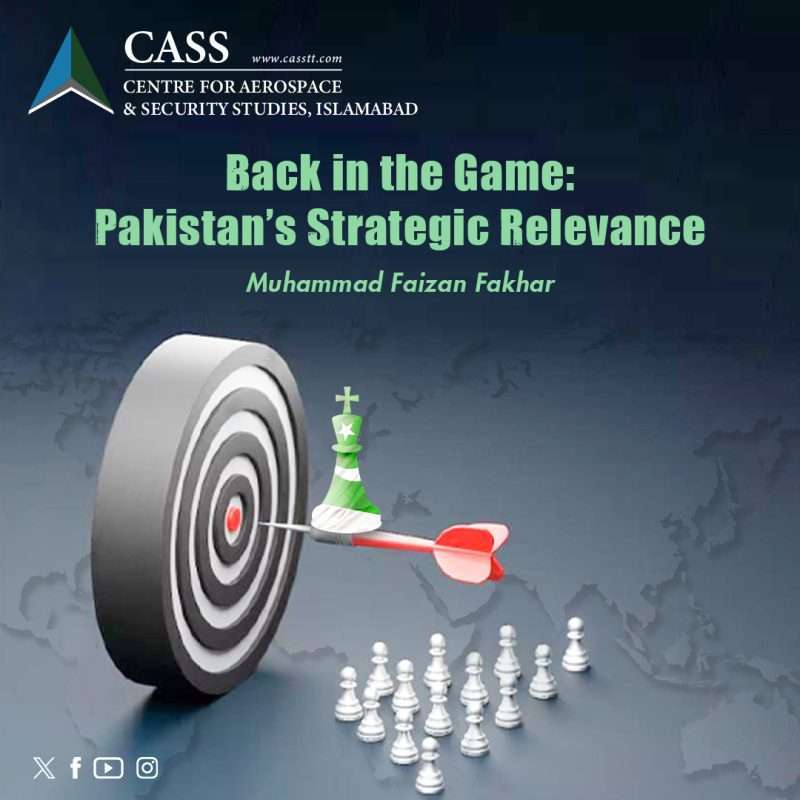
For many years, Pakistan was branded as a mere footnote in the strategic calculus of South Asia by India. In fact, India worked tirelessly, through its diplomatic, academic and media channels, to sell the narrative of Pakistan’s strategic irrelevance to the world. That illusion was decisively shattered during the Pakistan-India escalation of 2025. Now, in a striking reversal, it is India that finds itself struggling to convince the world of its own victory following its unilateral and unwarranted actions.
Pakistan, on the other hand, has taken centre stage in the geopolitical landscape. From the United Nations to diplomatic overtures with Washington, Beijing and other world capitals, Pakistan can be seen establishing itself as a credible player of the geopolitical game. The very Pakistan once dismissed by India as irrelevant has now become indispensable.
One of the most significant manifestations of Pakistan’s strategic relevance in global politics was the visit of its military leadership to the United States (US). On 18 June 2025, Pakistan’s Field Marshal was hosted for a private lunch with President Donald Trump. This lunch was an unprecedented occurrence. While Pakistan’s military leadership has previously taken part in official visits, a private White House luncheon with the US President alone had never been extended until now. Following this interaction, President Trump publicly commended Pakistan’s leadership for its role in de-escalating tensions with India and acknowledged its concerns regarding the Iran-Israel conflict. The visit also included high-level meetings at the State Department, CENTCOM, and the Pentagon signalling a clear elevation in Pak-US relations. The shift in tone and nature of the US reception were particularly noteworthy.
For years, India has sought to position itself as Washington’s primary strategic partner in the region serving as a counterbalance to China and the cornerstone of US defence cooperation in South Asia. However, these recent developments in Pak-US engagement are likely to leave a lasting impact on India’s ambitions to be viewed as the region’s sole credible power.
Earlier, in May 2025, Pakistan also became a founding member of the China-led International Organisation for Mediation (IOMed) that includes 33 countries. At that time, the Foreign Minister reaffirmed Pakistan’s stance on resolving the Indian Illegally Occupied Jammu and Kashmir (IIOJK) dispute in accordance with United Nations Security Council (UNSC) resolutions. In doing so, Pakistan not only reiterated its longstanding position but also challenged India’s narrative of the dispute being an internal matter bringing the issue firmly back to the international stage.
Moreover, Pakistan has been achieving notable diplomatic gains at the UNSC. The country was elected to serve its eighth term as a non-permanent member of the Council in January 2025 after securing a substantial majority of 182 out of 193 votes in the General Assembly. Subsequently, in June 2025, Pakistan was appointed to two key subsidiary bodies of the UNSC – one as Vice Chair of ‘UNSC Counter-Terrorism Committee’; and as Chair of the ‘Committee established pursuant to resolution 1988 (2011), which oversees the implementation of the sanctions measures on the Taliban’. The former appointment, just one month after India’s Operation Sindoor launched under the false pretext of terrorism, is in itself a clear indication of international recognition of Pakistan’s credibility and expertise in this domain. The latter further affirms the country’s pivotal role in shaping regional stability.
As the Israel-Iran tensions culminated into an active conflict in June 2025, Pakistan’s position gained notable prominence. Pakistan and Iran share a history of cordial relations rooted in cultural, diplomatic, and religious ties. On the other hand, the US’s direct involvement also presented a complex challenge for Pakistan in balancing its relations with both the US and Iran. Pakistan explicitly condemned Israel’s strikes on Iran’s territory and labelled them as a grave violation of Iran’s sovereignty and international law.
Pakistan shares a 900-km border with Iran marked by the presence of non-state actors who pose persistent security challenges for both countries. Given this vulnerability, any instability within Iran carries the potential to spill over into Pakistan, exacerbating regional volatility. These security concerns were communicated to the US President by Pakistan’s military leadership. In doing so, Pakistan demonstrated strategic clarity by reinforcing its bilateral ties with Iran without compromising on its broader geopolitical interests.
Since May 2025, Pakistan has been drawn into a series of diplomatic engagements that have elevated its international profile largely due to its credible display of military deterrence. However, sustaining this strategic relevance will require a clear vision, economic growth, political stability and meaningful global engagement.
Muhammad Faizan Fakhar is a Senior Research Associate at the Centre for Aerospace & Security Studies (CASS), Islamabad, Pakistan. He can be reached at: [email protected]



