Pakistan–India Relation: Fractured Past, Uncertain Future
The complex and often turbulent relationship between Pakistan and India remains one of South Asia’s most enduring and consequential realities.
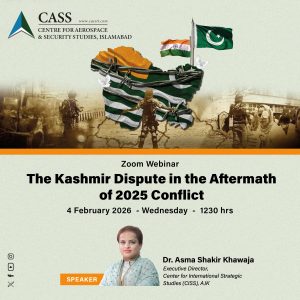
The year 2025 has redrawn the geopolitical map in many ways. The year witnessed a series of conflicts — including the recent India–Pakistan war, the Israel–Iran confrontation, and renewed instability along the Pakistan–Afghanistan border.
The contemporary era of warfare has transformed air and aerospace power into far more than a matter of aircraft and missiles. It now represents a comprehensive instrument of national strength — combining doctrine, technology, leadership, and psychology into a single continuum of influence.
Financial inclusion, the access and use of affordable financial services by all citizens, is an essential pillar of economic security and national stability.
The modern era has redefined the nature of power, where aerospace capabilities have become pivotal not only in national defence but also in economic and technological advancement. In an age where technological innovation is reshaping global competition, aerospace power serves as both a measure of national strength and a driver of strategic influence.
1. Outer space has transformed into a critical arena of astropolitics, where major powers are leveraging space technologies to shape global influence, gain strategic advantages, and contest dominance beyond Earth.
1. Air and aerospace power today extends far beyond aircraft and missiles. The decisive advantage lies in ‘doctrine, employment strategy, training and clarity of leadership’, reinforced by new domains of ‘space, cyber, electronic warfare (EW), and artificial intelligence’ (AI).
1. Financial inclusion, which entails the use and access of affordable…
Pakistan and India, since their independence in 1947, have remained entangled in a complex relationship defined by historical grievances, unresolved disputes, and missed opportunities for peace.
In contemporary warfare, the control of narratives and information has become as critical as the control of territory.