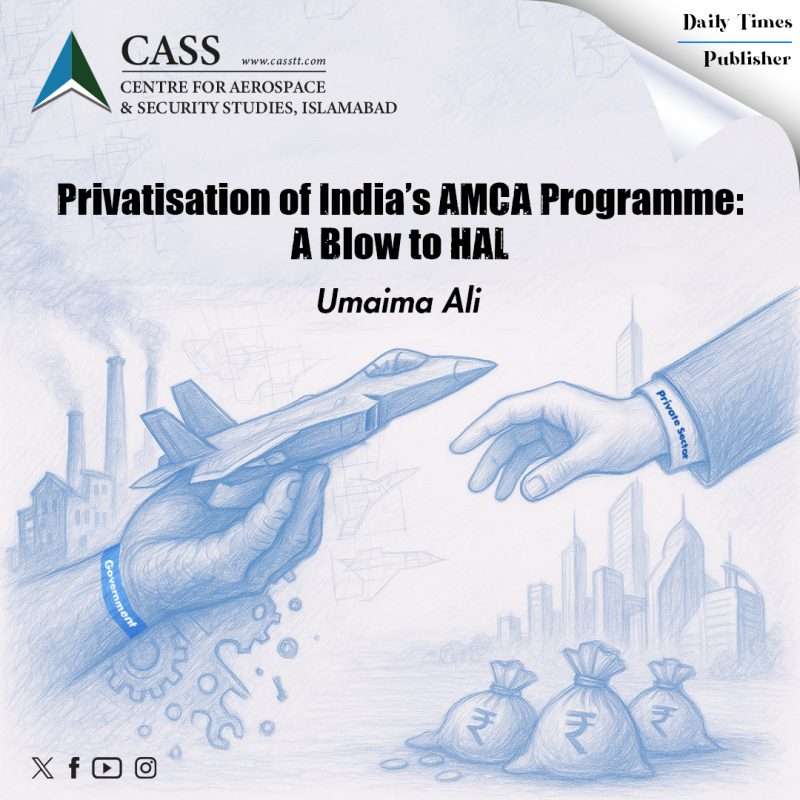
Last month, the Indian government approved the execution model for the Advanced Medium Combat Aircraft (AMCA) programme to advance its indigenous defence manufacturing capabilities. The programme, led by the Aeronautical Development Agency (ADA), will now be implemented through an industry partnership framework, breaking from the long-standing assumption that Hindustan Aeronautics Limited (HAL), India’s state-run aircraft manufacturer, would lead the project. This shift comes at a time when India faces growing criticism over the Indian Air Force’s (IAF) poor performance in Operation Sindoor. The AMCA, a 25-tonne, twin-engine, fifth-generation stealth multirole aircraft designed for air supremacy, ground strike, suppression of enemy air defences (SEAD), and electronic warfare missions.
The decision to open the AMCA programme to the private sector prompts us to consider how HAL has been performing lately. The company’s poor performance is evident from its delays in delivering the Tejas Light Combat Aircraft (LCA) to the Indian Air Force (IAF), primarily due to multiple design issues and disruptions in the supply of F404-IN20 engines from the US-based General Electric (GE). The LCA programme began in 1984, yet by February 2025, the IAF was operating only 36 Tejas Mk1 jets. In 2021, the IAF had placed an order for 83 Tejas Mk1A jets, with the first batch of 11 scheduled for delivery in 2024. However, none were ready by February 2025. In addition, the IAF’s repeated criticisms of HAL’s performance have become increasingly pointed. In February and again in May 2025, the IAF expressed dissatisfaction with HAL’s careless approach to production, labelling it a ‘ho jayega – it will get done’ attitude. Repeated IAF critiques have eroded HAL’s credibility. With the IAF’s squadron strength dropping from a sanctioned 42 to 31, the consequences of HAL’s failures are tangible.
In May 2025, 42 Pakistan Air Force (PAF) jets fought against 72 IAF jets in the largest aerial combat in modern history. The PAF downed six Indian fighter jets, including three Rafales: a development that indicates persistent weaknesses in the IAF’s doctrinal development and force structure, particularly the delayed induction of the LCA Tejas and the lack of timely replacements for ageing foreign aircraft. To expedite induction of India’s domestic fifth-generation stealth multirole aircraft, the government has decided that private sector firms will now compete to join the AMCA programme. According to the government, contracts would be awarded based on merit, with companies selected for their competence, timelines, and proposals. HAL, already overwhelmed with multiple ongoing programmes, will now have to compete with private sector firms like Tata Advanced Systems, Larsen & Toubro (L&T), Mahindra Aerospace, and Adani Defence & Aerospace.
While HAL still has a chance to participate, its future role is uncertain. If HAL somehow enters AMCA and collaborates with the private sector, it will likely become a ‘self-insufficient’ entity, relying on the private sector for expertise and innovation. Conversely, if HAL has to compete with the private sector to enter AMCA, it is unlikely to secure a spot, given its poor performance and comparatively stronger one of private defence firms.
In another scenario, if private companies lead the AMCA programme, their collaboration could yield results similar to the successful Lockheed Martin and Boeing collaboration on the F-22 Raptor. From a utilitarian perspective, if private firms deliver the fighter jet faster, at lower cost, and with superior technology, AMCA privatisation will be justified. The potential benefits of increased efficiency could outweigh the loss of HAL’s historical dominance. For example, through its involvement in high-profile fighter jet programmes such as the Rafale, F-16 Block 70, and LCA Tejas, Tata Advanced Systems has already established a credible track record in advancing India’s defence manufacturing sector.
Yet, this shift also invokes Gramsci’s hegemony, where dominant ideologies shape societal structures and power. In theory, privatisation could streamline production, reduce expenditure, and accelerate innovation, but at what cost?
As private companies gain greater influence in defence manufacturing, concerns have emerged that commercial interests could override national priorities. This apprehension is reinforced by the close ties some private companies maintain with the government. Anil Ambani’s ‘Reliance Aerostructure’, a private player with political ties, was reportedly given a key role in the Rafale deal. Similarly, another private company, the Adani Group, has political connections that could undermine the integrity of the selection process. The company’s involvement with the government raises questions about whether its political clout will skew decision-making in its favour.
The political ties of private companies could lead to favouritism, with key decisions potentially being influenced by a company’s proximity to power rather than the best technical or financial proposals. This situation mirrors challenges faced by the West, such as SpaceX’s collaboration with NASA, which raises concerns about conflicts of interest and NASA’s independence. These issues indicate that insufficient oversight and planning can lead to organisational and operational problems.
With the new policy of AMCA privatisation, HAL could find itself relegated to a secondary role, weakening the public sector’s influence in critical national security decisions. Just like in the colonial era, when indigenous cultures and economies were reshaped to serve external powers, the future of India’s defence could fall under the sway of a few mighty corporate giants, leaving national security decisions in the hands of those with the deepest pockets.
Umaima Ali is a Research Assistant at the Centre for Aerospace & Security Studies (CASS), Islamabad. The article was first published in The Daily Times. She can be reached at [email protected].