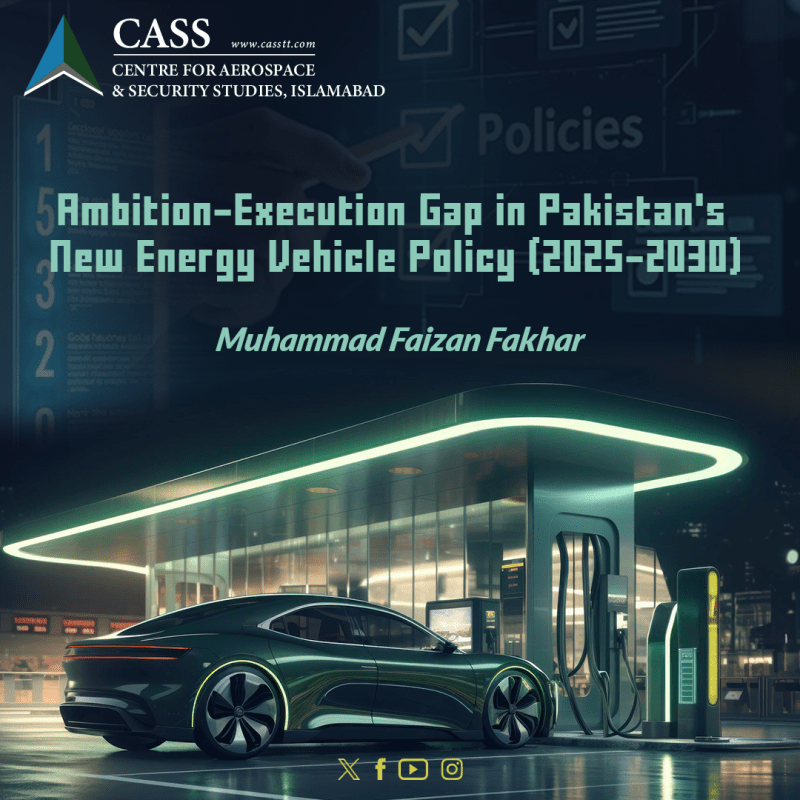
The government of Pakistan is all set to launch a ‘revised’ policy related to Electric Vehicles (EVs) under the title of ‘New Energy Vehicle (NEV) Policy 2025-2030’, with the inclusion of emerging sources of energy such as hydrogen. Pakistan’s first EV policy was launched in 2019 and it was further expanded and extended in 2020. NEV Policy upholds some of the EV penetration targets set by the preceding policies, however, it also introduces new goals of achieving 90% NEV sales by 2040, 100% NEV sales by 2050 and 100% zero-emission by 2060. Therefore, ambitious would be an apt term to use to describe the essence of the policy.
There are several aspects of the policy that could, in theory, prove to be effective in achieving its goals; however, it also has some shortcomings. For starters, it builds an appealing case in favour of the need for policy intervention by providing a context of worsening issue of carbon emissions in Pakistan and identifying the road transport sector as a major contributor to this problem. However, the data provided to support these arguments- related to carbon emissions and greenhouse gas emissions of road sector, projection of oil import bills of road sector and energy utilisations by NEV- cannot be verified independently owing to the absence of any references or supporting data.
Then there is the issue with timelines. Although the policy does identify broader timelines of achieving the targets of NEV sales, it does not outline a phased implementation roadmap with clear and specific milestones. Priority must be given to public transport sector by setting up targets and expected timelines for integration of NEVs in the mass transit services of federal and provincial governments. Moreover, in line with the spirit of previous EV policies, NEV policy also offers a comprehensive set of tariff based incentives for import and local manufacturing of NEVs and its components, but it does not set any specific manufacturing or import targets and timelines.
The policy document also lacks clarity of plan at times and tends to outline broad and general objectives without considering the implications of these objectives. For instance, in the section on ‘Charging Infrastructure Development’, the document claims that electricity will be provided to the commercial charging stations with a separate feeder line to ensure continued power supply. While this claim may sound encouraging for potential investors, high logistical and operational cost is involved in installing separate feeder lines. In this regard, consultation with the relevant departments and authorities such as National Electric Power Regulatory Authority (NEPRA), National Transmission and Dispatch Company (NTDC), and Distribution Companies (DISCOs) is a pre-requisite. The policy also does not mention any stakeholders, consultants or partners that were involved in the formulation process.
Similarly, NEV policy also calls for the establishment of Energy Vehicle Support Fund (EVSF), but it fails to specify the exact sources of the funding or a sustainability model for the fund. Moreover, in the same section, the document also mentions placing a tax on the traditional fuel without identifying a timeline, which seems impractical. NEV policy also offers a car replacement scheme whereby consumers would receive a 20% credit by the government on top of the scrap value of their old vehicles to buy NEVs. It states that government will take the old vehicle into custody, however, disposal / recycling of such cars require elaborate mechanisms which need to be addressed in the policy. Furthermore, one of the biggest environmental hazard associated with NEVs is the recycling of depleted lithium ion batteries. The policy does provide a broad framework on recycling of batteries, however, detailed implementation strategies would be more useful.
Finally, the policy does not adequately address the risks attached with the undertaking a nationwide transition to NEVs. These risks include disruption scenario of NEV supply chain, lack of local aftersales services, technological failures and resistance from the local automobile market. Therefore, the policymakers need to engage with the relevant stakeholders across public and private sector to address the gaps in the language, timelines and objectives of the policy.
There is also a need to identify other sectors that could offer effective and efficient transition to NEVs in the future. In this regard, electrification of railways could reduce the burden on road networks that are currently being used for hauling 96% of inland freight and carrying 92% of passenger traffic. Thus, railway is a critical sector that could offer substantial economic, environmental, and operational benefits with a transition to NEVs.
To sum, the NEV policy could prove to be a comprehensive blueprint for the transition of Pakistan’s road transport sector to green NEVs; however, addressing the gaps in clarity, timelines, and objectives of the policy could make it more effective.
Muhammad Faizan Fakhar is a Senior Research Associate at the Centre for Aerospace & Security Studies (CASS), Islamabad, Pakistan. The article was first published in Express Tribune. He can be reached at: [email protected].