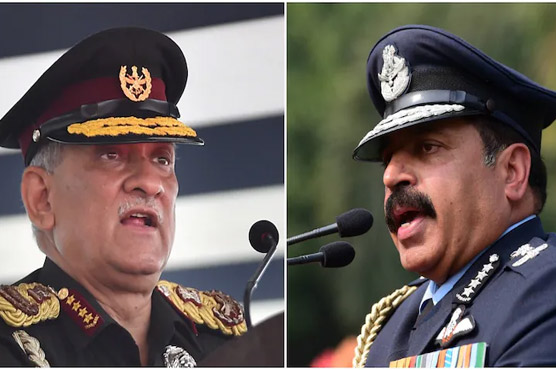
Recent public disagreement between Gen Bipin Rawat and ACM RKS Bhadauria demonstrates a serious disconnect and grave absence of understanding at the highest command level. Though, professionally it’s extremely unfortunate to witness a discord and conceptual misunderstanding at the CDS-Service Chief level, yet as a Pakistani it’s heartening to spectate utter confusion and want of strategic clarity in roles and application of an important and independent service in the overall scheme of defence forces of an arrogant neighbour. Gen Rawat, the highest office holder in the military hierarchy of Indian Armed Forces, has demonstrated his scarcity of indulgence in modern military thought that has been prevalent not since First Gulf war but since the WWII, when allied air power undertook independent aerial operations that contributed towards the ultimate national objective i.e. victorious culmination of the great war. Conventional strategic bombing campaigns across Europe, Africa, Asia, over Atlantic and Pacific oceans and especially the nuclear attacks on Japan had no element of army/naval support but demonstrated airpower’s independent war waging, conducting and culminating capacity. Development of independent airpower doctrines in ‘50s and ‘60s as well as their continuous updations is a clear manifestation of the fact that modern global thought has aligned to the fact that air power, independently, is a factor in available tools of national power, and not “a supporting arm or an extended artillery or Corps of Engineers” as vulgarly stated by Gen Rawat. Referring to historical accounts of previous contestations, IAF, with her much larger size and numbers, has not been a professionally casual or complacent adversary for the PAF.
This contempt and rejection is really sad and highlights not only the contestation and disagreements in roles and tasks of members of Indian Armed Forces hierarchy but also the impending problems in functioning (not establishment) of India’s dream “Theatre Commands” across her territorial borders. India certainly needs to address the competence and comprehension of its highest military leadership before embarking upon any grand military organisational shakeup that may ultimately becomes detrimental to professional efficacy and cohesion of her armed forces. Debates and discussions do take place in every mature system, and they also carry dissent and disagreements but incompetence or intelligibility of the highest chair is a curse awaiting disaster. India needs to evaluate other systems in the neighbourhood before undertaking any ambitious or revolutionary transformations in her system of forces.
Comparable organisational and doctrinal developments have also been continuous process in Pakistan Armed Forces. It is actually a foundational cause and contributory element of our operational expertise, technological progress and professional prowess. Establishment of Joint Staff HQ is also a result of one such process that materialised under a democratic government. Similarly, as an integrated part in our tri-services arrangement, PAF’s contributions towards national strife, equally in peace and war, has been recognised and appreciated at national and services levels. She had been at the forefront of all war operations, not only conducting her primary independent role of deterring the enemy and carrying out offensive operations against enemy air force/ strategic targets but also supporting and assisting sister services in accomplishment of their objectives through accomplishment of pre-planned / deliberated joint operations. Pakistan Armed Forces are smaller in size and equipment capacity. They have settled to the fact that their survival and success lies in jointness of operational thought and action. It is their destiny in shared rise and fall that binds them together. It is an ingrained common thought that all hands are important and all are needed to survive, sustain and succeed.
While there are certain (constructive) professional competitive jargons between the services (and within the arms of a service as well), which is desirable for faster treading towards professional excellence. There is no competition in proving superiority over other services, when it comes to achieving a national cause. During “Operations Rah-e-Rast, Rah-e-Nijat and Zarb e Azb”, PAF and PN Air Arm were at the forefront in supporting their brethren on ground with 24×7 ISR as well as hot engagements in pre, during and post ground operation environments against designated targets. It certainly was a joint effort that helped in eradicating an existential threat to the territorial and human integrity of Pakistan. The assistance came not as a liability of supporting arm but as a joint responsibility towards fighting a common enemy and reducing overall effort by judicious use of ALL available resources for ensuring success with quickest, safest and least human/material-cost. It is also a reassuring fact that Pak Army, on number of occasions, has not only provide physical assistance in terms of men and material, but also enthusiastically supported other services in achieving their force development goals by contributing from and sometime forgoing their share of national funding. This all is possible when there is an inner realisation to the fact that all members of the team are equally valuable and essential in attainment of a unified cause.
Nations, not militaries, fight wars; Nations, not militaries, rise or fall; and its nations, not militaries, that perish or endure. Germany and Japan are the two most recent examples. Their national resilience, unity and faith has marched them towards eminence from utter chaos and catastrophe. In building a house into a home, all hands count and in a nation’s walk to glory, all individuals count. Let leadership in Indian Army recognise and assent to Indian Air Force as an equal, independent and capable partner in securing and ensuring sovereignty and integrity of Indian union.
Air Vice Marshal Faheem Ullah (Retd) is a Director at Centre for Aerospace & Security Studies (CASS), Islamabad with main interests in Aerospace and International Relations disciplines. This article was first published in The Nation. He can be reached at [email protected].
Image Source: Dunya News. “Spat Between IAF Chief and CDS Bipin Rawat Accelerates.” July 7, 2021.