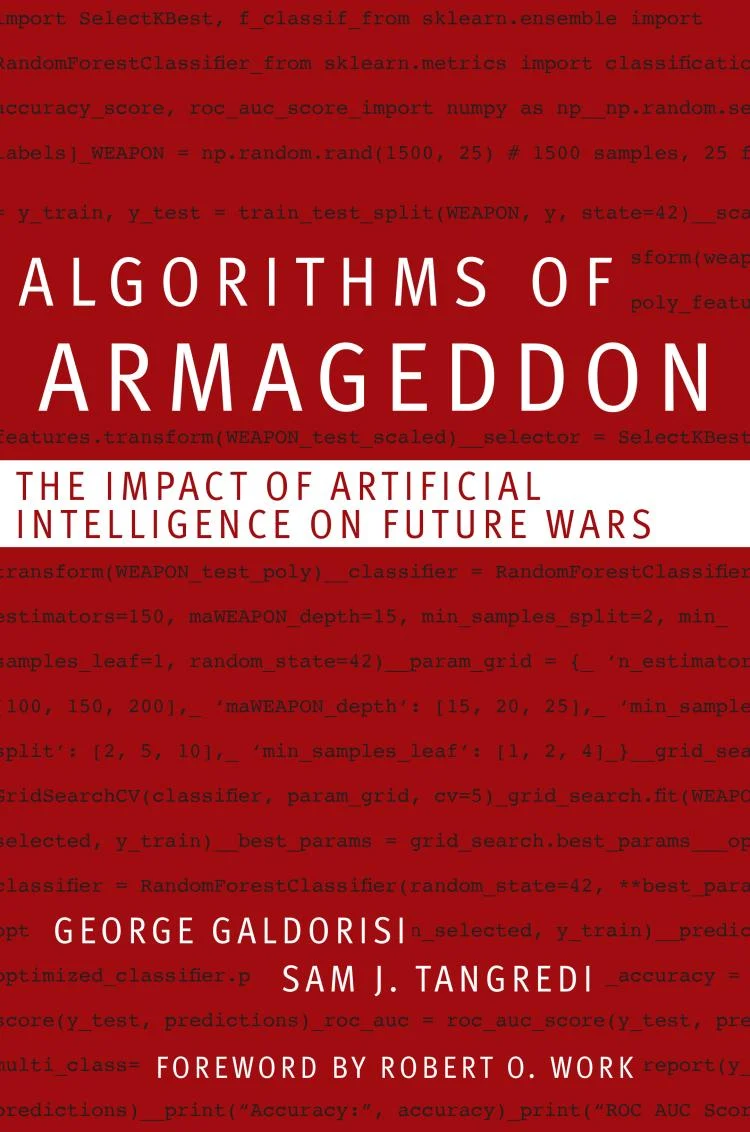
Sam J. Tangredi and George Galdorisi, Algorithms of Armageddon: The Impact of Artificial Intelligence on Future Wars (Maryland: Naval Institute Press, 2025)
Reviewed by Syed Ahmed Ali
Modern military conflict is dominated by sophisticated technology, where the army with the most advanced capabilities controls the battlefield. The dominant technology in this era is artificial intelligence. As was rightly pointed out by Professor Stuart Russell, who described autonomous weapons as the “third revolution in warfare”, after gunpowder and nuclear weapons. In this context, Algorithms of Armageddon: The Impact of Artificial Intelligence on Future Wars is a critical read, as it explores how artificial intelligence has reshaped warfare. The book has been authored by Sam J. Tangredi and George Galdorisi, which provides a rich, detailed account of how algorithms have enabled autonomous weapon systems to outpace human decision-making. The authors illustrate how artificial intelligence has overwhelmed the enemy with the speed and reliability in its decision-making. Understanding how artificial intelligence will impact weapon systems is critical, as autonomous decision-making is a core pillar of modern warfare. This makes the book a necessary read for those who are uninitiated to the realities of autonomous warfare.
Tangredi and Galdorisi provided a comprehensive account, explaining what Artificial Intelligence is, how it has evolved throughout history, and why it is significant. Throughout this book, the authors have quoted several real-life incidents explaining the difference in efficiency between humans and machines. For example, (pg. 102), the authors cited the example of an Iranian air defence officer who wrongly identified and shot down a Ukrainian airliner as a cruise missile, due to incomplete information. Such examples cement the book’s claim that the weaponisation of AI is inevitable, as the speed and reliability of decision-making cannot be matched by humans. The authors, recognising the inevitability of autonomous weapons, provided a section discussing International law governing the use of Lethal Autonomous Weapons (LAWS). The book concludes by presenting a hypothetical, fictional scenario in which AI is used in a World War III setting. The purpose of which seems to be the prediction of the nature of modern conflict. The authors do not make exaggerated claims about the future of AI; instead note that the current utility of AI is largely limited to processing large quantities of data.
Algorithms of Armageddon is an excellent entry point to the world of AI-integrated military systems. The book starts from basic concepts of artificial intelligence, such as types of machine learning, algorithms, and Big Data. All these complex terminologies are broken down into simpler contexts, making it easier to digest for a non-technical audience. The book avoids using excessive technical jargon while not compromising on important concepts. For example, on (pg. 74), the book discusses human in the on-the-loop, on the loop, and off the loop AI decision-making models. The authors have adopted a simplistic style of expression which has made the book comprehensible to a larger audience, thereby increasing its accessibility to a larger audience.
While the simplicity of style has broken down complex concepts of artificial intelligence into digestible ideas, it has come at the cost of depth and nuance. AI decision-making models are incredibly complex, where the construction of algorithms and their interaction with Big Data can often lead to mixed results. The book shies away from discussing complex AI paradoxes like the Black Box effect, where the inner workings of algorithms are not clear. Furthermore, the book does not discuss the integration of AI into complex strategic weapons such as nuclear, cyber, and conventional weapons. The subject of nuclear deterrence in particular is missing, which is critical, as these weapons provide strategic stability. Automated weapon systems in particular have a direct impact on decision making which may cause unintended military escalation, this issue needs to be further explored .The book is also missing a chapter on military doctrines regarding the application of artificial intelligence. The authors have sporadically made mention of American perspectives on autonomous weapons, but nothing comprehensive. In the case of China and Russia, the coverage of their perspective on autonomous weapons is limited, as sources from government officials and military officers were largely missing. The absence of these voices reduces the credibility of the Chinese and Russian incompetence that the authors claim.
To conclude the book does not discuss key areas of importance, such as AI doctrine, impact on nuclear deterrence, and other such factors. Rather, it focuses on the important concepts related to AI decision-making. For this reason, this book is less suited for more informed audiences that are looking to go deeper to explore this new type of warfare. For seasoned readers, alternative titles such as “AI and the Bomb” by James Johnson, which examines the impact of artificial intelligence on strategic stability and nuclear deterrence are worth exploring. Another relevant title is Cold War 2.0 by George Takach. His work explores the technological competition between great powers for emerging technologies like artificial intelligence. Nevertheless, “Algorithms of Armageddon: The impact of Artificial Intelligence on future Wars” is an excellent resource to understand the basics of AI-integrated weapons. Its place in the literature is that of an introductory chapter to the world of autonomous weapon systems, serving as an ideal platform to dive deeper into the field of emerging technologies.
Syed Ahmed Ali is a Research Assistant at the Centre for Aerospace & Security Studies (CASS), in Islamabad, Pakistan. He can be reached at [email protected]