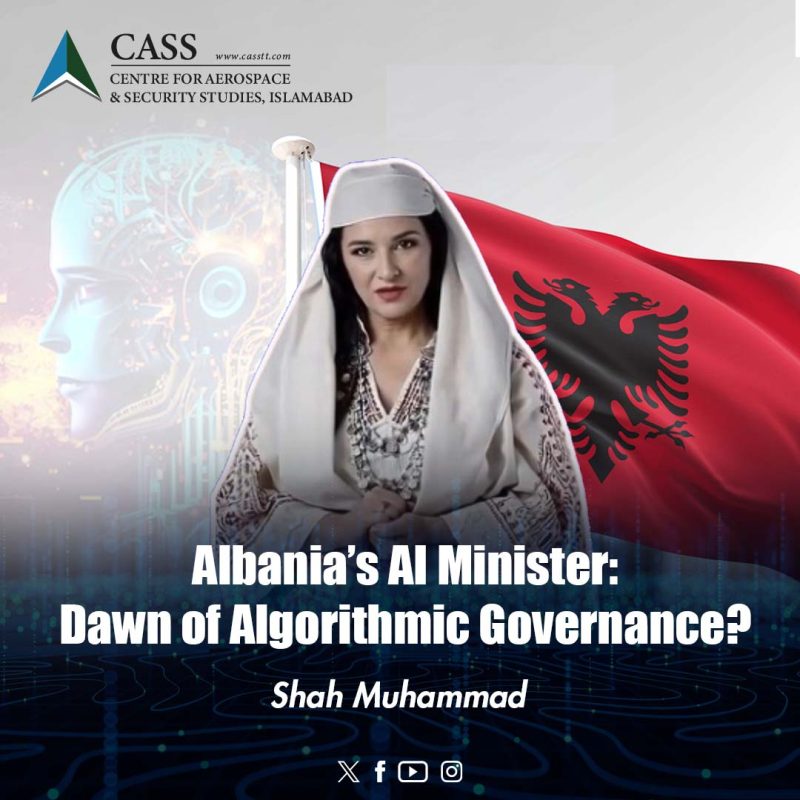
‘Some have called me unconstitutional because I am not a human being,’ the AI minister asserted while taking oath, ‘Let me remind you, the real danger to constitutions has never been the machines but the inhumane decision of those in power.’ On 18th September 2025, the world reacted with a mix of awe and hysteria as the world’s first AI minister, named Diella, took oath in the Albanian parliament. Dressed in traditional attire and exhibiting a firm composure, Diella is virtual avatar of a woman who has officially been entrusted with the charge of the Procurement Ministry in Albania.
Initially launched in January 2025 as a virtual assistant in the e-Albania platform, Diella was mainly tasked with rendering digital services to the public. It was later elevated to the role of cabinet-level minister through a presidential decree on 11th September 2025. It is an advanced language model that was created in collaboration with Microsoft and OpenAI.
The Albanian episode is the pinnacle of a growing trend towards algorithmic governance. For instance, in 2024, a British businessman Steve Endacott created his AI avatar called AI Steve to run his election campaign. Although he could not win the election, AI Steve hinted at what was to unfold in the future. In August 2025, Swedish PM Ulf Kristersson acknowledged that he uses ChatGPT for policy brainstorming and ‘second opinion’ on matters of governance. His claim was met with mixed responses on both sides of the aisle, with critics asserting that the people had voted for Kristersson, not ChatGPT.
In the Albanian PM Edi Rama’s own words, the purpose of this unprecedented embrace of AI is to ‘eliminate corruption’ and make the public bidding process ‘much more efficient and totally accountable.’ His proponents endorse the notion that, unlike humans, a mechanical entity would not be tempted towards unscrupulous governance practices such as bribery and embezzlement. In particular, the public bidding would be carried out on the basis of objective criteria rather than the subjective biases that often accompany human oversight. Furthermore, the bidding process and overall public procurement would also be enhanced through fast-paced screening of documents.
Nevertheless, the inclusion of Diella in the Albanian cabinet is the first ever instance in human history that an AI entity has been given policy control, effectively blurring the line between science fiction and the real world. The Albanian opposition leader Sali Berisha has raised questions over the constitutionality and legitimacy of a non-human entity being given access to a powerful ministry. In the Albanian constitution, or any other constitution for that matter, there is no provision for a non-human entity to acquire a mid-level or high-level governance role. Moreover, every AI system hinges on the credibility and accuracy of the data being fed into it. If the data itself is biased or manipulated, Diella might get compromised and thereby make decisions that are detrimental to public interests.
Importantly, the Albanian government has not come up with complete disclosure about the level of autonomy in Diella. Notably, these levels are characterised by human in the loop, human on the loop and human out of the loop models. A fully autonomous entity, with no human oversight, is essentially a human out of the loop system, while the other two correspond to varying degrees of human intervention in AI systems. Needless to say, the disclosure of autonomy levels and the potential limitations of AI systems are imperative for their accountability and transparency. As per OECD AI Principles and the Council of Europe’s AI Framework Convention, the countries are required to disclose these details to ensure that AI systems contribute to, rather than contradict, the goals for progress and development.
The embrace of algorithmic governance points towards another unsettling question: are societies and governments losing trust in the benevolence of humans? By claiming that AI would be better suited to eliminate corruption, the Albanian PM somehow implied that humans are inherently vulnerable to the temptations of greed and favouritism. However, his statement does not factor in the deeper understanding of human agency. It should not be overlooked that humans are also inherently endowed with the warm impulses of empathy, kindness and altruism. Given their non-sentimental and cold mechanical nature, AI systems will not exhibit any warmth when it is required.
The breakneck pace of emerging technologies is leaving behind constitutional, legal and ethical gaps that require urgent attention. It is every nation’s sovereign right to constitutionally embrace or reject the AI systems in governance roles. However, the regional and global institutions may conduct feasibility studies on this trend and craft widely accepted norms regarding the extent of AI integration in policy realm. The studies might go on to endorse the AI integration in public service delivery with an optimum degree of autonomy. In this regard, OECD AI Principles, Council of Europe’s AI Framework Convention, and the UN’s Framework for Global AI Governance should entertain the idea of partially or fully autonomous systems being in control of ministries or departments.
Diella is indeed an innovative leap in governance, but the question remains: Is it a harbinger of AI-driven good governance or a prelude to dystopian future?
Shah Muhammad is a Research Assistant at the Centre for Aerospace & Security Studies (CASS), Islamabad, Pakistan. He can be reached at: [email protected]