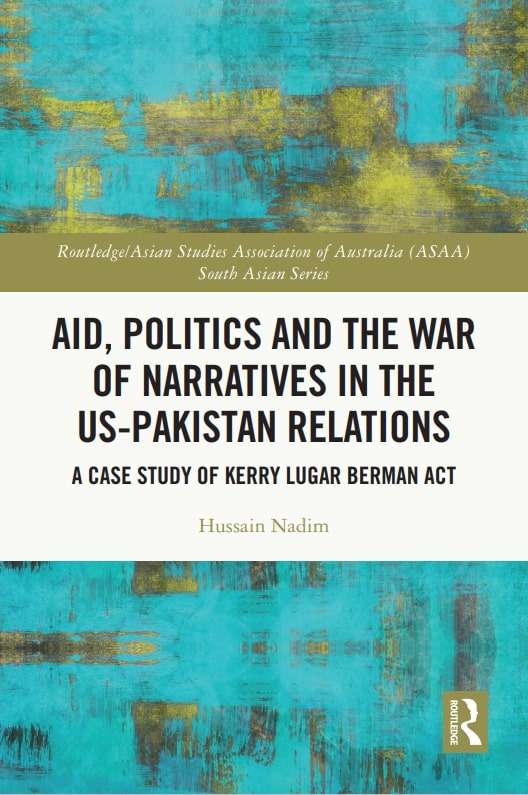
Hussain Nadim, Aid, Politics, and the War of Narratives in US-Pakistan Relations –A Case Study of Kerry Lugar Berman Act (London and New York: Routledge, 2023)
Reviewed by Khansa Qureshi
Aid, Politics, and the War of Narratives in US-Pakistan Relations – A Case Study of Kerry Lugar Berman Act sheds light on how foreign aid – with political undercurrents – highlights the short-term interests of donors over long-term economic or social improvements in the recipient country. Extensively analysing 1707 or the Kerry-Lugar-Berman Act 2009 (KLB), the book analyses data from datasets of United States’ foreign aid as well as takes insights from a number of interviews with officials from the US and Pakistani governments.
The author Hussain Nadim discusses how in the year 2009, the new Obama Administration decided that in order to stop failing in Afghanistan, it was necessary to fix Pakistan’s ‘behaviour’ as it was considered to be allegedly providing safe havens and logistical support to the Taliban. Therefore, Washington launched the Kerry-Lugar-Berman Act to invest in Pakistan’s development sector as better development promised better security, and better security required better development under the security-development nexus. However, the author argues, in parallel to development, the Act sought to influence Pakistan’s strategic considerations. Nadim explains how the ‘help us help you’ relationship was actually less of a help and more of a ‘short-term neo-colonial political intervention under the security-development nexus’ (p. 46).
One of the main postulates of the book is that the Act also incited a power struggle between Washington and Islamabad. Nadim argues that machinations of the Act strengthened the long-standing idea of Pakistan and the US being reluctant allies, focused on exploiting each other’s vulnerabilities.
Nadim explains that the KLB also engineered a shift in power balance in the country vis-à-vis the US’ shift from preferring to work with the military to collaborating more with the civilian government (p. 82). Within the framework of the KLB, certain provisions were articulated to ensure the primacy of civilian governance over the military(p. 84). This aspect of the KLB inadvertently led to tensions between Pakistan’s civilian and military entities. This development subtly challenged the nation’s evolving democratic fabric, the effects of which remain evident even after a decade (p. 30).
Through his extensive analyses of the US foreign aid from 2002 to 2017 to Pakistan, the writer also explains how the US funded different projects in the country spearheaded by Non-Government Organisations (NGOs), powerful media houses, religious clerics, and educational exchange programmes aimed at exerting influence on domestic policy discourse as well as public opinion (p. 51).
Although discontinued in its third year, the KLB Act served US interests by engineering a change in Pakistan’s national security decisions (p. 39). The Act, Nadim believes, also challenged Pakistan’s sovereignty. He explains how the notion of indivisibility of security and development was adopted by the US to not only serve its own interests in the region, but also how it tried to impact Pakistan’s security policy particularly regarding nuclear safeguards and Kashmir-based groups.
Meanwhile, for Pakistan, despite huge domestic uproar over the Act’s controversial terms and conditions alongside American pressure, the KLB helped Islamabad in achieving its regional security and military interests even from a position of weakness. While the KLB aimed to support the underprivileged and bolster Pakistan’s counterterrorism efforts, the Pakistani officials interviewed by the author did not perceive it as fulfilling these stated objectives (p. 67).
The author employs a de-colonial framework that ‘integrates the views, perceptions, policies, and reactions of the weaker actor’ (p. 20). He establishes that contrary to the widely perceived notion, Islamabad being a weaker actor was not a passive actor in its bilateral relationship with the US. In fact, Nadim argues that the country’s security establishment was an active stakeholder in formulating the security-development nexus and exerted its agency to a substantial extent. For example, he observes that by pitching the idea of Pakistan on the verge of collapse that was readily accepted by the US, Pakistani officials were able to coerce the former to assist the latter (p. 69).
This work seeks to eliminate the confirmation bias that exists in Western academia, and scholarship that only acknowledge the agency and policy autonomy of stronger actors in a certain foreign policy transaction. By studying the policies and respective responses of the US and Pakistan to the KLB, Nadim assigns a considerable level of agency to the weaker actor in a policy transaction as well. In this way, the book also shuns conventional notions of interplay of power symmetries or asymmetries between different stakeholders and the autonomy of action that comes with it. On the other hand, he also notes that many theories related to the ‘strings attached’ to foreign aid to Pakistan, previously considered to be wild conspiracy theories, were genuine. This shows how attempts of a stronger nation – the US – to further its own interests came at the expense of the recipient country – Pakistan. The US attempt at social engineering in Pakistan to turn public opinion in its favour led to significant domestic political polarisation in the country.
This book is an essential read for the students, practitioners, and scholars of IR given that it is a much-needed departure from the prevalent, Western-centric policy insights and discourse – which Nadim argues is also the main culprit behind the US’ failure in Afghanistan and its topsy-turvy relationship with Pakistan – on US foreign policy, particularly when in dire straits. Given the current realities, i.e., resurging terrorism in Pakistan and the country’s struggle to counter it not least due to the shambling economy, difficulty in securing an economic bailout, struggling democratic values, and most importantly, the lukewarm nature of Pakistan’s ties with the US and their relevance to the main tenets, studied in the book, make it an insightful and timely work. Reading it also puts into perspective a number of policy matters that are taking place in Pakistan’s domestic politics.
Khansa Qureshi is a Research Assistant at the Centre for Aerospace & Security Studies (CASS), Islamabad, Pakistan. She can be reached at [email protected]