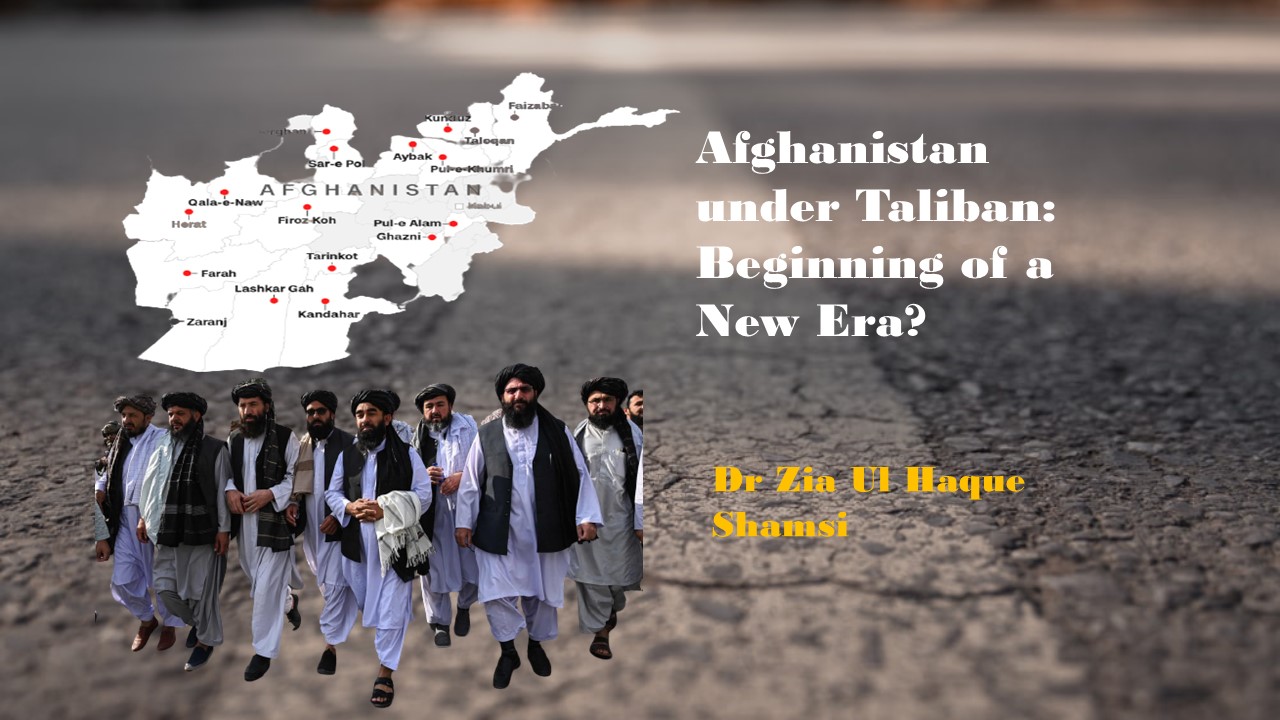
As western media and experts painted a horrifying picture of Afghanistan after the withdrawal of US and NATO troops following the Doha Agreement signed on February 29, 2019, between the Taliban and the US, stakeholders carefully crafted a scenario that would bring peace and stability, not only in Afghanistan but the entire region. Perhaps, this was the first time in over four decades of War in Afghanistan that regional countries including China, Russia, Pakistan and Iran, joined ranks to determine an all-inclusive and peaceful Afghanistan for sustainable peace and regional development.
On the other hand, the Taliban leadership is moving cautiously – not repeating the mistakes of the past – reassuring the international community of respecting women rights and according them their well-deserved status in a Muslim society. However, the western, as well as Indian media, are not willing to give the Taliban any space to prove their stated stance. They keep targeting their record of extreme ideas about women and human rights.
In my opinion, Afghanistan may be a changed place in the coming years, primarily due to the active participation of regional players, which was missing before. A brief look into the recent history of Afghanistan reveals that stakeholders abandoned the war-torn country when the erstwhile Soviet Union withdrew its forces in February 1989. The Soviet-supported government of Najibullah, which lasted for over four years until April 1992, miserably failed to effectively govern and unite various Mujahedeen groups. The civil war continued in Afghanistan during the short tenure of President Sibghatullah Mojaddedi, which lasted only 61 days in 1992. Similarly, the tenure of President Burhanuddin Rabbani, though it lasted officially for over nine years until 9/11, was overshadowed by Mullah Omer’s Taliban government that controlled over 90 per cent of Afghan territory between 1996-2001. However, it was only recognised by three states: Pakistan, Saudi Arabia, and the United Arab Emirates.
Unfortunately, Afghanistan was always treated as a battlefield by regional and extra-regional actors. The people of Afghanistan were forced to flee their homeland, and take refuge in the neighbouring countries: mostly in Iran and Pakistan. Iran kept them in refugee camps, but Pakistan opened its doors across the country. At present, their third generation is living in Pakistan. However, Pakistan has now proposed setting up special camps near the Afghan borders to accommodate the displaced people, should the situation so arise, in the aftermath of the US withdrawal. Pakistan has also called upon the international community to fulfil their obligations of hosting legitimate Afghan refugees. It is already hosting over four million of them for the last forty years.
However, the Taliban leadership has so far proved everybody wrong. As I keep reminding the biased western media analysts that the Taliban are Afghans, not the occupiers of the land. They have had the full support of their people in their struggle against external powers because no guerilla movement can succeed without the active and full support of the local populace. Moreover, the Taliban moved in to take control of Kabul in a very organised and controlled manner. They faced limited resistance in Herat, Kandahar and, of late, in Panjsher Valley, where Indian media tried to project Ahmed Shah Masood as a potential game-changer. However, Panjsher was also taken over by the Taliban without much resistance.
The Taliban leadership showed no urgency in announcing the formation of their government in Kabul and took nearly three weeks to announce an interim setup. The Taliban leadership is concentrating more on garnering support from regional powers, mainly China and Russia, whereas the Taliban are well aware that Pakistan supports the cause of peace and stability in Afghanistan. Once the Taliban Administration is recognised by regional powers, it will be relatively easier to get recognition from other countries and achieve the much-needed legitimacy to govern their state. Therefore, this time, an effort is being made to concentrate on getting regional recognition, and Pakistan is leading the way. Pakistan’s involvement was a given because there remains no other country (except Afghanistan) that is more affected by the continuing instability due to conflicts in Afghanistan.
The writer is a published author and presently working as Director in Centre for Aerospace & Security Studies (CASS). This article was first published in Daily Times. He can be reached at [email protected].
Image Source: Etfa Khurshid Mirza