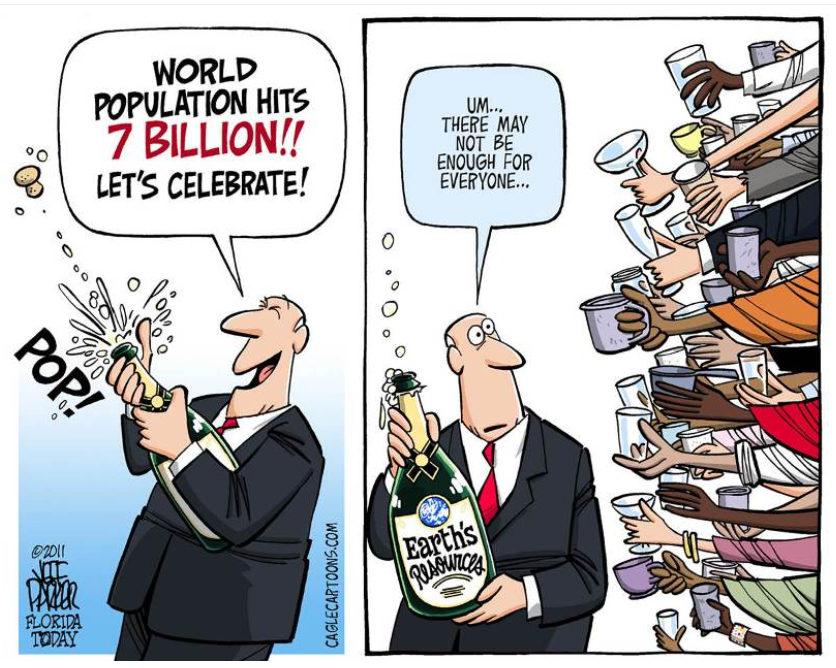
Exponential growth of the human population is posing a serious threat to the limited resources of planet Earth. This indiscriminate increase is causing depletion of available resources rendering the environment less sustainable and unsuitable with the passage of time. It also raises serious concerns regarding the management of these limited resources and exacerbates developmental challenges for all countries. However, the truth is that the situation is graver for countries that are underdeveloped, have weak infrastructure, and/or are performing poorly on the Human Development Index (HDI). Pakistan is no exception to these vulnerabilities.
The current population of Pakistan, according to United Nations’ latest data, stands at 227,282,382 and is growing at an alarming rate of 2.4% per annum. According to the United Nation’s Population Division’s medium projection, the country’s population would further increase by 84% during the period 2017-2050. 2.1 million young people will enter the labour force every year which is expected to reach 180 million by 2050. Keeping in view these figures, it is high time for Pakistan to treat population control as a national priority, integrate population planning in academic, religious, and national policies, and develop the labour market to accommodate her youth.
Growing population becomes a challenge when the relationship between population growth and a country’s development is not directly proportional. Pakistan has not done well in this area as it is ranked 154 among 189 countries in the Human Development Index (HDI). According to the current statistics, half of the population has no access to basic health facilities and sanitation. 17 million people have no clean water, proficiency rate remains stagnant at 60%. Sadly, also Pakistan ranks at the bottom of the Gender Gap Index, rate of unemployment has increased by 6.5% and 21.9% of the population is living below the poverty line. Keeping in view these indices, Pakistan’s population has often been called ‘a ticking time bomb’ – one that is interconnected with multiple threats.
In order to overcome its population crisis and fulfill its international obligations, Pakistan needs to lower its population growth from 2.4% per annum to 1.5% per annum by 2030. To achieve this objective, the Government of Pakistan needs to study the successful population control models such as those of Bangladesh and China that contributed to their economic development. The success of the Bangladesh model is reflected in the strong collaboration between its medical sector, society, Non-Governmental Organisations (NGOs), and government. In this regard, Pakistan needs to train more Lady Health Workers (LHWs) to educate women on family planning; create more awareness about the use of contraceptives; increase the provincial health budget; reduce income and resource inequality and focus on addressing structural inequalities of access to health and education. Likewise, it is important to take into consideration the factor of demographic dividend.
To come up with an effective population planning framework, it is pertinent to understand the country’s religio-ethical, political, economic, and international environment. Pakistani society is driven primarily by its ethical, religious, and cultural values. Economic growth, given the very structure of the economy, has not been able to produce socioeconomic opportunities in desired quantity and quality. The political or institutional context is riven due to rivalry between political parties, centralised federal control, and an unresolved working relationship between the Federal and Provincial governments. And yet, on the international front, Pakistan is committed to the UN Sustainable Development Goals (SDGs) and the pledge to work towards achieving universal access to reproductive health and increasing Contraceptive Prevalence Rate (CPR) to 55% by 2020.
The Government of Pakistan has taken a number of initiatives to address this challenge such as adoption of comprehensive recommendations by the Council of Common Interest (CCI) on population dynamics and population growth; establishment of a Federal and Provincial Taskforce on population; endorsement of a National Narrative on Population under the UNFPA; establishment of a Parliamentary Forum for Population created to monitor progress made on the recommendations of the CCI and national commitment signed at the International Conference on Population and Development (ICPD) in 2019. While these initiatives are noteworthy and evidence of political commitment, a lot more needs to be done.
Effective population control measures can serve as a compelling tool for Pakistan in fulfilling its international obligations; achieving the SDGs; improving its HDI; and achieving equitable development. Population control efforts can help address internal planning fiascos; decrease pressure on the environment; and provide a fleeting opportunity for dealing with other important issues such as the provision of better public services, improving living standards and redirecting resources to developmental projects to increase net investments.
Amna Tauhidi is a researcher at the Centre for Aerospace & Security Studies (CASS), Islamabad, Pakistan. She can be reached at [email protected]
Image Source:Philibert, A. 2020, “Overpopulation Will we ever run out of room?” Story maps, 8th Dec. https://storymaps.arcgis.com/stories/a00bd5e204a04760a0d5e7173947b567