
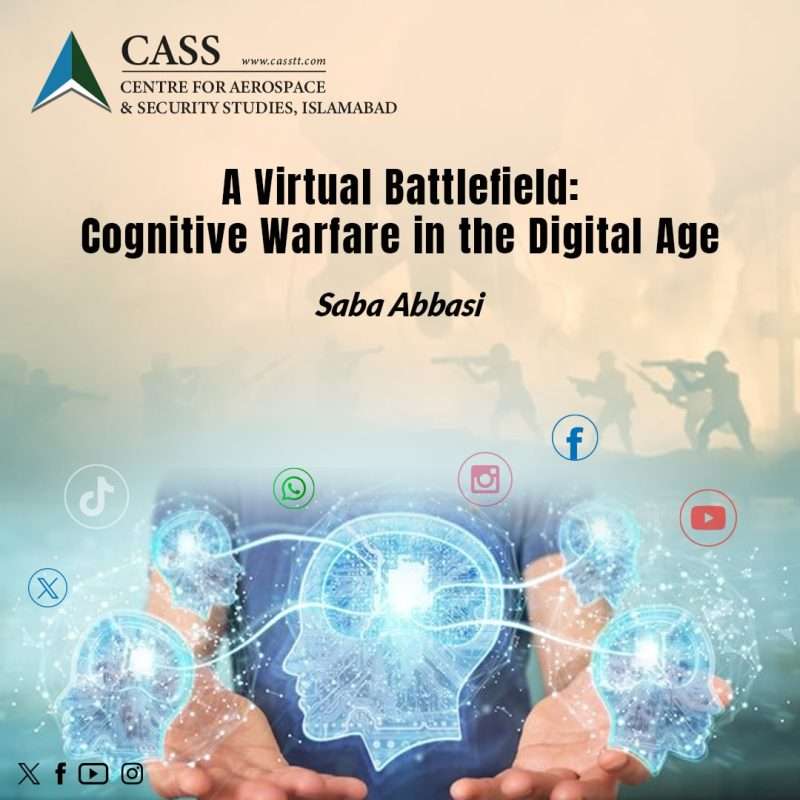
Cognitive warfare is a non-kinetic form of conflict that seeks to shape or disrupt an individual’s mental state and behaviour. Historically, such strategies targeted decision-makers, aiming to deceive and manipulate them within military and political arenas. In contemporary contexts, the scope of cognitive warfare has expanded beyond decision-makers to encompass the general public, largely through digital platforms. These platforms, using features like algorithms, viral content, and engagement trends, serve as powerful tools for psychological influence. Combined with technology-driven tactics, they amplify the impact on public perception, shaping opinions and attitudes at scale. Hence, one of the many aspects of cognitive warfare is psychological operations. Platforms such as Instagram or TikTok are highly effective for these operations because of their vast public reach.
During the recent Israel-Palestine conflict, digital platforms played a major role in raising global awareness about the atrocities faced by the Palestinian people. Through images, videos, live streams, and interactive content, the suffering of Palestinians was brought to the forefront, sensitising a large portion of the global audience. This digital exposure achieved two key outcomes: widespread condemnation and a growing economic boycott of Israel. On one hand, it informed and mobilised people to speak out against the violence and accuse Israel of genocide. On the other, it fuelled international support for a boycott of Israeli products. At the same time, Israel also engaged in psychological operations, disseminating fake news, engaging in trolling, harassment, and deep fakes, in efforts to discredit and diminish the Palestinian narrative.
Narratives such as ‘oppressed becomes the oppressor’ disseminated through reels, tweets, posts etc. shaped how people interpreted Israel’s war crimes. Compelling parallels were drawn between the past abuses of Nazi Germany and the cruelties of Israel. Despite having the most advanced military technology and enormous resources, online polls placed Israel on the wrong side of history.
The Israel-Palestine conflict shows that cognitive warfare tactics can consist of contrasting aspects – manipulation and awareness. Typically, the term cognitive warfare is understood as operations aimed at misleading and deceiving masses. However, this conflict indicates that psychological operations and influence campaigns can be used to aware and educate the public.
The use of generative AI to portray subconscious or covert narratives is increasingly central to understanding cognitive operations in today’s technology-driven digital world. A recent example involved an AI-generated video featuring US President Donald Trump and Elon Musk, broadcast via a cyber-attack on Department of Housing and Urban Development televisions. The video quickly went viral, sparking widespread debate, as it satirically portrayed the power dynamic between the two figures. It irked some and amused others. However, it met the goal for which it was disseminated: generating a socially divisive debate. The incident underscored that harmless, satirical AI-generated content can affect perceptions and frame situations in a particular light. In the longer run, such content may also erode public trust in visual evidence and create or reinforce biases leading to pervasive confusion and scepticism.
The 2018 ‘U.S. Army in Multi-Domain Operations’ document mentions cognitive warfare as a critical area and emphasises ‘outmanoeuvring an adversary cognitively’. China’s ‘Three Warfares’ doctrine also includes public opinion warfare and psychological warfare as its main tenets. Ironically, despite cognitive domain becoming a key area in the military strategy of two superpowers, there is no dedicated, comprehensive treaty that explicitly governs this field.
Efforts to establish a legal framework faces challenges, particularly around the issue of digital sovereignty. A central question is whether virtual space should be considered part of a state’s territory and therefore be subject to its laws? Moreover, should international law take precedence over national legislation, or be subordinate to it? Furthermore, development of technologies such as AI, data science, and quantum computing, are outpacing legal absorptive capacity. The inability of existing international frameworks to keep up with technological developments is enabling states to exploit ambiguities in the interpretation of international laws, using them to safeguard and advance their national interest.
Cognitive war waged, overtly or covertly, through digital mediums by state or non-state actors can not only alter perceptions but also compromise social cohesion. This necessitates multi-pronged measures, including legal frameworks, cross-governmental information-sharing capabilities, and technically advanced monitoring systems that send timely alerts to decision-makers. Furthermore, public literacy and awareness to question presented information must also be cultivated at a grassroots level. Promoting education, open dialogue and developing fact-checking initiatives can help strengthen society’s psychological resilience against cognitive warfare.
Saba Abbasi is a Research Assistant at the Centre for Aerospace & Security Studies (CASS), Islamabad, Pakistan. She can be reached at [email protected].



