Has the Indian leadership worked out the magnitude of damage that would be wrought on India’s economy if it were to initiate a war with Pakistan?
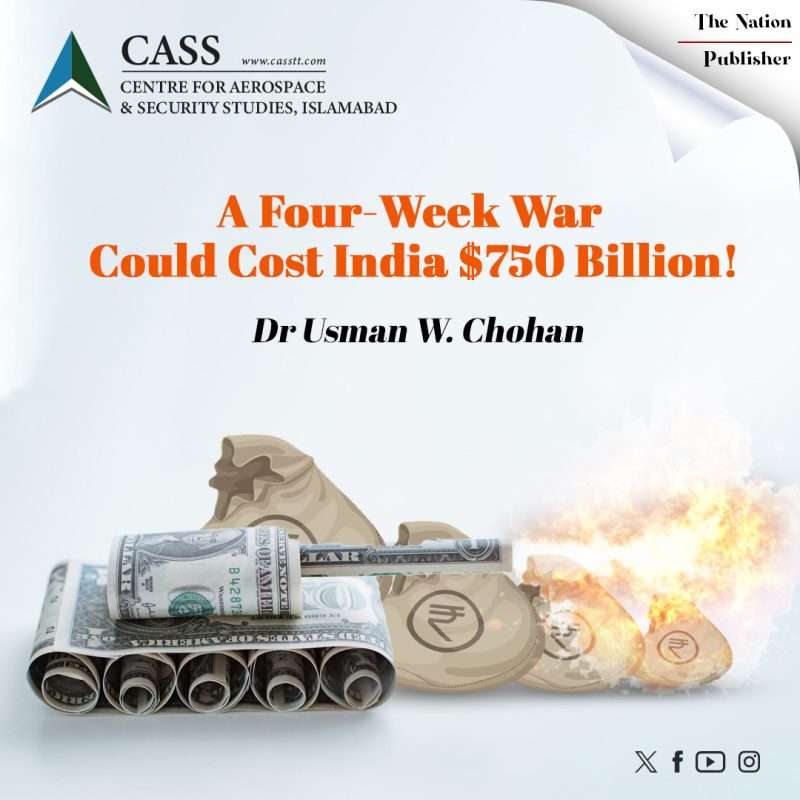
A macroeconomic analysis by the Centre for Aerospace & Security Studies (CASS) indicates that a four-week conventional war would incur USD 750 billion in economic losses to India — three-fourths of a trillion dollars in just four weeks. This analysis echoes the findings of a previous study made during the height of the 2019 India-Pakistan standoff, which found that India’s losses over such a period would have exceeded half a trillion dollars — USD 500 billion at a minimum back then. This would not be a trifling sum by any means for an economy that had not reached even 3 trillion US dollars at that time and which is now approaching USD 4.2 trillion. With the exception of the COVID-19 Pandemic that was very poorly handled by the Indian government, India’s economy has grown larger, and so too have its economic stakes in the event of a confrontation with any neighbour.
The multifactor macroeconomic model used in both studies (2025 post-Pahalgam and 2019 post-Pulwama) assessed aggregate output categories of consumption, government spending (civilian and military), investment, and foreign receipts, with key subcategories within each factor calculated and then normalised on a monthly basis. It was cautioned in 2019 that, if the damage were to approach anywhere near this mark, India would have faced a GDP decline of nearly 20 per cent, and a similar proportion today as well. This is an amount seldom seen in recent history, except in the cases of catastrophic economic dissolution as experienced in Argentina (2001) and Greece (2011) during peacetime, and Iraq (2003) and Libya (2011) in wartime. Even countries hit by the worst of COVID-19 would not countenance such destruction.
The greater number of roughly USD 750 billion today (3/4 of a trillion dollars) should not be surprising when seen in light of the nature of tallying the damage of war. A costing exercise of this sort is not merely a question of cheques issued by a government as war spending, but rather an estimation of the catastrophe arising from disrupted or destroyed human lives, military hardware, property, projects, markets, savings, morale, psychology, and any semblance of sanity in society.
At a time when India is aiming to draw greater investment from around the world, and negotiating tariffs, how would the course of fixed capital and financial investment proceed in the midst of a full-blown conventional war with a neighbour? How would economic activity maintain the semblance of normalcy? The damage to retail activity, to FDI, infrastructure projects, to internal and external commerce would be incomparably worse than even the darkest periods of South Asian history. This does not even begin to touch the ultimate fear — that of a very limited nuclear exchange, since the loss in that instance would be near-incalculable and long-term.
As we had noted previously, citing a 2019 example of how quickly losses are incurred in modern warfare, the reckless employment of the Indian Air force in operations when the Pakistan Air Force shot down two Indian fighters and a fratricide helicopter downed resulted in a loss of over USD 100 million in less than ten minutes of air action. As such, the ultimate figure in the study helps to frame India’s risks and stakes as a deterrent to further violence and conflict. As India’s economy has grown, so too has the glass house in which it sits. The dividends of India’s GDP growth on paper have gone almost exclusively to the top 5% of their society, with the bottom 51% majority holding barely 3 per cent of all economic assets. India has 1.2 billion poor people, and barely 2 million high income individuals, and the thin stratum of ‘middle class’ is calculated at an income of just USD 10 per day.
It is those teeming masses who would suffer the most as the Indian establishment works its people into a war frenzy that would cause devastation at the levels we have modelled out, if not worse. Yet the Indian jingoism of its ‘Billionaire Raj’ elite is fanning a hysteria after Pahalgam on their media that would annihilate their economic futures. They are threatening the water security of the region and playing fast and loose with longstanding water agreements that help address the requirements of nearly one billion people in the northern section of the subcontinent.
As it stands, India does not enjoy stable relations of trust with any of its neighbours, but as with the previous study, the updated calculation bolsters the very same claim: that peace must prevail in South Asia, for without it, the region cannot realise its full economic potential — certainly not while its largest member, India, repeatedly absolves itself of its responsibilities to its people, to its neighbours, and to the world at large.
Cooler heads must prevail, and India must dispassionately examine the consequences of three generations of militarised occupation of Jammu and Kashmir for its own future. With 1.5 million military and paramilitary personnel to tyrannize the Kashmiri people, and only to find the Kashmiris still mustering resistance to Indian atrocities, the futility of Indian policies requires a sober revision to move beyond imbroglios. Operation Swift Retort is a firm reminder of India’s failures and follies. The Indian leadership must be mindful of this and urge for peace and confidence-building, with mutual economic prosperity in mind. That is the only way through which the economic potential of the region can be redeemed and assured in the future.
Dr Usman W. Chohan is Advisor (Economic Affairs and National Development) at the Centre for Aerospace & Security Studies, Islamabad, Pakistan. The article was first published in The Nation. He can be reached at [email protected].