
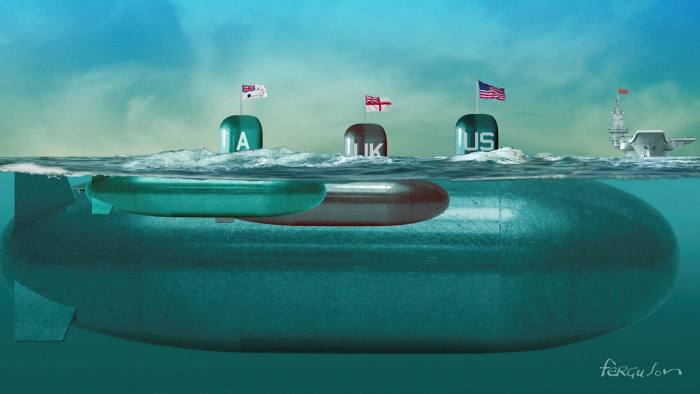
The recent Australia, United Kingdom and United States (AUKUS) announcement about the provision of nuclear-powered submarines by the US and UK to Australia through a build and design project has set a new norm in international relations, power politics and nuclear proliferation. The resultant cancellation of a 2016 deal for the provision of French submarines to Australia has caused a diplomatic crisis between the US, Australia and France as the development will have far-reaching implications in the ongoing power struggle and evolving geopolitical environment. If not handled well, this will create a long-term wedge between the US and France as well as other European nations. While the US and UK are the obvious beneficiaries, France will bear a huge financial setback. Additionally, many other nations will also benefit or bear the negative effects of this development.
Historically, there has always been competition for sale of defence equipment and countries use their political clout to clinch a deal. However, forcing a deal through cancellation of an earlier concluded deal, especially of a friendly country, is unprecedented. France, a leading member of the European Union (EU) and part of NATO is outraged at the AUKUS decision. Demonstrating its unhappiness, it has recalled its ambassadors from the US and Australia. The entire episode suggests deep fissures between the EU and the US as well as US and its EU NATO members.
The provision of SSNs to Australia is aimed at countering the Chinese naval presence in the Asia-Pacific. It is, however, surprising that the US did not provide this technology to India, another Quad member, which promotes herself as pivotal in US’ China containment policy. The most probable reason could be a lack of American trust in Indian capability, especially when viewed in the backdrop of the diminished Indian role in Afghanistan, her military’s performance in Galwan as well as against Pakistan in 2019 and handling of the COVID-19 pandemic. It is also possible that the US and UK trusted Australia more as all three have the same origin.
The AUKUS deal is unique since it is the first time a non-nuclear state is being provided with nuclear-powered submarines. The only other example that comes close is when the US provided this sensitive technology to the UK in 1958. However, at that time, the nuclear control regimes were not as effective. The deal, thus, supports horizontal proliferation by setting a new norm.
While China has strongly criticised the deal, India seems happy as it provides her with an opportunity to exploit French discontent with the US. India, for a very long time, has been endeavouring to acquire advanced nuclear power technology, which in the past was denied by both the US as well as France. After this development, India will now actively endeavour to persuade France for the transfer of technology as it would help the latter recover her financial loss as well as showcase her independence in making decisions.
In case India succeeds in persuading France to obtain such technology, the balance of power will shift in the South Asian region prompting an arms race. This will also make New Delhi more belligerent towards its smaller neighbours, creating a security situation between rival nuclear states. The French government, however, is in a dilemma. If they sell these submarines to India, they are strengthening Quad and if they don’t sell, they incur financial loss.
India, despite being a non-signatory to the Treaty on the Non-Proliferation of Nuclear Weapons (NPT), was supported by the US for inclusion in the Nuclear Suppliers Group (NSG).
In its China containment policy, the US seems to be unconcerned about nuclear proliferation. It first signed a strategic partnership with India and helped its entry into the NSG. Owing to US support, many Indian nuclear facilities continue to remain outside the International Atomic Energy Agency’s (IAEA) watch, helping it to continuously increase weapons-grade fissile material. During the last few months, there have been at least three reported cases of unauthorised possession, transportation and sale of fissile material in India, without attracting much criticism from the international community, including the US.
This trend does not bode well for the nuclear non-proliferation regime and if remains unchecked; many other nations would aspire to acquire similar technologies and capabilities. It is about time that the US rethink its policies, and its reliance on Indian military and intelligence. The Indian military has repeatedly performed poorly in the past even against smaller neighbours, therefore, it cannot be counted as a counterweight to China. While the US has highly sophisticated electronic intelligence and surveillance systems, it relies to a great extent on India for human intelligence. Afghanistan is a good example where Indian intelligence, assessments about the Ashraf Ghani government and role crumbled like a house of cards. The US would be wise to revisit its policies and avoid reliance on India and stop investing in its failures. Otherwise, in the long term this will hurt the entire globe and the US will be no exception, rather, reliance on India will hurt the US the most.
The author is a retired Air Marshal of the PAF who served as Pakistan’s Air Adviser at New Delhi from 2002-2006, presently working as Director Strategic Defense and Security at Centre for Aerospace & Security Studies, Islamabad, Pakistan. This article was first published in The Nation. He can be reached at [email protected]
Image Source: Rachman, G. (2021, September 20). Why Aukus is welcome in the Indo-Pacific. Financial Times. https://www.ft.com/content/cac4b3b0-faec-4648-a49d-8dbcd96eac02.



