
Pinata - Dr Usman- Article thematic Image - January 2023 copy 2

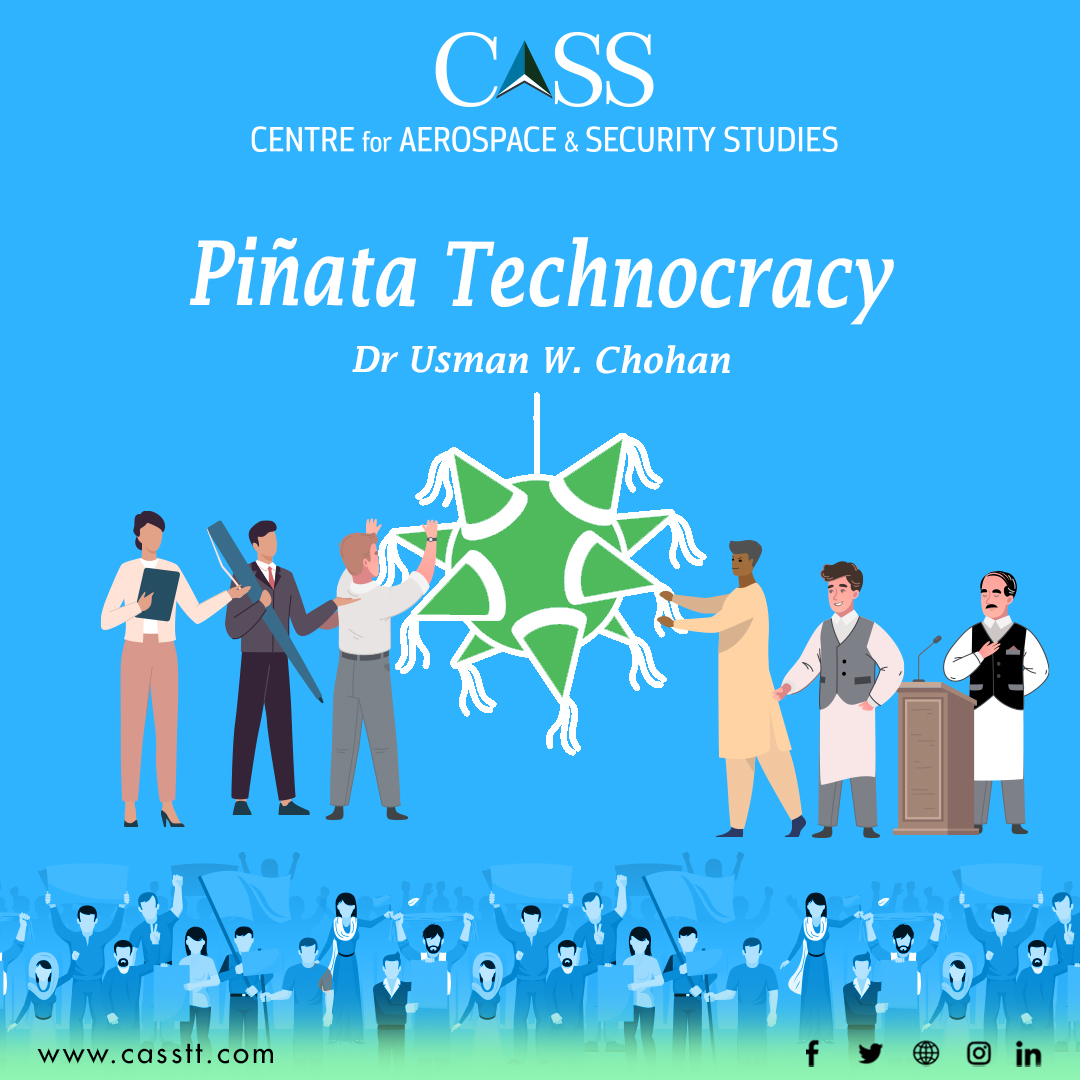
For centuries, the children of Mexico have played with a candy-filled toy at birthday parties known as a piñata. The piñata is a large, animal-shaped stuffed toy that is hung from trees, with the idea that children will pick up large sticks and beat the piñata to a pulp, letting all the sweets pop out from inside. Parents enjoy using piñatas to distract children, letting the kids focus their violent energies on the stuffed toy and keep the childrens’ mob-energies at bay during the party.

It is with the same Mexican fiesta mindset that the political chatter now raises the specter of a “technocratic government,” which is to come in (unelected), and take all the “hard decisions” that need to be taken, so that the current setup does not need to take any electoral blowback or public backlash for those tough policy choices. In other words, the current setup would, like Mexican parents at a fiesta, put up the technocratic regime as a large, pink piñata. The public would pick up their sticks, like kids at a fiesta, and bash the piñata for all of the economic hardships it would face. The politicians would, in such a situation, watch gleefully as the so-called “technocrats” are strung up by the mob while attempting to force-feed the public any bitter pills of unpopular reforms.

This is not a reasonable way to manage a society, and the premise of so-called “technocrat” piñatas suffers from two basic flaws. The first is that technocratic governments do not have a sufficiently strong record of performance over the past 75 years. Their reforms are piecemeal at best, and serve a multitude of interests other than the people of Pakistan themselves. There are ideological and perceptual limitations in their actions, which are a subject of the places where they have been trained, and whose tagline they follow. Although the word “technocrat” sounds like some progressive, futuristic techno-buzz, Pakistan’s technocrats are often old enough to have seen Noah’s ark in action, and their (sometimes octogenarian) advanced age reflects outmoded “technocracy.”As such, there is little solace in the word “technocrat” as we approach the second quarter of the 21st century, while these old goofs of IMF props were witness to 2100 B.C. and have come time and time again under various governments with little to show for it.

The second problem is that, like the Mexican fiesta-parents who want the kids distracted, the politicians want to keep the public’s ire off their backs. This scapegoating is both silly and undemocratic. If politicians cannot take hard decisions and see them to implementation in the national interest, then they aren’t “leaders” worthy of the name. In that case, they simply shouldn’t lead. Good leadership requires mobilizing the people towards common goals and persuading them to sacrifice in the immediate term for a greater good. In the Art of War, this is the first of the traits mentioned in the evaluation of the leader: the Moral Law. If politicians cannot muster such leadership, and intend to put gerontocratic stuffed-animals at the helm, then why should they vie for power?

The solution, therefore, is not to place piñatas to begin with. A government that reflects the will of the people must come and serve. By the people, for the people, and persuade the public that difficult choices, if taken, will help the nation to weather the difficult international storm that the world is passing through. Let the organizers at the fiesta know: the case for gerontocrats and kleptocrats are both weak; but the case for democracy, supported by technical expertise and the will of the people, is strong.

Dr. Usman W. Chohan is the Director for Economic Affairs and National Development at the Centre for Aerospace & Security Studies (CASS), Islamabad, Pakistan. He can be reached at [email protected].


Share this article

Facebook
Twitter
LinkedIn

Recent Publications

Browse through the list of recent publications.

The Cover-up: IAF Narrative of the May 2025 Air Battle

Even after one year since the India-Pakistan May war of 2025, the Indian discourse regarding Operation Sindoor remains uncertain under its pretence of restraint. The Pahalgam attack on 22 April, which killed 26 people, triggered an escalatory spiral. New Delhi quickly accused Pakistan-linked elements, while Islamabad refuted the allegation and demanded an independent investigation. On 7 May, India launched attacks deep inside Pakistan under what it later termed as Operation Sindoor. The political motive was intended to turn the crisis into coercive signalling by shifting the blame onto the enemy and projecting a sense of military superiority.
This episode, however, began to fray immediately as war seldom follows the intended script. Within minutes PAF shot down 7 IAF aircraft including 4 Rafales. On 8 May, Reuters reported that at least two Indian aircraft were shot down by a Pakistani J-10C, while the local government sources reported other aircraft crashes in Indian-occupied Jammu and Kashmir

Read More »

Why the IAF’s Post-Sindoor Spending Surge is a Sign of Panic

After Operation Sindoor, India is spending billions of dollars on new weapons. This is being taken by many people as an indication of military prowess. It is not. This rush to procure weapons is in fact an acknowledgement that the Air Force in India had failed to do what it was meant to do. The costly jets and missiles that India had purchased over the years failed to yield the promised results.

Sindoor was soon followed by India in sealing the gaps which the operation had exposed. It was reported that Indian Air Force (IAF) is looking to speed up its purchases of more than 7 billion USD. This will involve other Rafale fighter jets with India already ordering 26 more Rafales to the Navy in 2024 at an estimated cost of about 3.9 billion USD. India is also seeking long-range standoff missiles, Israeli loitering munitions and increased drone capabilities. Special financial powers of the Indian military were activated to issue emergency procurement orders. The magnitude and rate of these purchases speak volumes.

Indian media and defence analysts have over the years considered the Rafale as a game changer. When India purchased 36 Rafales aircrafts at an approximate cost of 8.7 billion USD, analysts vowed that the aircraft would provide India with air superiority over Pakistan. Operation Sindoor disproved all those allegations. Indian aircraft did not even fly in Pakistani airspace when the fighting started. India solely depended on standoff weapons that were launched at a safe distance. The air defence system of Pakistan, comprising of the HQ-9 surface-to-air missile system and its own fighters, stood its ground.

Read More »

May 2025: Mosaic Warfare and the Myth of Centralised Air Power

Visualise a modern-day Air Force commander sitting in the operations room, miles away from the combat zone, overseeing every friendly and enemy aircraft and all assets involved in the campaign. In a split second, he can task a fighter, reposition a drone, and authorise a strike. In today’s promising technological era, he does not even need an operations room; a laptop on his desktop will suffice. The situation looks promising as it offers efficiency, precision, and control. The term used for such operational control is ‘centralisation’, which has been made possible with advanced networking, integrating space, cyber, surveillance, artificial intelligence, and seamless communication, enabling a single commander to manage an entire campaign from a single node. Centralised command and control, championed by the Western air forces and then adopted by many others, has thus been seen as a pinnacle of modern military power.
The concept of centralisation, enabled by state-of-the-art networking, may seem promising, but it is nothing more than a myth.

Read More »


