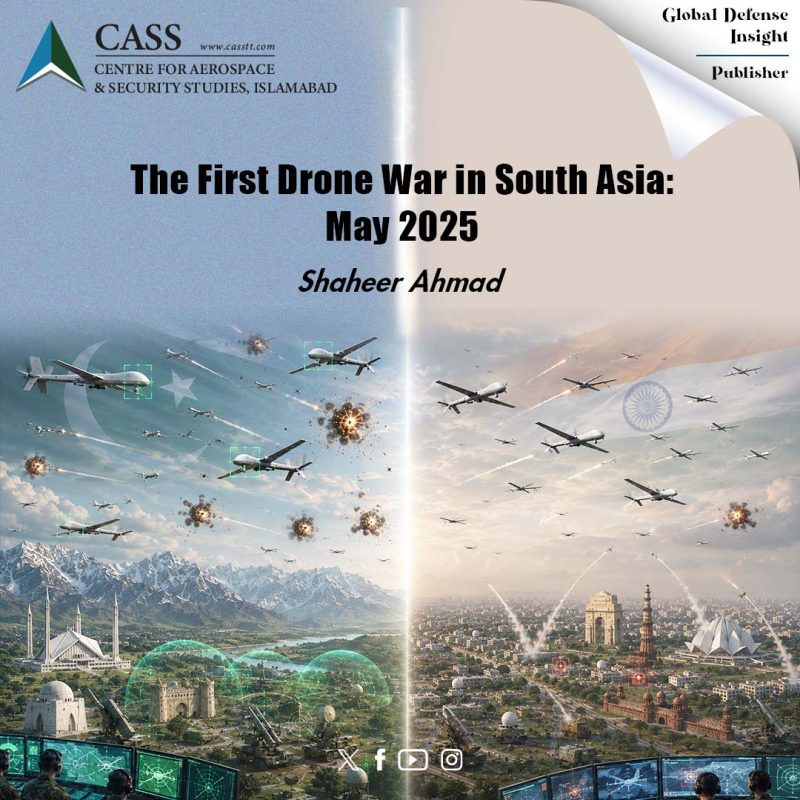
The four-day India-Pakistan conflict saw the emergence of drone warfare as a new strategic reality in the South Asian theatre. Drawing inferences from the Russia-Ukraine war, both sides deployed drones for precision targeting, probing air defences, and performing intelligence, surveillance, and reconnaissance (ISR) tasks. The conflict marked a qualitative escalation where unmanned systems were used for coercive targeting besides their utility for tactical surveillance and reconnaissance.
The loss of 7 top-of-the-line fighter aircraft in the initial phase of battle swiftly ended the Indian Air Force (IAF) bid for air dominance, forcing it to retreat to the rear bases. The loss of control of air created a decision dilemma and operational pause for the Indian leadership, compounded by the absence of a coherent strategic direction.
When the IAF realised that it could not compete with PAF in the air, India shifted to an alternative axis of engagement: unmanned aerial vehicles (UAVs) and standoff weapons. With the IAF out of the operational equation, India launched a tri-phased UAV penetration employing coordinated swarming tactics against Pakistan’s Integrated Air Defence System (IADS). In the initial two days, India launched 78 killer drones, including Israeli-made Harop and Polish-made Warmate-3, across multiple target locations in Punjab and Sindh. The intrusion was aimed at restoring tactical advantage, conducting cross-border ISR, gauging the response of Pakistan’s IADS, and locating the camouflaged early warning radars and surface-to-air missile (SAM) sites.
In response, Pakistan intentionally refrained from engaging drones to conceal signatures and locations of its IADS. Instead, it adopted a mix of hard and soft kill measures to intercept or disable the loitering drones. These included the deployment of decoy radars, waiting for drone exhaustion, and subsequently shooting them down below 3000 feet with Oerlikon anti-aircraft guns operated by the PAF and Pakistan Army. On the soft kill side, it is widely believed that Pakistan deployed its indigenous Spider anti-drone system capable of disrupting flight paths and communication jamming.
India’s failure to accomplish suppression of enemy air defence (SEAD) missions compelled it to amend employment tactics. During the early hours of 10 May, the IAF’s Integrated Air Command and Control System (IACCS) and the Indian Army Air Defence Corps launched another wave of drones inside Pakistani territory. Besides performing SEAD missions, the drones were programmed and launched alongside surface-to-surface missiles (SSM) to hit Pakistani airbases and related military infrastructure.
However, none of the drones succeeded in reaching their designated targets. Pakistan’s IADS rendered the UAV incursions ineffective by jamming, spoofing, and mid-air interceptions. The successful interceptions demonstrated the efficacy of Pakistan’s air defence grid, including its ability to detect low radar cross-section (RCS) targets with surgical precision. These operational failures created pressure in Indian decision-making cycles and exposed Indian operational vulnerabilities.
Pakistan also launched drones against numerous targets inside India in the early hours of 10 May. According to Indian sources, Pakistani drones loitered at 26 locations, along with reports of them being sighted at New Delhi and Gujarat for several hours. Primarily, Pakistan employed Yiha-III and Asisguard Songor drones, which mounted a proportionate and cost-effective response while maintaining the escalation threshold. These drones conducted precision strikes on the Indian airfields, logistics hubs, and related infrastructure.
Besides the military utility, a significant aim of deploying UAVs was to inflict psychological damage on the public morale. Indian planners anticipated that loitering drones with hovering sounds would cause panic among the civilian populations. However, the drones became a source of public amusement and curiosity. Graphics and visuals from digital media showcased civilians intercepting drones with rudimentary air guns along with security forces, and collecting the pieces of wreckage as war trophies. Contrary to the Indian expectations, the Pakistani public demonstrated a unified and resilient national character in times of crisis.
Overall, the drone incursions in the 2025 conflict demonstrated an alternative form of airpower. With less political and operational threshold of action, drones provided a cost-efficient way of precision targeting and ISR without risking the manned platforms. Despite India’s numerical superiority, PAF’s calibrated employment of drones turned out to be a comprehensive success for Pakistan at operational and tactical levels. This also points to the emergence of a new operational reality where drones would serve as a potential weapon of choice for both parties in the tense operational environment.
Shaheer Ahmad is a Research Assistant at the Centre for Aerospace & Security Studies, Islamabad. The article was first published in Global Defence Insight.He can be reached at [email protected]