Humanity’s expedition towards stars is inevitable. According to the organic state theory, states have a tendency to expand and occupy the available space, much like organic beings. Astropolitik has proved the same in the past few decades, as states have started expanding towards the cosmos. It is no longer a triumph, rather a matter of survival for the states. Therefore, the launch of the first Hyperspectral satellite (HS-1) by Pakistan is a leap towards digital sovereignty.
Pakistan launched the “Pak-Sat” in 2004 as a step forward in the regulation of Pakistan’s prospective space program. Taking the mission forward, in 2020, the state decided to minimize its dependence on foreign satellite services and consequently launched Pakistan’s National Space Policy and Space Activities Rules in 2023. Apart from ensuring digital sovereignty, the promotion of local satellite network also projected the financial advantage of around $600-700 million by 2030. Over the years, Pakistan has joined the league of space explorers through the launch of several satellites, including Badr-1, Badr-B, PakSAT-1R, PakSAT-MM1, PakTES-1A, PRSS-1, and PRSC-EOS.
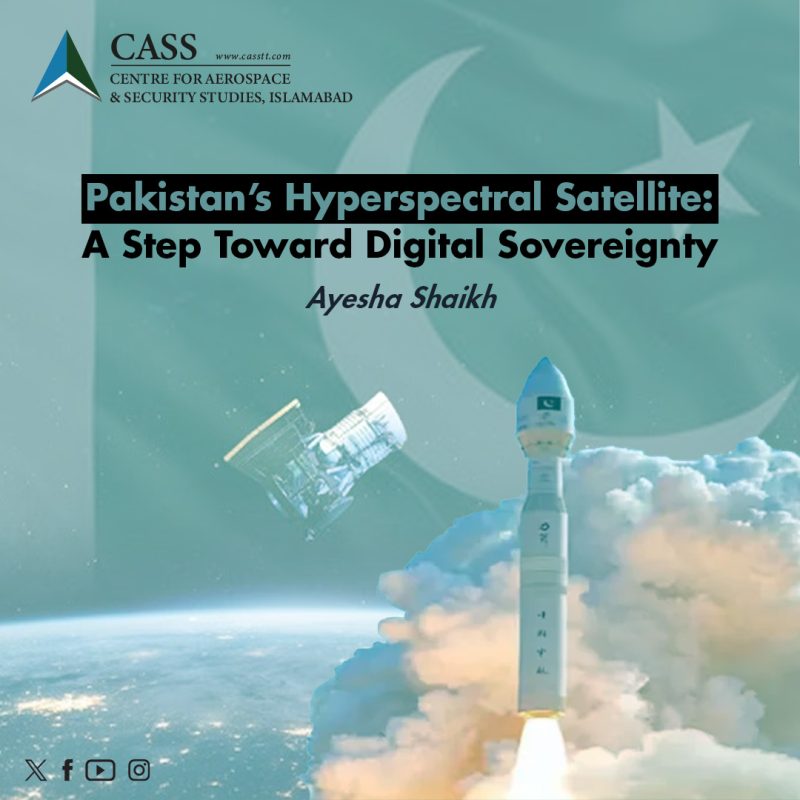
Recently, Pakistan expanded its presence in the cosmos with the launch of its first Hyperspectral Satellite (HS-1) on 19th October 2025, from the Chinese satellite launch centre. This is a key milestone in Pakistan’s drive towards technological sovereignty. Having a hyperspectral capability will minimize the state’s dependence on external imagery.
Hyperspectral Imagery can zoom into narrow spectral bands to provide high-resolution and high-precision data. Different features of our planet engage with light differently. A hyperspectral satellite deals with the energy absorbed, reflected, refracted, or dispersed by the surface of Earth. Unlike the traditional Red, Green, Blue (RGB) coding, it can sense a wider spectrum of light. Thus, it can be used for careful resolution of landscape, geography, water channels, minerals, climate-related phenomena, and strategic energy infrastructure. Especially with an AI-enabled setup, satellite-based sensing can be translated into actionable policy measures.
In this regard, the launch of HS-1 is a major leap. Before the recent launch of HS-1, Pakistan relied on foreign satellite services for 79 per cent of its satellite usage capacity. This initial step can set the ground for the future of the long-term domestic space ecosystem in Pakistan. Expanding the existing resource and installing an AI-integrated ground station can advance the decision-making cycles, in key issue areas, by manifold. It can majorly contribute towards food security, climate preservation, and strategic awareness regarding critical resources and infrastructure.
For instance, Pakistan, as an agricultural state has faced major agricultural losses in the past two decades due to climatic shifts. HS-1 can provide a two-fold application in this regard. It can provide a real-time, high-precision imagery of the agricultural land for optimal usage and efficient assessment. Furthermore, it can also provide exceptional early warning services to protect the crops against climatic shifts.
Another application of the HS satellite is precision farming, with minimal resource intake and maximum yield. It can provide a precise account of available yield and demographic needs, consequently promoting food security by impartial allocation of resources.
Additionally, HS imagery is critical for conservation of biodiversity and preservation of climate. It can optimize climate and disaster resilience. The high-resolution and real-time footage provides precise foresight. It supplements the coordination of the disaster preparedness and emergency response. For instance, the efficiency of recently launched anti-smog guns can be monitored by observing the emission spectrum from the atmosphere, pre- and post-operation.
Finally, the deployment of HS-1 has a strategic dimension as well. It can help the authorities with the evaluation and recalibration of key strategic resources and projects like the China-Pakistan Economic Corridor (CPEC). Similarly, the hyperspectral imagery is also crucial for the search and examination of the rare-earth minerals. Thus, the development can boost the autonomous capacity of Pakistan to explore its rare-earth minerals in the future, aligned with the newly found interest.
Nevertheless, Pakistan is still lagging in the field of AI infrastructure and skilled human resource. While China has been an ironclad supporter and facilitator of Pakistan’s space program, the focus on indigenous development is missing. Moreover, Space imagery and intelligence offer a wide range of applications in various domains, but the system lacks coordination between data providers and policymakers.
AI-integrated data analysis under active human control can convert the data obtained from satellite imagery into precision foresight and tangible policy measures. Thus, Pakistan needs to focus on technological upgradation and capacity building to attain autonomous capability. It should diversify its support base through tech-driven strategic partnerships to minimize dependence on one strategic actor. Moreover, since the hyperspectral satellite contributes to diverse domains, counter-sectoral integration is also required. Finally, the state needs to consider this launch as the beginning and have a forward-looking approach for a domestic space ecosystem in the future.
Space is no longer alien to the political tendencies of nation-states. Pakistan’s space expedition marked a major milestone with the launch of HS-1. With an appropriate strategy and tangible measures in place, Pakistan can capitalize on this opportunity to enhance its digital sovereignty.
The writer is a Research Assistant at the Centre for Aerospace & Security Studies (CASS), Islamabad. The Article was first published by _Eurasia Review_. She can be reached at: [email protected].