
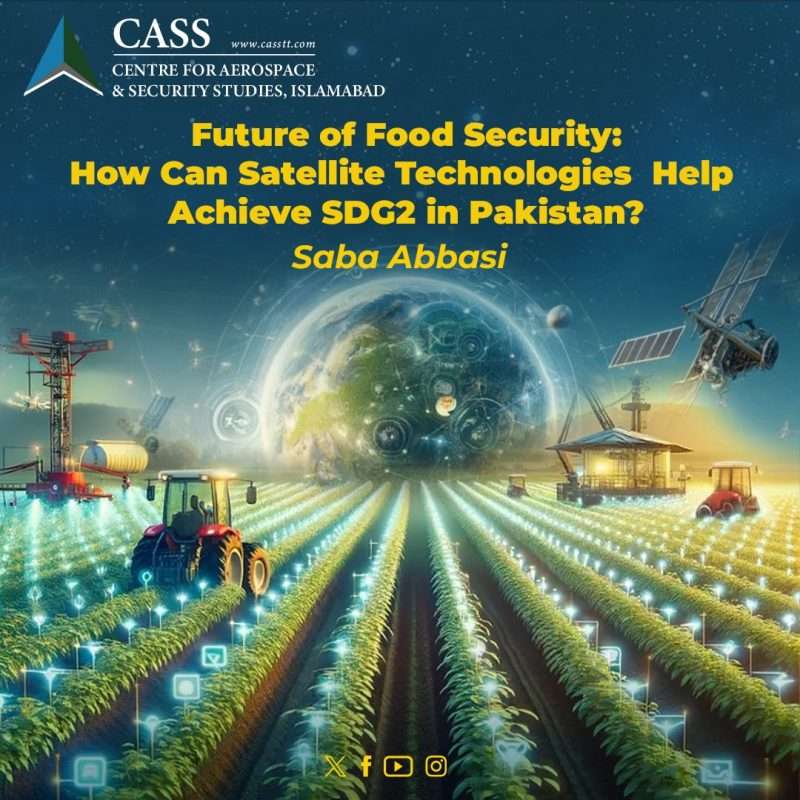
Sustainable Development Goal (SDG) 2 is one of the 17 SDGs of the ‘United Nations 2030 Agenda for Sustainable Development’ that slogans ending hunger, achieving food security, improved nutrition, and promoting sustainable agriculture. Succinctly, this goal is referred to as ‘Zero Hunger’. The goal presupposes all the dimensions of food security, such as physical availability and nutritional utilisation of food, which is directly related to agricultural productivity.
Pakistan’s agricultural sector faces a range of interconnected challenges, including environmental degradation, unsustainable exploitation of non-renewable resources, and the pressures of a rapidly growing population. Addressing these issues aligns with Target 2.6 of SDG 2, which underscores the need for investments in agricultural research and technology to strengthen production capacity.
Among the diverse technologies available to enhance agricultural output, satellite technologies stand out as a particularly promising avenue for investment. These technologies combine the ability to monitor extensive land areas with advanced capabilities such as hyperspectral imaging sensors and LiDAR systems, which offer high spatial and spectral resolutions. This makes them uniquely suited for applications in agriculture, enabling precision monitoring, resource management, weather forecasting and improved crop productivity.
Hyperspectral sensors generate detailed spectral signatures of light reflected by crops and soil, enabling precise detection of a crop’s physical status, biochemical properties, and anomalies. Applications include measuring soil organic content, estimating harvest quality, identifying water stress, and generating early warnings for anomalies, all of which are critical for timely and informed agricultural decision-making.
LiDAR, on the other hand, uses pulsed laser light to calculate distances and produce highly detailed 3D models of land surfaces. These models reveal subtle variations in soil and shifts in elevation, often invisible to the naked eye. By mapping slopes and water sources, LiDAR helps in optimised irrigation and minimises erosion of fertile topsoil. It also plays a vital role in assessing the extent of damage to agricultural land caused by natural disasters, providing critical data for timely interventions. Together, these technologies offer a comprehensive toolkit for addressing challenges and improving agricultural resilience.
The caveat here is that despite the benefits of integrating spectrometry and LiDAR systems into agriculture, the over-ridding problems for Pakistan include limited digital data sets to make predictive models, human resource training, and yes, the cost of development and implementation especially at the grassroots/farm level. Furthermore, international collaborative projects like ‘Agripak’, initiated in 2006 between Airbus and SUPARCO, have contributed to the agriculture sector by facilitating acreage estimation and production forecasting. However, the methodologies and satellite analytics employed in Agripak, as well as in other Earth observation satellites like PRSS-1 and EO-1, lack the ability to capture critical information such as vegetation’s biochemical status or land elevations. These factors are essential for comprehensive crop evaluation, enabling the detection of early signs of desertification, diseases, and water stress – key indicators for proactive agricultural management.
Consequently, it is imperative for Pakistan to look for ways to overcome technological limitations to space-based agricultural technology. To overcome technological constraints, forming collaborative partnerships for the Goals (under SDG 17) with government and private organisations like NASA Harvest, Wyvern and Flyguys could be constructive. On top of that, utilising indigenously developed drones can circumvent the economic limitations attached to using hyper spectral and LiDAR satellites over small farms. Sensor-mounted drones for agricultural monitoring of small land area is more economically viable such as for surveying potential locust swarm sites, while satellite-based imagery provides macro level data to study post-event effects. Hence, both air and space borne sensors can be utilised in a complementary fashion to fulfil the requirement of localised as well as large-scale areas.
The integration of advanced technologies into agriculture is not merely an option but a necessity, as declared in Pakistan’s National Food Security Policy as well. Among its key objectives is the commitment to accelerate the diffusion of technological innovations, a crucial step toward achieving food security. This diffusion must occur on both international and national fronts. Globally, Pakistan can use SDG 17 to develop partnerships that facilitate the transfer of relevant technologies from developed nations. Domestically, strategic coalitions between the government, aerospace hubs, and progressive agriculturists can drive the development and deployment of space-based technologies. By embracing these advancements, Pakistan has the opportunity to modernise its agricultural practices, mitigate vulnerabilities, and solidify its position as a resilient agrarian economy poised to meet the ambitious targets of SDG 2.
Saba Abbasi is a Research Assistant at the Centre for Aerospace & Security Studies (CASS), Islamabad, Pakistan. She can be reached at [email protected].



