
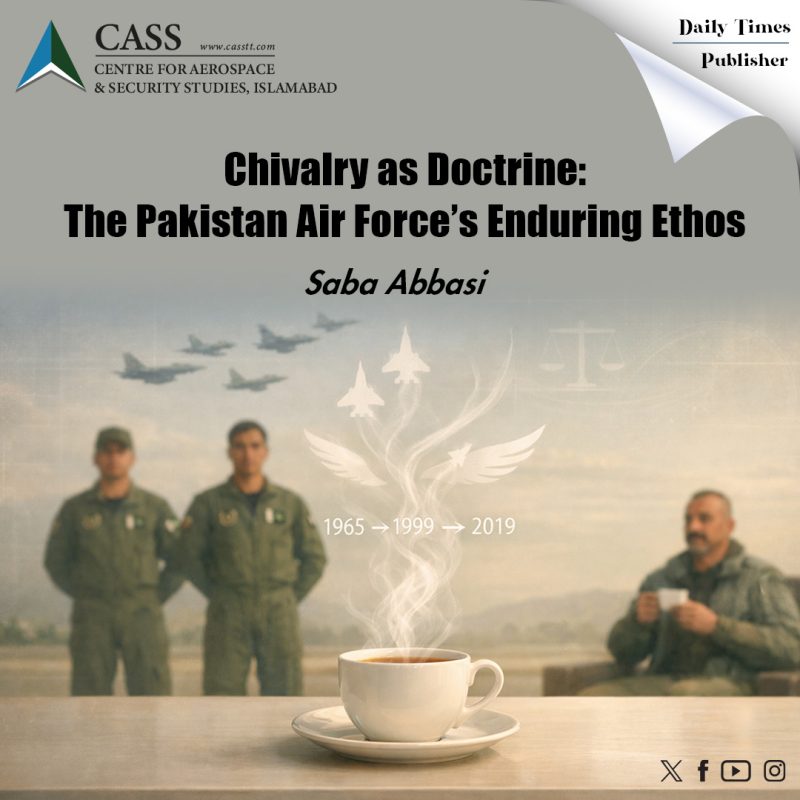
Operation Swift Retort was the first time in decades since 1971 that the air forces of India and Pakistan were pitched against one another. It’s been seven years since the incident, but the memory of a captured Indian fighter pilot sipping tea on national television remains vivid to this day. While the operational details are seldom discussed, the highlight of Operation Swift Retort remains the capture of Wg Cdr Abhinandan Varthaman, an ill-fated Indian Air Force (IAF) pilot, whose MiG-21 was shot down by the Pakistan Air Force (PAF).
After merely four days in captivity, on 1 March 2019, Abhinandan was handed over to Indian authorities at the Wagah border. It is worth recalling that the custodial conduct that he received during his internment symbolised PAF’s chivalry and benevolence, as he was extended due respect as a member of the fighter pilot fraternity and treated as per Geneva conventions. Despite him being an active combatant of an arch-rival’s air force, Pakistani forces demonstrated elevated ethical conduct and adhered to dignified restraint.
However, instead of acknowledging the respect and kindness shown to their pilot, the Indian media, at the behest of their leadership, portrayed the episode according to their typical narrative. By making baseless claims such as Abhinandan being returned only due to the fear of an imminent Indian attack, or Pakistani forces having mentally harassed the Indian pilot in captivity, the Indian media attempted to distort the true facts. In the released video, in which Abhinandan leisurely praised the tea while sipping it, he did not depict the demeanour of someone who was subjected to harassment.
Wg Cdr Abhinandan was not the first pilot captured and then treated with grace and dignity by the PAF. During the Kargil war in 1999, Pakistan forces captured a MiG-27 pilot, Kampampati Nachiketa, who ejected after being shot down by Pakistan’s Man-Portable Air-Defense System (MANPAD). According to the Indian narrative, the pilot was badly beaten up before being handed over to the Red Cross owing to ‘diplomatic pressure.’ The reality of the matter was, in the words of renowned PAF writer Air Cdre Kaiser Tufail, who took Nachiketa’s interview, that he was treated with dignity and in accordance with the International conventions that the Pakistan armed forces strictly abide by.
Air Cdre Tufail also wrote that the IAF pilot went on to answer his queries ‘as if he was sitting in a crew room gossiping with a fellow pilot.’ However, Indian media outlets did not spare the renowned author, dragging him into their propaganda by making false claims about his whereabouts at the time of the crash and labelling his interview with Nachiketa as ‘interrogation.’ Indian social and press media made false allegations about Nachiketa being subjected to physical torture but intentionally skipped mentioning the cakes that Nachiketa received from the PAF personnel for his 27th birthday, which fell during his captivity.
The benevolence of the PAF fighter has not been limited to Indian pilots only. In 1988, a Pakistani F-16 shot down an SU-25, and its Russian pilot was taken as a prisoner of war. The pilot, Rudskoi Alexander, who was also the inspector of SU-25s deployed in Afghanistan, was eventually handed over to the Russian authorities in the span of a few days. However, unlike in India, the Russian media did not exhibit the tendency to present facts in a skewed fashion, and the matter was reported in its true perspective, without any false propaganda. Interestingly, the captured Russian pilot rose to the position of vice president of Russia in 1991.
Another manifestation of PAF’s chivalry is Gnat no. 1083 which ignominiously landed in Pasrur airfield during the 1965 war and is presently displayed at PAF museum, Karachi. The IAF Gnat pilot, Sqn Ldr Brij Pal Singh Sikand, upon his encounter with the PAF’s F-104 promptly lowered his undercarriage in surrender and landed the aircraft intact. The pretext he used for landing was having his radar and compass lost and his cannons jammed. However, on later inspection it was revealed that the guns and equipment of the Gnat worked perfectly, and it was the intimidation of PAF that caused the IAF pilot to land hastily. As is customary, the PAF treated the fear stricken prisoner of war pilot graciously, even though he was dismissed by the IAF while in captivity in Pakistan.
It is clear from the past instances that the PAF embodies the moral codes of chivalry and honour. It has historically followed an unspoken code of professional integrity in which demonstrating dignity for pilots in custody is deemed as a voluntary obligation. The etiquette of combat, exhibiting courage, is just as important for PAF as having courtesy and respect for the pilot from the fraternity. The seventh anniversary of Operation Swift Retort revives memories of not only PAF’s tactical brilliance and strategic restraint, but also its chivalry, decorum, and propriety. This incident underscores that sparing defenceless enemies and treating them with grace are the foundational aspects of the institution.
Saba Abbasi is a Research Assistant at the Centre for Aerospace and Security Studies (CASS), Islamabad, Pakistan. The Article was first published by Daily Times. She can be reached at [email protected]



