
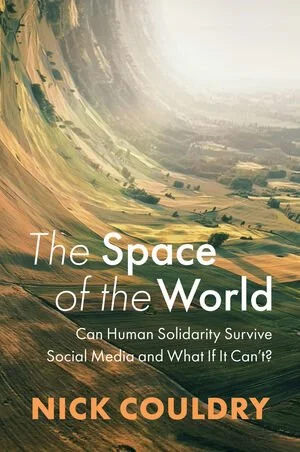
Nick Couldry, The Space of the World: Can Human Solidarity Survive Social Media and What If It Can’t? (New Jersey: Polity Press, 2024).
Reviewed by Shafaq Zernab
Two to three decades ago, humanity committed an enormous mistake. We handed over the design of our social world to business, something we should have never done. Is it too early to rectify this mistake? Nick Couldry who is a professor of Media, Communications and Social Theory at the London School of Economics and Political Science, in his book, The Space of the World, asks the similar question. It is a captivating read and first of the trilogy, Humanising the Future, which suggests a different vision to create our digital spaces.
The book lies at the intersection of media theory, social theory, political philosophy, and contributes to the current discussion regarding the repercussions of social media on democracy, ethics and human solidarity. Positioning himself as a social theorist, Couldry compels us to ponder how social media has shaped the conduct of modern society and politics. Furthermore, the book invites us to envision a future beyond the current profit-seeking social media owned by a handful of Big Tech corporations. His vision of the future is a place where the social media is toxicity-free, that builds solidarity and promotes oneness of the human race.
Across seven chapters, Couldry argues that commercially developed social media platforms, have dominated the exact ‘space of the world’ on which humans socialise and carry out political activities. This digital space is becoming a major platform on which we build our relationships, communicate, debate ideas and organise politically. According to the author the acquisition of the space by Big Tech intentionally cripples our ability to unite and take collective action to ensure the survival of humanity, such as during climate disasters.
Couldry presents three main arguments regarding how these companies have remodelled the digital space and its impacts on our society. First, he posits that as compared to early 1990s when Internet was merely a tool of information sharing, the present-day social media curates the very circumstances under which people live and interact. To reinforce this fact, Couldry observes that the majority of us nowadays lead our lives ‘with social media, through social media, in social media,’ sharing everything from milestones to insignificant details. In short, social media has now become a place where we love, celebrate, grieve, repent, argue and live.
Secondly, Couldry argues that shared social space is warped, as the underlying rationale of Big Tech is user engagement and profit maximisation. This distortion of the social space as the author describes, results in a myriad of socio-political issues such as polarisation, mistrust and formation of attention economy which is weakening democracy and privileging a competitive impulse instead of cooperation, thus making it more difficult for people to accept and acknowledge what unites them. Such obliviousness toward common humanity puts us in jeopardy during climate disasters. Couldry presents multiple accounts from recent history to show how social media breed polarisation. From racist attacks against migrants in Europe to recent caste-base abuse in South East Asia and hate speech against minority Muslims in Myanmar, the author argues that social media has been at the centre stage of all these instances.
In the face of grave existentialist threats, what can be done to counter these tech giants and their impact on undermining humanity? Couldry calls for a radical shift in how Big Tech runs social media platforms in order to facilitate public discourse serving democracy rather than vested interest of few elite businesses.
However, the question is whether such a mammoth project is even feasible or not? With immense commercial potential and cut-throat competition among the Big Tech to capture attention of the users, the following questions come to mind: who will be the first to take moral step to redesign their existing social media platforms, giving up billions of dollars in profits? And what would be the viability and sustainability of such alternatives in the face of mainstream social media platforms that can invest millions to market its products and services?
Couldry reminds us that there are already a number of platforms that are non-profit, do not include advertisements, collect information about users or employ algorithms to make the content more absorbing. One such decentralised platform is Mastodon, where user experience is not dictated by Big Tech but driven by user’s own choice of content and interactions. For that, inherent cultural will of a society should be able to deny the commercially motivated platforms that we have become accustomed to and adopt a paradigmatic shift.
The Space of the World is a provocative work that enhances our understanding of digital spaces. It challenges us to think about what our nearly mindless consumption of social media implies and what a radically new landscape of social media might resemble and how it can be used to create collaboration and empathy. As a result, it is particularly suited for researchers and academics exploring the intersection of emerging technology, and the digital space with how it relates to human psychology. 2025 Gen Z revolts in Asia where the youth, fed up with alleged systemic corruption, turned to social media to overthrow their governments demonstrate the potential. However, the 6 January Storming of the US Capitol is the ultimate illustration of how one social media post from influential figures can trigger political polarisation and extremism.
On the whole, Couldry takes a negative view of social media, pointing at its negative aspects. Such a pessimistic view fails to acknowledge that social media has also been a force of good in the society, such as creating awareness about people living with disabilities, giving voices to marginalized groups of people, and enabling people to demand transparency and accountability in governance. Leaving that criticism aside, the book attempts to change the focus of the discussion from content moderation or dealing with misinformation on the digital platform to a complete redesign of the architecture of social interaction which makes it a new and valuable addition to the current body of literature.
The writer is a Research Assistant at the Centre for Aerospace & Security Studies (CASS), Islamabad. She can be reached at: [email protected].



