Concept Note
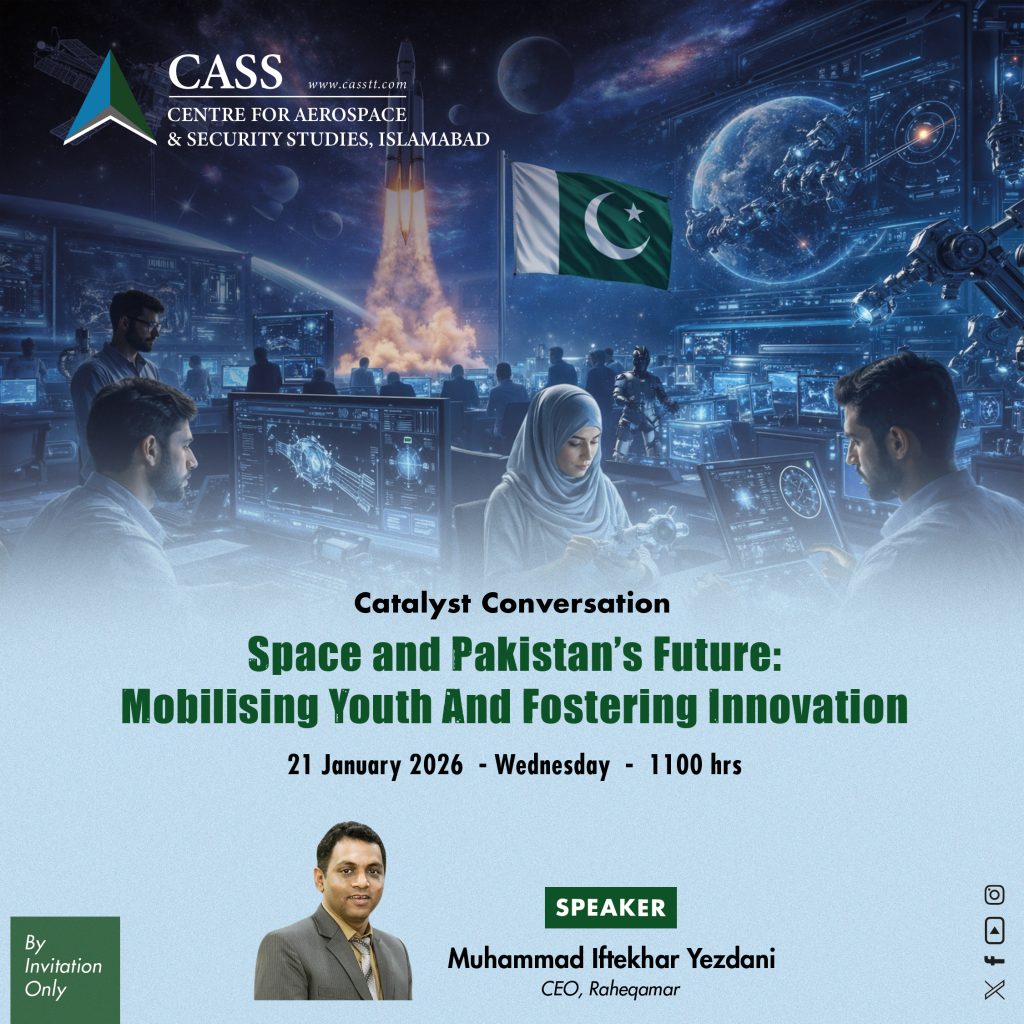
In recent years, outer space has emerged as a critical domain shaping national power, economic competitiveness, and technological sovereignty. Advances in satellite technology, space-based services, and space exploration missions are no longer confined to a handful of major powers; they are increasingly influencing the strategic and developmental trajectories of developing states. For Pakistan, space is increasingly a relevant domain with tangible implications for national development, security, and innovation. Pakistan’s space milestones in 2025, including satellite launches, expanded international cooperation, and announced plans for human spaceflight participation, signal renewed momentum for the national space programme. These developments indicate not only technological progress but also growing opportunities across downstream applications such as communications, navigation, disaster management, agriculture, and data analytics.
Despite these recent advances, public awareness of Pakistan’s space activities, particularly among the youth, remains limited. This gap is significant, as young people constitute a critical national resource for sustaining innovation, building technical capacity, and shaping future leadership in science and technology. Without a foundational understanding of space science, space applications, and emerging career pathways, Pakistan risks underutilising its demographic potential at a time when global competition in advanced technologies is intensifying. A vibrant space ecosystem depends not only on state institutions but also on a well-informed and skilled population. Countries that have successfully expanded their space capabilities have invested heavily in space literacy, academic–industry linkages, and youth engagement through education, research initiatives, and digital outreach. In this context, fostering space awareness is a strategic investment in long-term innovation and economic resilience.
Aim: This Catalyst Conversation, organised by the Centre for Aerospace and Security Studies (CASS), Islamabad, aims to examine the relationship between space development and youth engagement in Pakistan. The discussion will explore how awareness, education, and targeted outreach can translate Pakistan’s recent space achievements into sustained innovation, workforce development, and national capacity-building. It will also consider the role of policy, academia, industry, and digital platforms in shaping a coherent national narrative around space. The session seeks to identify practical pathways for mobilising youth as stakeholders in Pakistan’s evolving space ecosystem. In doing so, it aims to contribute to broader conversations on how space can serve as a catalyst for technological progress, economic opportunity, and national confidence in the decades ahead.
Structure
- Format: One keynote speaker followed by a discussion
- Speaker Duration: 25 minutes
- Discussion Duration: 20 minutes
- Audience: CASS Researchers with fair knowledge about Pakistan’s space programme.
Questions to Address
- How can Pakistan translate recent progress in its space sector into meaningful awareness and engagement among youth?
- What role can education systems, universities, and research institutions play in strengthening space literacy and skills development?
- How can digital platforms and social media be leveraged responsibly to communicate Pakistan’s space achievements and opportunities?
- What policy frameworks and institutional collaborations are needed to align youth development with Pakistan’s long-term space ambitions?
What are the financial implications of running a space industry, and which model should be adopted?