
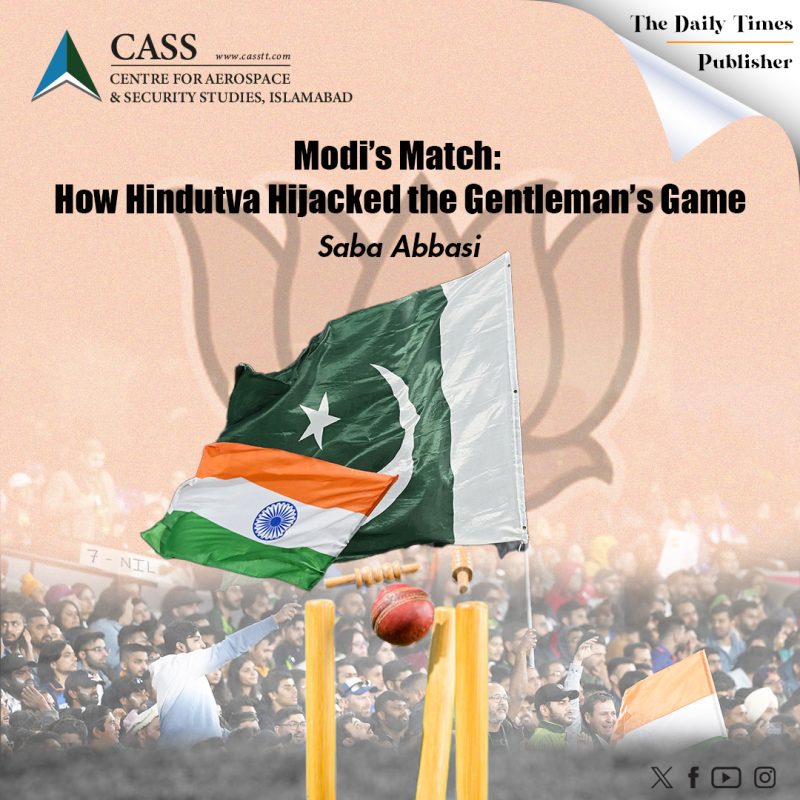
“Operation Sindoor on the games field. Outcome is the same – India Wins.”
These were the words of the Prime Minister of supposedly one of the world’s largest democracies on his X account, reflecting the mindset of the nation-state’s leadership. This statement by Narendra Modi came after the first Pakistan-India cricket match at the Asia Cup, which drew considerable attention due to the Indian team captain’s refusal to shake hands with his Pakistani counterpart. This was not an isolated incident, as similar lapses in professional decorum by the Indian cricket team (both men’s and women’s) were observed in all the succeeding matches during Asia Cup 2025. Furthermore, the Indian team even refused to accept the trophy because it was to be presented by Pakistan’s Interior Minister.
Cricket is known as a gentleman’s game, where sportsmanship and respect are considered as vital as victory itself. Players, even in competition, are expected to display grace, honour, and mutual respect. However, for the Indian leadership, politicising sports and undermining the spirit of sportsmanship seem to have become part of the winning strategy.
In the past, cricket diplomacy has been an integral part of Pakistan and India relationship. It can be traced back to 1987, when General Zia-ul-Haq travelled to India to watch an India-Pakistan match during heightened tensions over Kashmir. Later, despite strained political relations, the Indian team visited Pakistan in 2004. The tour was dubbed as cricket diplomacy, with then President Musharraf praising the Indian team and later attending a cricket match in India himself. Even after the Mumbai attacks, both teams overcame the major setback in political relationship and played again in the ICC World Cup of 2011. Manmohan Singh, then-Prime minister of India, invited his Pakistani counterpart, Yousaf Raza Gilani, to watch the match together. Internationally, their joint attendance was hailed as a symbol of restraint and dialogue through sport.
However, Asia’s cup handshake snub has dealt a blow to cricket diplomacy and signalled a tense moment in the India-Pakistan relationship. The reason is that India’s hardline ideology has seeped into non-military domains like sports, which explains why the handshake episode was not condemned at home. The Indian government remained silent, and many citizens openly applauded the move. The BJP government steps to influence and radicalise masses against Pakistan seem to be successful which now further narrows the prospects of normalisation between the two states.
It is evident that the nature of leadership dictates and reflects a nation’s behaviour. Modi’s Hindutva ideology has started to perpetuate anti-Muslim sentiment, intolerance, and polarisation even in all arenas including sports. The hysteria in India has reached such extremes that protests broke out ahead of the Asia Cup match, and a faction of Indian students even filed a petition claiming that playing against Pakistan was against national interest.
A major reason for this incident is that Hindutva ideology has been badly bruised after the historic 7–nil defeat of the May 2025 Indo-Pak military standoff. The Indian masses, despite their leadership’s elevated rhetoric, have not come to terms with what transpired during those four days of conflict. For Pakistan, 7–nil stands as a remarkable milestone and symbol of national pride, while for India it remains one of the greatest military embarrassments in its history.
The crux of the reason why Indian team did not end things on a professional and an honourable note is that they mirrored their vengeful leadership and were seeking to settle military scores beyond the battlefield. On the other hand, the reality of the matter is that even if Modi continues to feed into India’s collective delusion of Operation Sindoor’s success and equating cricket victories with military successes, the on-ground facts will not change, that is: although the Indian cricket team managed to secure runs, the Indian Air Force could not secure its Rafales.
However, in contrast Pakistan has repeatedly demonstrated maturity and strategic patience in both military and non-military domains. It remains open to dialogue and peaceful resolution of bilateral issues, however constructive engagement requires reciprocity. Until and unless India forgoes its extremist and embittered posture, all channels of diplomacy will continue to suffer. If such patterns continue then the spirit of sportsmanship, once a bridge between the two nations may become another casualty of politics, leaving future opportunities for reconciliation increasingly distant and dim.
Saba Abbasi is a Research Assistant at the Centre for Aerospace & Security Studies (CASS), Islamabad, Pakistan. She can be reached at [email protected]



