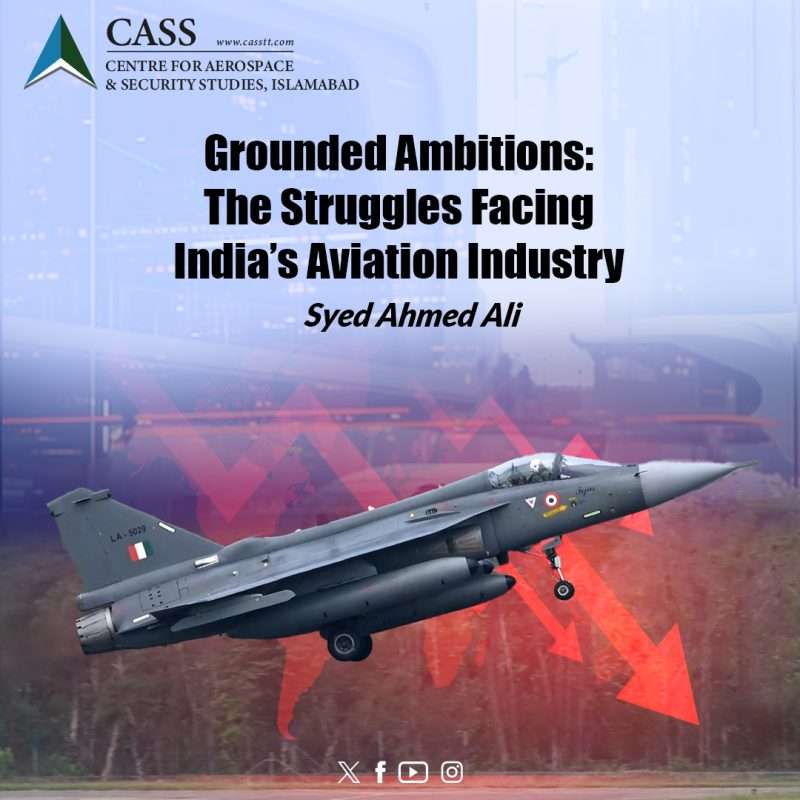
On 7th January, Indian Air Chief Amar Preet Singh addressed the 21st Subroto Mukerjee seminar, asserting that ‘technology delayed is technology denied,’ stressing the urgent need for reforms in India’s aviation industry. This statement reflects mounting concerns over the delayed production of the Light Combat Aircraft (LCA) Tejas, developed by Hindustan Aeronautics Limited (HAL). Against this backdrop, the Air Chief also warned about rapid advancements in Chinese and Pakistani air force capabilities, stressing the urgency for India to enhance its technological and operational readiness.
The Indian aviation industry has a slow pace concerning its indigenisation program which the Indian Prime Minister Narendra Modi calls ‘Atma Nirbharta’ meaning self-reliance. Much to the Indian Air Chief’s frustration the Indian aviation industry has still not met the demand of its first 40 indigenous fighter aircraft. The question then arises as to why the Indian aviation industry faces such a lag in its production of LCA aircraft.
The first issue pertains to production of the aircraft which hinges on delivery of GE-404 engines by a South Korean supplier. Logistical issues have pushed back delivery of the engines, resulting in a slower production of the HAL Tejas. As a result, in 2024-25, HAL will acquire only two to three aircraft as opposed to the planned 16. Apart from these supply chain disruptions, the Indian aircraft faces integration issues, where the Indian Air Force (IAF) plans to incorporate an Israeli radar system to counter Chinese and Pakistani threats. This integration has effectively delayed induction of HAL Tejas Mark 1 A and Mark 2 fighter jets, further complicating production.
India’s extended production timelines and the increasing demand for advanced fighter aircraft have amplified calls for the acquisition of foreign alternatives. The LCA Tejas’s GE engine does not provide the necessary thrust-to-weight ratio limiting its performance. In comparison with foreign aircraft like the recently acquired Dassault Rafale, the LCA has lower payload capacity, operational range, and advanced avionics. In the earlier versions of Tejas, standard features such as the Active Electronically Scanned Array (AESA) radar were not properly integrated. These challenges render the HAL Tejas less appealing to the IAF, which has access to better options in the global market. In response, the Indian aviation industry introduced updated versions, such as the Tejas Mark 1A and Mark 2. However, these upgrades have further delayed production timelines and contributed to the aircraft’s technological obsolescence.
To counter technological gaps, India has initiated its Next-Generation fighter project called ‘Advanced Medium Combat Aircraft (AMCA)’, mutually developed by the Aeronautical Design Agency (ADA) and HAL. The AMCA is envisioned as a 25-tonne twin-engine aircraft that, while not fully stealth, will have low observability through reduced radar cross-section, infrared, and aural signatures. It is planned to be powered by a 90-kilonewton (kN) GE-414 engine, with an ambitious goal of eventually integrating an indigenous 110-kN engine.
The AMCA project is slated for its maiden flight in 2026, with service entry anticipated in the early 2030s. Its objectives are ambitious since progress has been hindered by technical challenges, primarily related to the GE-414 engine. As noted earlier with the LCA Tejas, the GE-414 engine has also faced persistent supply chain disruptions, further complicating the project’s timeline.
Apart from reliability issues of the GE-414 engine, the Indian aviation industry faces budgetary restrictions. The IAF still relies heavily on its aging fleet of Sukhoi 30 MKI and its MiG-29, which require extensive funds for maintenance and upgradation to maintain combat effectiveness. This effectively strains the already scarce resources for the AMCA project which may lead to future delays.
The strategic challenge of modernising and indigenising aircraft is further intensified by the highly competitive environment in which the Indian aviation industry operates, particularly in comparison to China. This underscores the time-sensitive nature of decision-making in the sector, as highlighted by the Indian Air Chief’s observation that R&D efforts lose relevance if deadlines are not met. This is a matter of concern for India, as China is a generation ahead in aviation technology. The unveiling of China’s latest aircraft, the J-36, speculated by Indian media to be a sixth-generation platform, highlights this gap. India’s aviation industry has yet to demonstrate a strong commitment to developing indigenous aircraft, often favouring foreign imports such as the Dassault Rafale as more viable options. Another challenge is integration with its own indigenous platforms, where the incorporation of advanced avionics, such as the Israeli radar causes delays in the production timeline.
The Indian aviation industry is struggling to maintain technological superiority as it faces the need for ‘technological acceleration’. It can navigate this issue through a fully indigenised ‘aircraft’ that has a long, uncertain production timeline, gamble on costly foreign imports that compromise strategic autonomy, or come up with a realistic plan that balances imported technologies with localised innovation. So, the question is, will it rise as a self-reliant force, or remain tethered to external dependencies?
Syed Ahmed Ali is a Research Assistant at the Centre for Aerospace & Security Studies (CASS), in Islamabad, Pakistan. He can be reached at [email protected].