
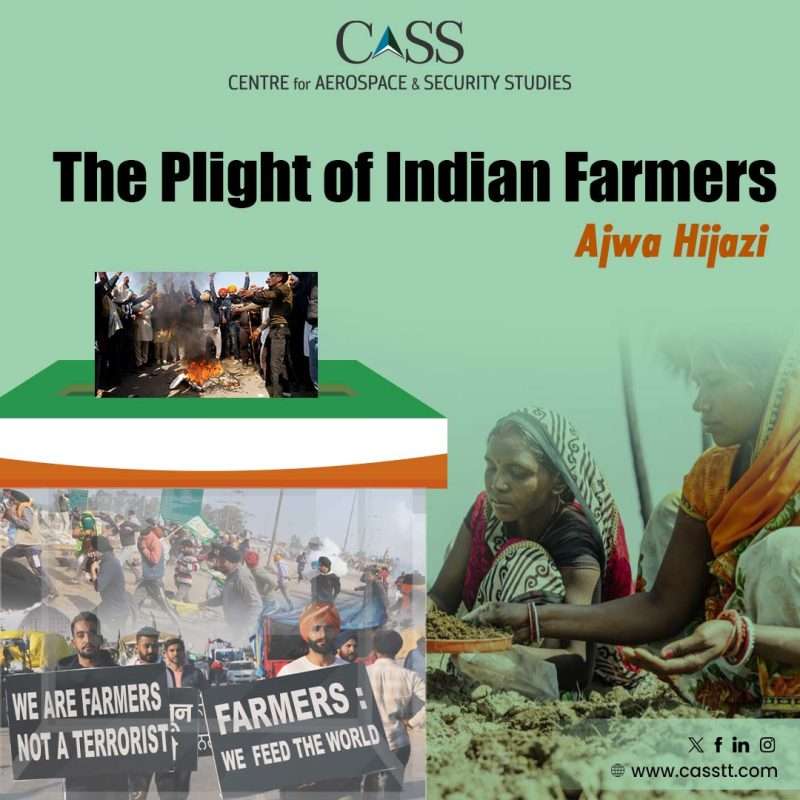
The recent national horizon of Indian politics has significantly been characterised by the farmers’ protests since 13thFebruary. The farmers, hailing mainly from the northern Indian states of Punjab and Haryana, initiated the ‘Delhi Chalo’ movement with their list of demands, in which assured crop prices are at the top. To dilute the effectiveness of the farmers’ march, the Modi government sealed the various entrance points of the capital with barbed wires and cement blocks, banned large public gatherings in the city, and suspended the internet in some districts of Haryana state. The Haryana police used drones to drop thousands of tear gas shells on the tens of thousands of protestors on 13, 14, and 21 February to stop them from marching toward Delhi. The situation intensified when one of the farmers died due to a bullet injury.
Amidst this, four rounds of talks have been held between the farmers’ union leaders and government officials. However, these failed to resolve the deadlock on the key issue of separate legislation regarding guaranteed prices for all crops. On 23rd February, the leaders of the groups organising this protest (Samyukta Kisan Morcha (non-political) and Kisan Mazdoor Morcha) announced to pause their march toward Delhi until 29th February. Till then, they decided to remain at the Punjab and Haryana border.
The current protest is a continuation of the farmers’ 2020-2021 movement. In 2020, farmers initiated a year-long movement of protests against three farm laws passed by the Indian parliament. Those laws diluted the rules related to the farm-produced goods’ sales, pricing, and storage. Indian farmers sell most of their goods in the government-controlled wholesale market at fixed rates, also called the ‘Minimum Support Price’ (MSP). However, the proposed farm laws introduced provisions that allowed farmers to sell their produce to private entities at market prices. A significant concern among farmers was that these laws would enable private stakeholders to have considerable influence over pricing, potentially undermining the MSP system. The MSP system plays a crucial role in ensuring farmers receive a stable income for their produce. Critics argued that the new laws could weaken the position of farmers, making them vulnerable to the whims of market forces and private corporations, thus threatening their livelihoods and financial security. The earlier farmers’ movement received global coverage, where many farmers camped outside the capital during the harsh weather and even in COVID-19 conditions. Following these intense protests that tragically resulted in the loss of approximately 700 lives, the widespread opposition eventually compelled Prime Minister Narendra Modi to repeal the controversial farm laws.
However, in the subsequent years, the government did not meet the demands it had promised to fulfill. These demands included guaranteed crop prices, loan waivers, and an increase in farmers’ income. Due to the government’s failure to adhere to its initial commitments, farmers have declared that they will not return home this time without ensuring these demands are met. Over the years, farmers have contended with unstable income, as crop prices have not kept pace with the escalating costs of inputs, such as fertilizers and seeds.
According to government data, more than 11,000 people belonging to the agriculture sector ended their own lives in 2022 due to rampant poverty and heavy debts. These horrifying statistics depict the necessity for the BJP government to move beyond mere rhetoric and acknowledge the plight of Indian farmers. However, the hollow promises of the Modi regime at the end of the last protest have instilled a trust deficit between the farmers and the state.
Furthermore, these protests have been occurring when India is months away from its general elections, in which Modi’s BJP is expected to win a third consecutive term. The farmers constitute an influential voting block since they comprise two-thirds of India’s 1.4 billion people. BJP’s government faces the challenge of dealing with the angry farmers right before the polls. The government’s posture of suppressing the protestors and not letting them reach the capital does not paint a promising picture of the shining and inclusive India that the BJP claims to have created.
Some analysts believe that the government is preventing protestors from reaching the capital to avoid negative publicity that could challenge the writ of the state. Yet, the measures taken – erecting barbed wires, setting up road blockades, using heavy shelling, deploying water cannons, and the reported firing on farmers – paint a picture of a government in a precarious position, relying on suppression to maintain control.
In its tenth consecutive year of governance, the BJP has successfully countered its political adversaries in elections. However, it has failed to address the grassroots movement that has emerged from its indifference and ongoing disregard for the farmers’ struggles. The persistent farmers’ protests reveal that despite the veneer of Hindutva-infused nationalism and claimed progress, such issues cannot remain obscured indefinitely, even from international scrutiny. The world is watching to see how the Modi administration will address the grievances of the farmers. Its inability to effectively manage this situation could seriously undermine the perceived efficacy of its governance, especially with the Lok Sabha elections on the horizon. This moment could be a critical test of the BJP’s leadership and its commitment to resolving the genuine concerns of its citizens.
Ajwa Hijazi is a Research Assistant at the Centre for Aerospace & Security Studies (CASS), Islamabad, Pakistan. She can be reached at [email protected].



