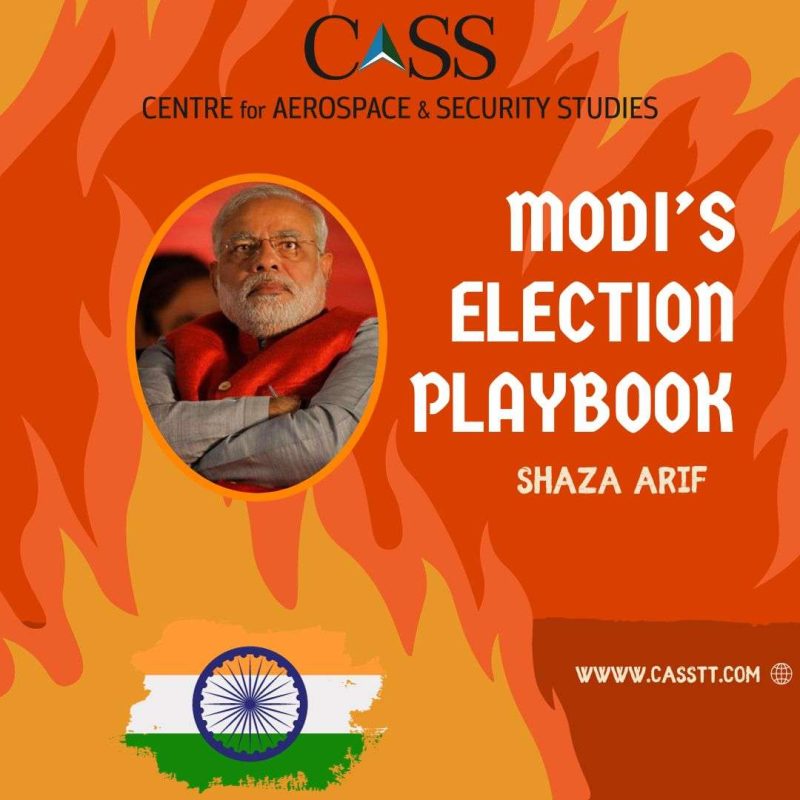
In the evolving theatre of politics, narratives often take centre stage. When skillfully crafted and effectively delivered, they have the potential to manifest profound influence, yielding results that often surpass expectations. In the looming political landscape of India, Prime Minister Narendra Modi has successfully capitalised on the ‘Hindutva’ and ‘anti-Pakistan’ narratives, which have been the linchpin of his previous two election campaigns. These narratives have found remarkable resonance in the Indian populace as manifested by the electoral majority conferred upon him and the domination of the Bharatiya Janata Party (BJP) in the political landscape since its ascendancy to power in 2014. Moreover, Modi has emerged as one of the most popular leaders across India, aggravating the problems of the opposition parties.
As India gears up for the next General Elections in 2024, the Modi regime will flash several badges to attain a third term in office. These include: abrogation of Articles 370 and 35A; harsh treatment of minorities, particularly Muslims and Christians; and an impasse with Pakistan. Likewise, the Modi administration will seek credit for India’s successful lunar mission, Chandrayaan-3. Most recently, India hosted the G20 summit, which is also being hailed by the BJP government as a remarkable diplomatic win, marking India’s international importance. In fact, during this Summit, the BJP even stroked controversy regarding re-naming India as ‘Bharat’ – a moniker revered by Hindu nationalists. However, these might not be enough for Modi to have the landslide victory he aspires to achieve.
Until recently, the ruling party exhibited remarkable confidence in winning not only the upcoming elections but most of future Indian elections as well. However, the on-ground realities present several challenges for the regime. While Narendra Modi is trying to project India as a rising power to the Indian public, a large population lives below the poverty line and faces several social issues. Likewise, while it intends to strengthen ties with other countries, its relations with its immediate neighbours, i.e. China and Pakistan, are at their lowest. Likewise, while the economy is seen as a prime priority, inflation has risen to a 15-month high of 7.44% and does not align with the rosy picture painted by the regime.
Exacerbating the situation are the electoral setbacks BJP suffered in Maharashtra, Himachal Pradesh, and particularly in Karnataka where it lost by a considerable margin. Interestingly, these victories have given more confidence to the opposition to defeat their seemingly unbeatable adversary. Consequently, 26 parties in India have formed a joint opposition to contest the elections against BJP under the banner of ‘Indian National Developmental Inclusive Alliance’ (INDIA), setting the stage for a symbolic ‘Modi vs INDIA’ showdown. The alliance faced an initial leadership issue given the disqualification of Rahul Gandhi. However, the Supreme Court has suspended his conviction, making him eligible for leading the alliance and contesting the upcoming elections. Via seat adjustment, the alliance aims to attain considerable representation to remove Prime Minister Modi from power or at least weaken him to an extent that BJP would be forced to form a coalition government, in which the alliance could balance his influence and curb his unlimited power.
Hence, the present regime may not be satisfied with its existing position and might not be convinced to go into the elections in the prevailing situation. In such a scenario, they may feel the need to revive the ‘anti-Pakistan’ narrative once again to sweep the elections safely. The strategy has historically benefitted the Indian leadership just before the elections, as seen after the Mumbai attacks in 2008, the so-called Uri surgical strike in 2016, and Pulwama. Interestingly, prominent political figures like Satya Pal Malik and Mamata Banerjee have also hinted of the Pulwama attack being a staged act. Resultantly, Modi may be willing to pay a hefty price for his next electoral victory. A similar pre-planned false flag operation may be in the offing right before the elections, most likely in the disputed Jammu & Kashmir region, to boost the political stature of the sitting Prime Minister and solidify his foothold by instilling a wave of nationalism.
Just as the green screens with fancy slogans were spread around Delhi ahead of the G20 Summit to hide the slums of the city and the prevailing poverty of the masses from the international audience, an anti-Pakistan adventure may be orchestrated to hide the inefficiency of the incumbent regime from the voters. In the quest for electoral victory, new ‘normals’ have been institutionalised by Modi regime, particularly with respect to Pakistan. The choice of the Indian voters remains to be seen in a couple of months, nevertheless, the outcome will have a profound impact not only on the immediate political landscape but also on the regional trajectory for years to come.
Shaza Arif is a Research Assistant at the Centre for Aerospace & Security Studies (CASS), Islamabad, Pakistan. The article was first published in The News International. She can be reached at: [email protected].
Design Credit: Mysha Dua Salman