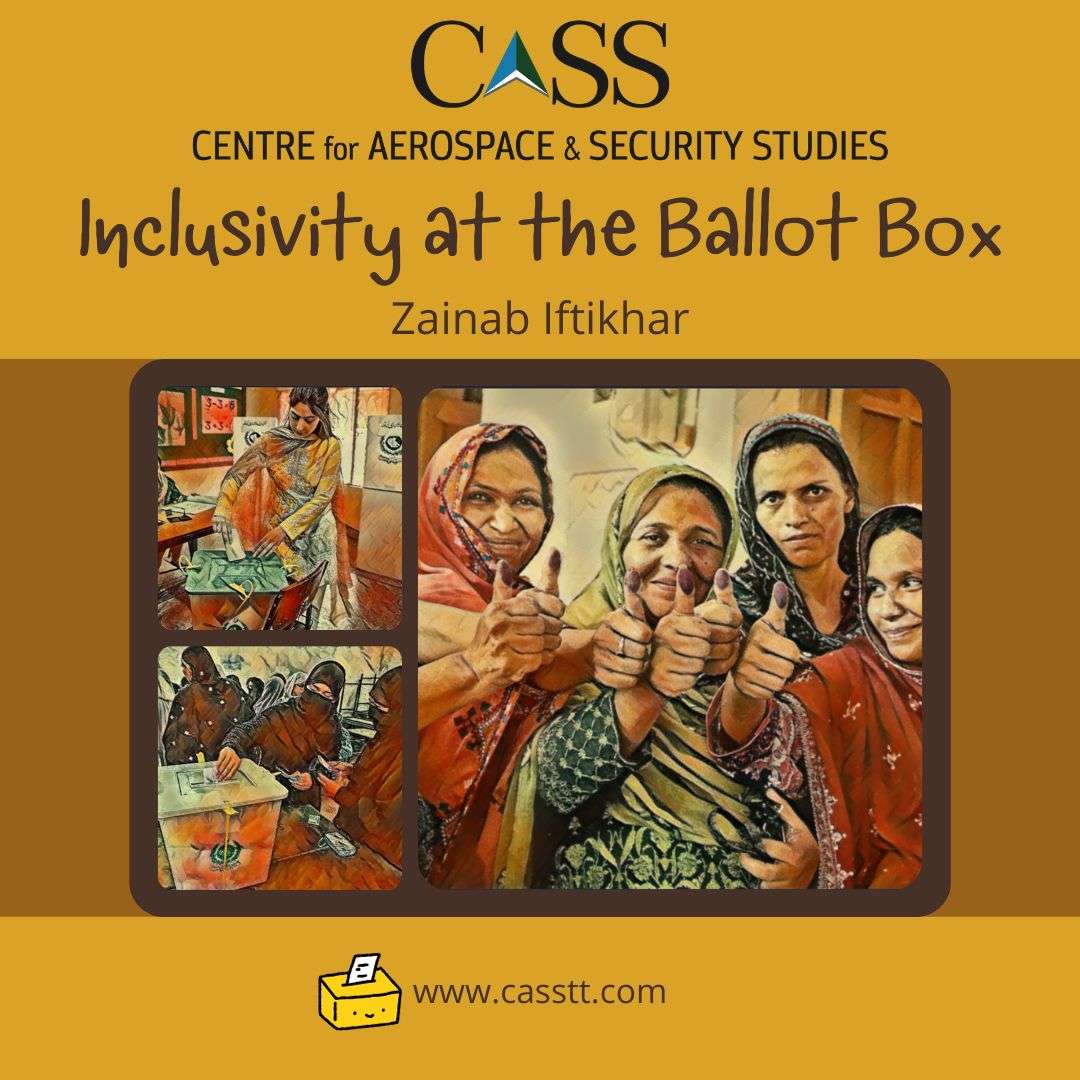
The representation of women in democratic processes is a fundamental aspect of equitable governance and political empowerment. Historically, women’s participation in politics has remained constrained, with their voices marginalised and their voting rights often denied. However, over the past century, there has been significant progress in achieving greater representation for women in the voting booth. This article explores the significance of women’s political participation, the progress made in securing their voting rights, and the continued need for efforts aimed at enhancing their representation in democratic systems, with a targeted focus on Pakistan.
Women’s participation in the political process is not merely a matter of numerical representation, it is a critical factor in the vitality and legitimacy of democratic systems. When women are actively engaged in voting and political activities, they bring diverse perspectives, priorities, and experiences to the forefront of public discourse. This diversity enriches political decision-making, leading to more comprehensive and equitable policies that address the needs and concerns of all citizens.
Pursuant to the Global Gender Gap Index 2023, Pakistan is ranked 142nd out of 146 countries in terms of gender equality. In Pakistan, there is a notably large gender gap in political involvement, which is acknowledged as a crucial element of gender equality. Given the vitality of women’s participation in the political process, it is alarming that it is still compromised in our country despite the fact that the female population is almost equal to the male population.
Several powerful long-term forces embedded in the Pakistani social fabric are unfavourable to female electoral participation. The most prominent ones are illiteracy, limited political awareness, and socio-cultural norms and practices. A USIP survey conducted in Lahore, found that men continue to play a decisive role in buffering women’s access to the voting booth, their individual opinions and adherence to societal standards are significant determinants for women’s turnout in major cities. The results indicated that ‘8.3% of men believe it is inappropriate for women to cast a ballot in a general election and 55% of men believe it is right to bar women in their household from casting a ballot if they vote differently.’ Secondly, the lack of political awareness of women is intertwined with diminished levels of political interest. Women are more willing to vote when they are educated about the political processes in general and the voting process in particular.
However, data recently released by the Election Commission of Pakistan has offered a silver lining as the number of registered women voters has grown from 47 million in 2018 to a remarkable 58 million as of July 25, 2023. The addition of 11.7 million more women’s names to the voter list marks an important breakthrough toward reducing the pervasive gender disparity in voter registration.
Despite the notable progress made, challenges persist in achieving full and equitable representation of women voters. Women, continue to face barriers such as voter suppression, and systemic inequalities that affect their access to the ballot box. Literacy is a key element in increasing female electoral participation and their overall engagement in the political process as this can help them make more informed voting decisions. As per the data of 2022, female literacy in Pakistan stands at 48% and hence necessitates serious improvement.
The government should develop voter education programmes that explain the voting process, candidates’ positions, and the importance of women’s participation in elections. Research analysing a ‘nonpartisan voter education campaign run by two Civil Society Organisations (Aurat-Foundation and SAP-PK) in Lahore before the 2018 elections’ revealed 8% enhanced women turnout.
Moreover, a higher percentage of women in Pakistan’s parliament is essential for achieving gender equality, advancing women’s rights, and improving overall governance. It enriches the legislative process, enhances policy outcomes, and would serve as a beacon of progress toward a more inclusive and equitable society. For instance, Rwanda is often cited as a global leader in women’s political representation. The country’s constitution directs that at least ‘30% of parliamentary seats be reserved for women.’ On ground, this has resulted in women holding ‘more than 60% of the seats in the Rwandan Parliament,’ making it one of the highest female representation in any legislature worldwide. Pakistan ranks 111th in the world in terms of the proportion of women in Parliament as per the data of the Inter-Parliamentary Union.
Conclusively, endeavours to increase women’s participation in voting is not just a pursuit of gender equality, it is an investment in the very essence of democracy. By breaking down barriers that have historically limited women’s political engagement, it is possible to unlock the potential for more inclusive, representative, and responsive governance.
Zainab Iftikhar is a Research Assistant at the Centre for Aerospace and Security Studies (CASS), Islamabad, Pakistan. She can be reached at [email protected]
Design Credit: Mysha Dua Salman