Under normal circumstances, compasses point towards a fixed point geographically situated on the globe called ‘True North’. However, if another magnetic field creates an interference large enough, the compass shows a magnetic north instead. If the compass-holder is unaware of this phenomenon, they may mistake it for ‘True North’. Similarly, the hype around India’s G20 presidency is creating an illusion large enough to overshadow more serious matters. The moral compasses must be recalibrated to correct this deviation, lest it be be mistaken for direction. Even if lies are repeated so often in hopes they become the truth, the onus lies on global leaders to know whom they are doing business with and at what cost.
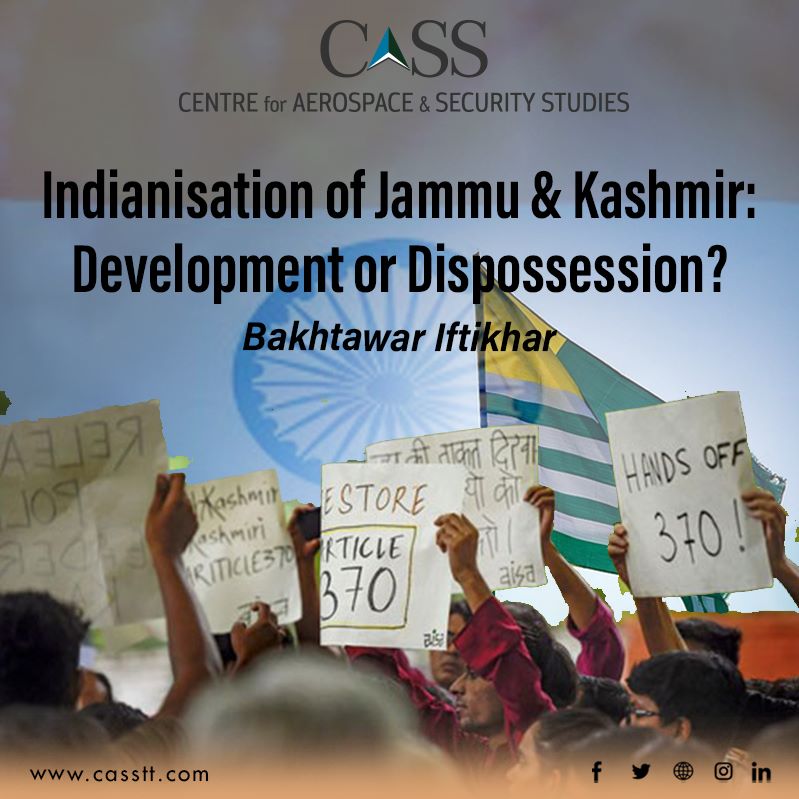
India is propounding its economic prowess with a disingenuous narrative about the disputed region of Jammu & Kashmir. The 3rd Tourism Working Group meeting scheduled on 22-24 May in Srinagar attempts to project so-called normalcy in Indian Illegally Occupied Jammu and Kashmir (IIOJ&K). The theme Vasudhaiva Kutumbakam translates to ‘One Earth, One Family, One Future,’ and the Lotus symbol seemingly represents the seven continents and the seven seas but duplicitously excludes Kashmiris’ plight.
IIOJK is not safe – it is occupied. It is under an onslaught of epic proportions where the region is ironically safe for tourists but not for its own indigenous population. Indian propaganda deliberately suppresses the underlying realities that have driven decades of occupation.
Behind the Fancy Curtain
IIOJK is being Indianised in a number of ways. The beautification of the host city before the Summit is happening at a pace almost as fast as the accelerated dispossession and quashing of resistance. This distraction, driven in part by the Smart City initiative, is also endangering its cultural heritage, with settler-colonial ambitions aggravating the increase in demand for land.
Ever since abrogation of Article 370 and 35A that fractured Jammu & Kashmir, non-locals can be hired for government jobs which were earlier reserved for locals only – a violation of the Fourth Geneva Convention 1949, which explicitly states that ‘the occupying power shall not transfer parts of the civilian population into the territory it occupies’. Not only do the legal changes accommodate settlers, but they do so by removing locals from their homes and refusing to extend leases of local hoteliers. Moreover, when the category of domicile is expanded to include Indian soldiers, oppressors become neighbours.
Under the guise of development, business licenses are callously handed to Indian companies taking livelihoods away from Kashmiris. For example, in December 2019, mining contracts were auctioned online during an Internet blackout in the occupied territory. 70% of the tenders for mineral extraction and all ten mining blocks in Srinagar went to non-local contractors. At the Dubai Expo in 2022, IIOJK was projected as a lucrative ‘Jammu and Kashmir Union Territory’ to attract investment.
The Bharatiya Janata Party (BJP)has even attempted to create a database of unique alpha-numeric codes of Family IDs to identify Kashmiris – which could conveniently be used to tighten surveillance of civilians. All these factors are only part of the chokehold that has tightened over 75 years of occupation. In 2019, 50, 000 military and para-military personnel joined the 700,000 already stationed there, and in January of this year, the Indian Ministry of Home Affairs announced it would deploy 18 more Central Reserve Police Force.
Call for International Action
India must be held accountable, and soon, for the human rights violations and for recruiting a settler class to dispossess indigenous Kashmiris. With IIOJK stripped of its autonomy and deliberate demographic changes, any plebiscite, as required by the earliest UN Resolutions on Kashmir, would be neither fair nor impartial.
So, as suited men walk into big conference rooms to be seated in comfortable chairs for the G20 Summit, the dispossessed Kashmiris will wonder if their plight is on the agenda, if the political, social, and economic perils will be part of the discussions. Would the ‘leaders’ remember the unsettling experiences of COVID-19 lockdowns and realise that IIOJK had known lockdowns before any pandemic ever came? Would it matter that the so-called ‘economic giant’ is projecting normalcy in one of the world’s most militarised regions? Is it fitting for leaders to overlook human rights violations for profit, especially when a fascist regime is tactfully suppressing victims’ voices? Would they recalibrate their moral compass?
Human well-being has often been brushed aside by people in power who think of themselves as ‘practical’ – a grave oversight. However, the world cannot know peace unless international forums and leaders with legitimacy take responsibility for humanitarian causes instead of treating economic development and human well-being as separate pursuits.
As the guardians of global economic progress, G20 leaders bear a solemn responsibility to uphold the values of human dignity and justice. It would be a grave dishonour to turn a blind eye to the unspeakable human rights abuses being perpetrated in occupied Jammu & Kashmir, simply for the sake of commercial gain. Behind the veil of geopolitical expediency lies a forgotten people whose cries for freedom and dignity echo across the mountains and valleys of this beautiful land. Let us not forget the plight of Kashmiris, who have suffered for far too long under the weight of occupation and oppression. It is time for the world to stand up and take notice, and for the leaders of the G20 to rise to the challenge of defending the fundamental rights of all people, regardless of their nationality or religion.
Bakhtawar Iftikhar is a Research Assistant at the Centre for Aerospace & Security Studies (CASS), Islamabad, Pakistan. She can be contacted at: [email protected].