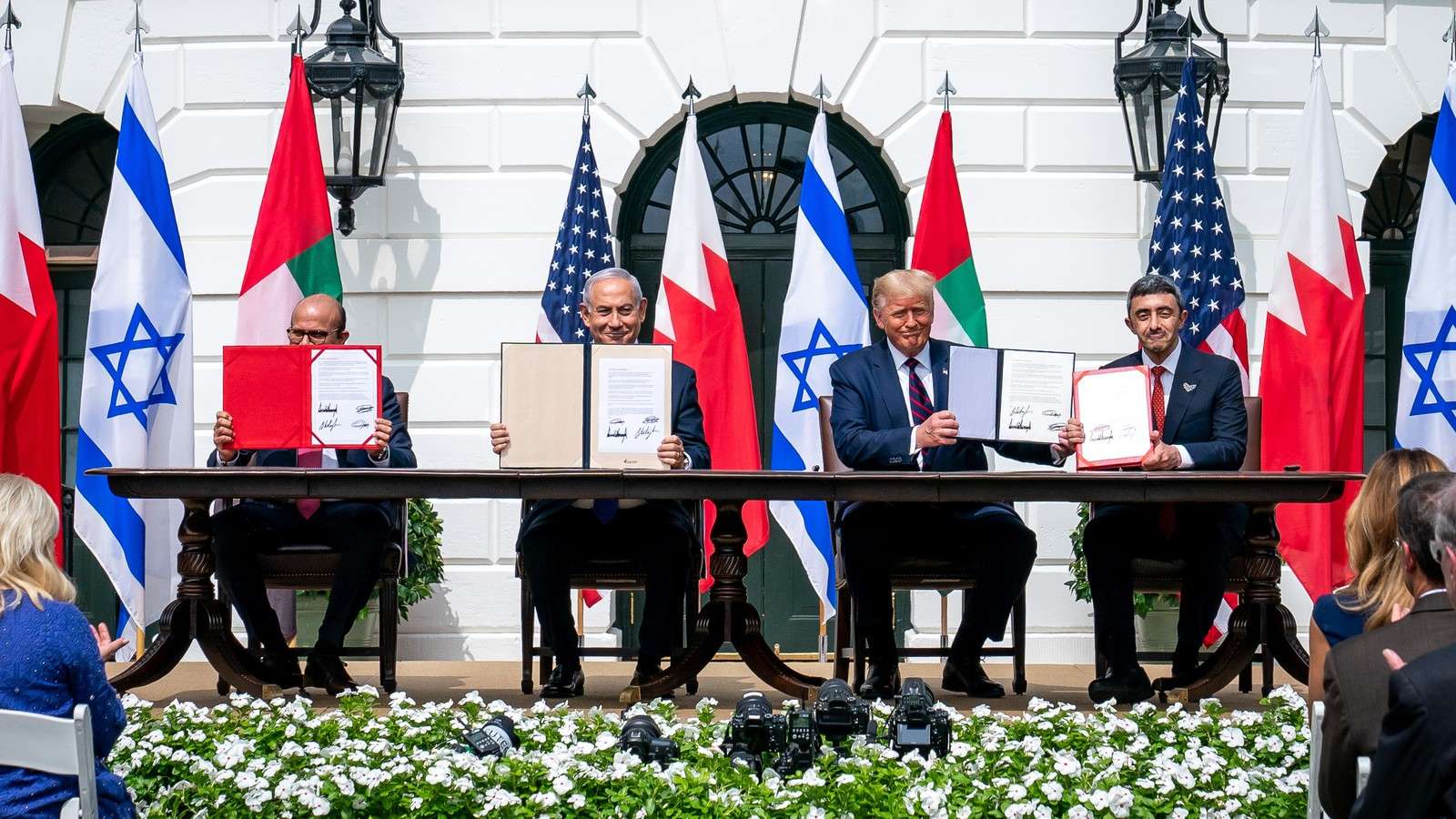
One year has passed since the Abraham Accords were brokered by the United States between United Arab Emirates (UAE), Israel, and Bahrain. This was followed by the addition of Morocco and Sudan shortly afterwards. The Gulf Cooperation Council (GCC) members normally take decisions after consulting with their GCC allies. Signing of Abraham Accords is an example of high-level cohesion where Bahrain, Sudan, Morocco and UAE are aligned to cooperate with Israel purely on transactional basis. The accords were primarily based on the idea of Arab-Israel normalization – a step leading to peace in the Middle East. However, the reality is contrary to the noise made by the initiators in the name of peace. To date, nothing from the lofty promises has been realized because of the Machiavellian nature of Israeli political establishment.
Complex domestic and foreign policy realities of member states manifest the parochial interests and realpolitik of all the stakeholders involved. The rationale behind the recognition of Israel by the UAE was that after decades of animosity with Arab states, Israel has emerged as a strong military, economic and political power in the region with US support. While, some analysts argue that the Accords provide new avenues of economic, strategic and political cooperation for member states, there are those who point out that the Arab-Israeli normalization came at the cost of the Palestinian cause.
It has to be pointed out though that these Accords have opened new economic avenues for member states in diversifying their business – in fields other than oil. Since normalization of ties, the volume of trade between UAE and Israel has grown rapidly to USD 600 million. UAE now eyes increasing this number to USD 1 trillion over the next decade. The World Economic Forum Report 2020 argues that this normalization will also have a positive impact on Gross Domestic Product (GDP) of the Middle East. Furthermore, a dedicated fund has been created called the ‘Abraham Funds’ to promote economic cooperation in the region. This positive trend encourages states aspiring to achieve economic prosperity to normalize their relations with Israel.
The Abraham Accords are not only touted for boosting economic cooperation, but also set the stage for cooperation in strategic areas like Artificial Intelligence, development of anti-drone systems, big data analysis, and acquisition of advanced class Israeli and American weaponry. One of the initial moves following the normalization agreement was a meeting between UAE and Israel’s cyber experts in Tel Aviv where their cyber security chiefs discussed cooperation in the cyber realm. UAE has always looked to Israel as an experienced player in technology and industrial base, wishing they could be as successful in transforming their societies into hubs of innovation. Under the ambit of these Accords, UAE leadership will have more opportunities to transform their society into a hub of innovation and modernize its technology and industrial base.
From the geostrategic point of view, the Accords may serve as a counterforce to Iran. As almost all Arab countries treat Iran as a threat to their interests in the region, therefore finding an anti-Iran ally would be in favor of their political interest. However, with the change in political administration both in the US and Iran, the political aspect of the Accords may have to be revisited as per the needs of the time.
The US, under the Biden administration, is interested in reopening negotiations with Iran. Similarly, the new Iranian president Ebrahim Raisi has signaled his willingness to return to the Joint Comprehensive Plan of Action (JCPOA) agreement to reap economic benefits. Israel, on the other hand, is apprehensive of this move by the US. In a recent meet-up, the Israeli Prime Minister voiced concerns regarding the revival of JCPOA and presented Biden a new strategy to counter Iran. This new strategy is based on strengthening alliances with the Arab countries and carrying covert Israeli attacks on Iranian nuclear facilities. The objective of countering Iran and the mindset of Israeli leadership reiterates the fact that Abraham Accords were a preplanned strategy to secure the vested interests of all stakeholders. The US political establishment reassured its full support to Israel vis-à-vis its efforts for Iran’s containment.
The Abraham Accords, under the cover of peace, have proved more beneficial in improving bilateral relations between UAE and Israel rather than bringing peace and a logical conclusion to the Palestinian issue. The same could be observed in the meeting held during the first week of September 2021 between Israeli and American political leadership as the Palestinian question was absent from their agenda. Keeping in view the above-stated aspects of the Abraham Accords, it is by no means a peace deal, rather a smart transaction in which national interests of the US, Bahrain, UAE, and Israel seem to converge.
This Arab-Israel normalization and growing strategic ties between Arab states, Israel and India are real foreign policy challenges for Pakistan. If Pakistan does not deal with the issue in a pragmatic manner it will be singled out as the Muslim country opposed to the national interest of GCC countries. This is already happening as people of GCC states have started to perceive Pakistanis on their soil as a potential threat. Similarly, the India and Israel alliance has resulted in strengthening of the former’s relationship with the Gulf encouraging them to extend cooperation in geopolitical and geostrategic affairs. So, from Pakistan’s standpoint, this relationship needs to be tackled in a more neutral manner by strengthening its ties with all relevant stakeholders. The prime objective of such a neutral approach is to secure Pakistan’s larger national interest, its national security and image at the international level.
Amna Tauhidi is a researcher at Centre for Aerospace & Security Studies (CASS), Islamabad, Pakistan. She can be reached at [email protected]
Image Source: Kaplan, F. “What the Trump-facilitated “Abraham Accord between Israel and two Arab monarchies really means.” Slate, 15 Sep.https://slate.com/news-and-politics/2020/09/trump-israel-uae-bahrain-deal.html