
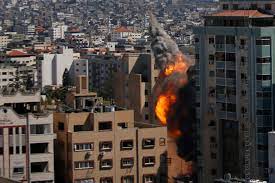
Israel’s atrocities on the Palestinian population reignited this month as Israeli forces carried out aerial strikes over Gaza for 11 consecutive days. The Israeli forces demonstrated the height of insensitivity and irrationality during this period by targeting the Palestinian population, including children, women and elderly, without any discrimination.
While a ceasefire has now been put in place, there are various aspects related to this topic that need to be discussed. These include international law, human rights, religious dimensions, regional alliances, international security and the involvement of major powers. However, more than any of these issues, which although important, are more or less well-known, the sheer indifference of world leaders, especially those of the developed world, is the most concerning and pressing.
It is highly problematic that while citizens in most countries are cognizant of the crimes committed so blatantly by Israeli authorities, majority of the world leaders are silent, save some Muslim countries and their leadership. It is surprising to see that the “civilised” international states have shown lack of concern over such a critical issue. The major powers who claim to be flag-bearers of democracy, champions of human rights and advocates of international law have turned a blind eye to the cruel and vicious Israeli actions. In fact, numerous countries openly took Israel’s side and justified its cruel actions. Some were hesitant to even condemn Israel’s violent tactics.
The pictures of families mourning the death of their loved ones did not wake up world leaders to demand rationale behaviour from Israel. Hundreds of houses have been destroyed and turned into rubble. Approximately 250 people have become victims of Israeli airstrikes. This figure includes 66 children as well. It has been extremely painful to see children screaming and weeping as warplanes fly over their houses. These memories will leave an everlasting trauma on the young minds who are absolutely helpless in front of this aggression.
Ironically, amidst these atrocities, various arms agreements with Israel are still being approved or are in the pipeline. This silence speaks of the double standards of world powers and shows that justice in the international system is selective.
The muted response from international organisations also raises questions about their credibility and bias. The UN Security Council held a meeting with unnecessary delay. The meeting was merely symbolic and did not bear any concrete output or policy guidelines. Likewise, the Organisation of Islamic Council (OIC) failed to generate any consensus over the possible response over Israel’s actions.
What is even more concerning is that not only did most countries remain silent over Israeli oppression, but they also decided to mute those who wanted to speak out against Israel. It has been observed that social media posts and content which condemned Israeli aggression and the plight of the Palestinian was and is constantly being removed from social media platforms, such as Twitter, Facebook and Instagram. Moreover, the content is being labelled as offensive/sensitive in order to forcefully limit its reach.
If the term “rogue state” is analysed, it refers to those states that defy international norms and pose a threat to international peace and security. Scrutinising Israel’s aggression over the Palestinian population, it wouldn’t be wrong to say that its actions are very similar to that of a rogue state. It has disregarded the laws of armed conflicts, human rights, principles of freedom of speech and above all – humanity.
The lack of concern shown by the G-8 countries has made Israel even more confident to continue its belligerent activities and get away with it. It is the years of silence (not just this month) which has allowed the conflict to take the dangerous shape it has taken today. Nobody has been held accountable for these massive crimes against humanity in Palestine. It is the Palestinian children who are paying the biggest price of this silence.
This recent conflict has caused a lot of bloodshed (250 Palestinians dead, including dozens of children, 2000 injured) and is extremely destabilizing for the region. While there is now a ceasefire, it does not imply that the crisis and conflict is over rather it will continue to re-emerge in more dangerous forms. The issue demands some concrete and meaningful actions along with accountability rather than mere statements in order to stop the chaos which has been going on for so many decades.
Shaza Arif is a Researcher at the Centre for Aerospace & Security Studies (CASS). She can be reached at [email protected]
Image Source: Image Source: Alsaafin, Linah. “What is behind Israel’s targeting of prominent buildings in Gaza?”, Al-Jazeera, 19 May 2021, https://www.aljazeera.com/news/2021/5/19/what-is-behind-israels-targeting-of-prominent-buildings-in-gaza



