The war in Ukraine and the resultant rise in global commodity prices sent economic shockwaves worldwide, with the South Asian region being no exception. In this backdrop, a recent report published by the World Bank in April projected a 1.0 percentage point lower growth in South Asia in 2022 compared to the growth estimates that were released in January this year. In particular, Pakistan’s GDP growth has been projected to slow down to 4.3% for FY 2021-22. In light of this, the report underlines that South Asian economies should expedite the shift towards a low-carbon development path to reduce reliance on energy imports and goes on to recommend the greening of taxation to achieve the said goal.
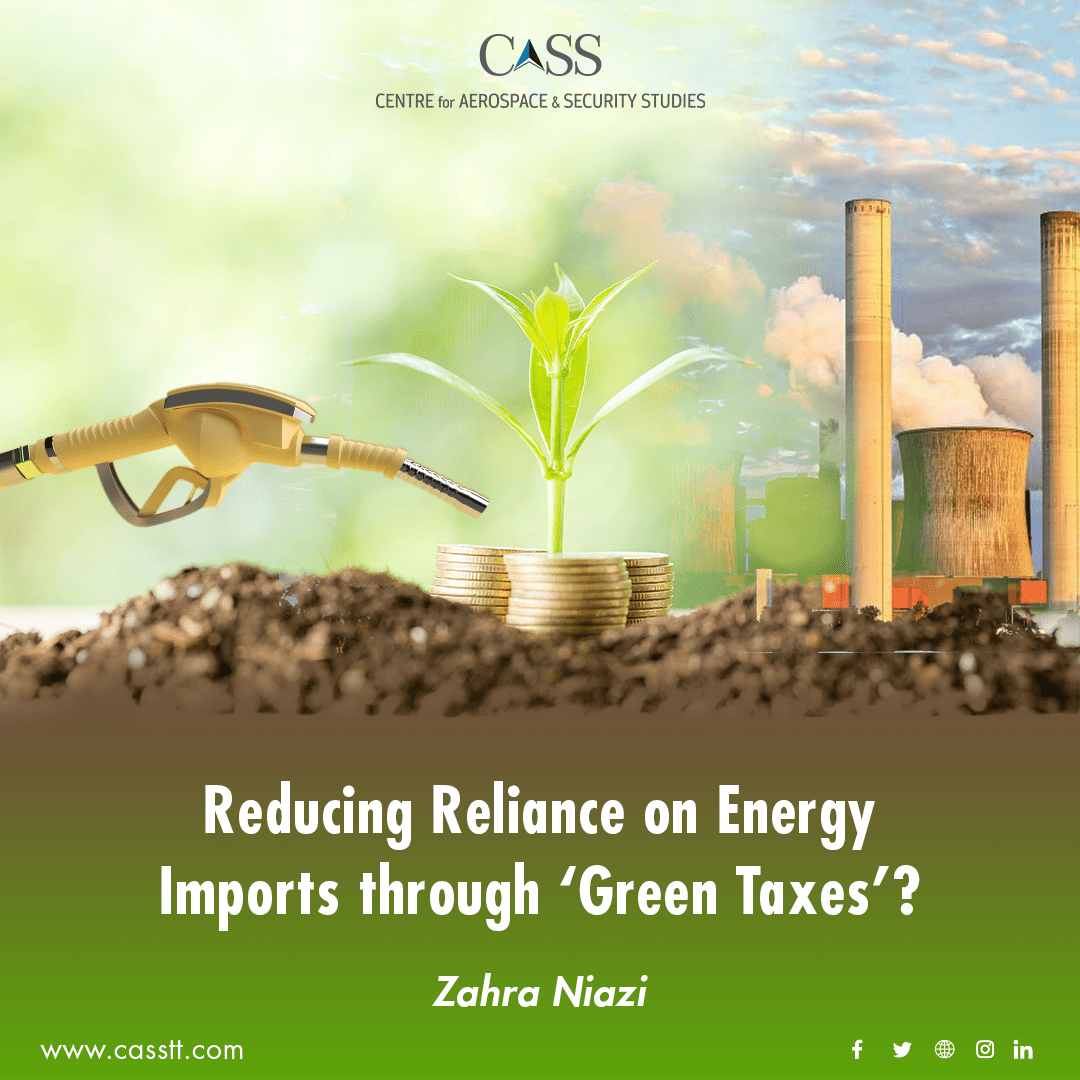
Green taxes, also called environmental taxes, are taxes imposed on environment polluting activities or goods to discourage anti-ecological behaviour. From the perspective of expediting the shift towards a low-carbon development path, green taxes would be levied on carbon-intensive energy products such as petrol, diesel, natural gas, or coal etc.
To an environmentalist, the idea of ‘greening’ taxation may sound like a great idea at first sight. However, its intuitive appeal notwithstanding, it is important to assess ‘whether’ it can be considered a viable policy option for Pakistan, especially to reduce reliance on energy imports, and if not, what are the alternatives.
Introducing a ‘green tax’ on energy may not be as simple as it may seem. In Pakistan, the poor spend around 12% of their incomes on energy alone, and small changes in energy prices can substantially affect their household economy. Expecting the poor (or other low-income households) to switch to renewables remains a far-fetched dream, given the considerable cost of basic technology requirements. Similarly, purchasing a fuel-efficient vehicle is not viable for economically vulnerable or even middle-class households. A hybrid vehicle, by one estimate, is 14% costlier, while for an electric (fuel cell) vehicle, the cost is 140% higher than a conventional one. The same is the case with electric bikes. Additionally, in indirect terms, the adverse effect of taxing energy products on the household economy may come in the form of an increased price on a wide range of goods due to the resultant high cost of production. That said, taxes on carbon-intensive energy sources can potentially intensify the hardships of economically struggling households and leave the less well-off with limited options to switch to low or no carbon alternatives. This can have important implications for poverty and inequality.
Another concern is that the imposition of ‘green taxes’ on industries can negatively influence the ability of trade-exposed and energy-intensive sectors to compete internationally. This can have implications for Pakistan’s trade deficit which has already recorded a rise of 70% during the first nine months of the present fiscal year compared to the same period of 2020-21.
A counter argument could be that the undesired impact of energy taxes on households can be addressed through a compensation scheme (e.g., cash transfers). However, practically, this is problematic. First, the utilisation of energy resources may vary greatly among households within a similar socioeconomic class and a compensation scheme may not be able to account for this variation. Second, it is questionable whether such a scheme would be sufficient to fully compensate for the adverse effect of taxes on the household economy. Third, disbursing payments under a compensation scheme may also be costly and require the establishment of a highly efficient infrastructure. Similarly, one could argue that trade-exposed sectors can be shielded from the adverse effect by being given tax exemptions. However, this is also problematic in practical terms as it can create perceptions of unfairness and potentially lead to domestic opposition from firms that do not qualify for tax exemptions.
This brings us to another fundamental question: what alternative measures need to be taken to expedite the shift toward a low-carbon development path and reduce reliance on energy imports? First, it is necessary that the government mobilise private sector investment in renewables, especially given the fact that it has been struggling to fund large-scale solar and wind power plants. Second, Pakistan needs to capitalise on its mitigation efforts (e.g., Ten Billion Trees Tsunami programme) to obtain soft loans or grants from international financing sources to fund large-scale renewable energy projects. This necessitates the development of a comprehensive resource mobilisation strategy that sets the specified budget costs of varied projects and identifies potential international financing sources. In recent times, the uptake of solar PV systems at the micro-level has been increasing in Pakistan, and the users of rooftop solar panels have also been adding their excess electricity to the grid. To facilitate this further, it is important that the recently applied taxes on solar panels are withdrawn, and the uptake of net-metering connections (a prerequisite to selling the excess produce of electricity to the grid) is facilitated through, for instance, the provision of soft loans or subsidies. Additionally, there are 83 sugar mills in Pakistan—almost all of which have co-generation plants for electricity generation through sugarcane bagasse (bagasse is clean fuel burned in a sugarcane mill). However, to fully exploit the potential of bagasse-based electricity generation, it is important that the government facilitates the installation of high-pressure broilers (through, for instance, the provision of subsidies or soft loans) as a replacement for existing co-generation plants as they remain inefficient.
All in all, the goal of reducing reliance of energy imports has become all the more important today and one that is going to require substantial efforts, both from the public and private sector. However, any solution adopted in this regard can only ideally lead to the desired results if it is practical and realistic. The good news is that such solutions are indeed many and only demand due attention and political will.
Zahra Niazi is a Researcher at the Centre for Aerospace & Security Studies (CASS), Islamabad, Pakistan. She can be reached at [email protected].