
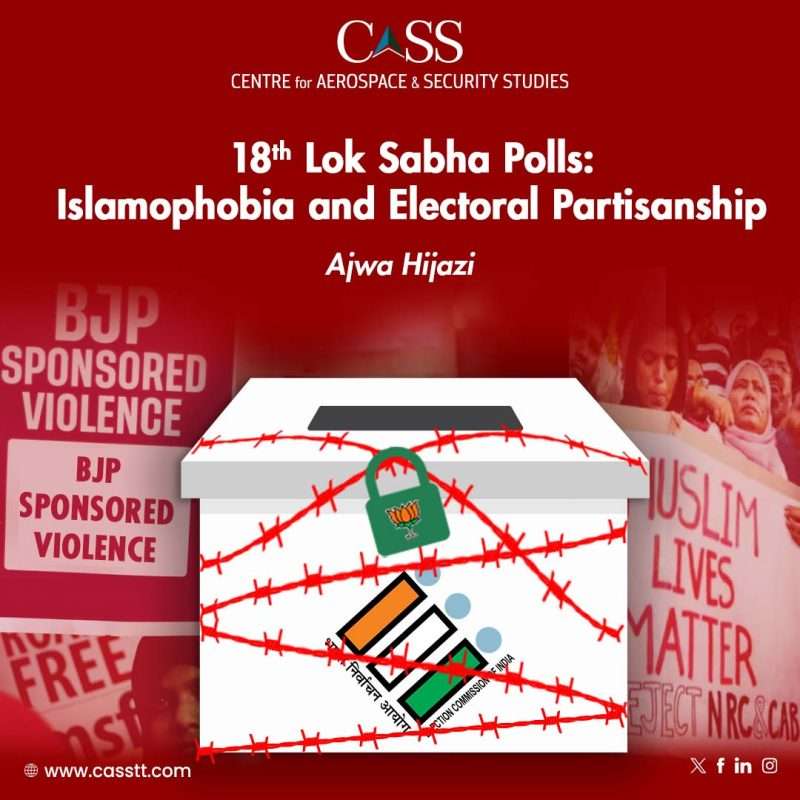
The Indian political horizon is in a frenzy with the ongoing 18th Lok Sabha polls. Voting for the multi-phase elections started on 19th April and will span over six weeks, with results scheduled to be announced on 4th June. This election is primarily between the two main alliances: Narendra Modi’s BJP-led National Democratic Alliance (NDA) and Congress-led 28-party opposition alliance, Indian National Developmental Inclusive Alliance (INDIA). Under BJP leadership, Hindutva-influenced politics have permeated every facet of society, government, and institutions, including the electoral process, over the years. In the ongoing Indian elections, Islamophobia and majoritarian politics have been blatantly mainstreamed. At the forefront of it is the Prime Minister of the country, Narendra Modi, along with his political party.
Narendra Modi and the BJP have positioned themselves as champions of ‘Hindu interests’ in the current election, asserting that to protect these interests effectively means defending them against perceived threats from Muslim communities. This strategy highlights a deliberate polarisation tactic, aiming to consolidate a majoritarian vote base by delineating clear in-group and out-group dynamics. This divisive posture of the ruling party of the country has turned the national elections into a ‘Muslim-hating contest’. This unfortunate reality was vividly manifested during Modi’s campaign trail, in the western Indian state of Rajasthan. While speaking to a public gathering on 21st April, he said that after assuming power, Congress would redistribute Hindu wealth among ‘infiltrators’ and ‘people with more children’, referring to Muslims in a snarky manner. He also claimed that two decades ago, former Indian PM Manmohan Singh, declared that Muslims have first right to their fair share of the country’s resources. However, the Congress party contends that former Prime Minister Manmohan Singh never made such a statement, and their manifesto does not promise wealth redistribution, contrary to claims made by Narendra Modi
In the aftermath of his controversial remarks, he has faced widespread criticism both nationally and internationally for using the office of the Prime Minister to propagate Islamophobic views. Nevertheless, instead of acknowledging the severity of his divisive statements, he reiterated his stance at another rally in Rajasthan just two days later. In his quest to forcefully garner the electoral support of Dalits and the backward sections, he stated that Congress plans to take quotas away from the scheduled caste, tribes, and backward classes and give them to Muslims. Unfortunately, this pattern of using Muslims as electoral rhetoric is not new and has also been used by the other avowed Hindu nationalists of the BJP: Amit Shah and Yogi Adityanath.
Given the Islamophobic undertones prevalent in electoral campaigns, it is crucial to look at the role of the Election Commission of India (ECI) in addressing these issues. According to the Model Code of Conduct (MCC), issued by the ECI, candidates need to refrain from campaigning on communal and religious grounds. While the Commission took notice of the opposition’s complaints against continuous violations of the MCC by the Prime Minister, it issued a notice to the BJP chief J.P. Nadda instead of Modi. Moreover, the notice did not mention Narendra Modi’s name (even though the complaints attached are those filed by the opposition against his malicious Rajasthan speech). Not surprisingly, the BJP chief ignored the notice of the ECI, and reiterated the above-mentioned remarks of Modi (accusing the Congress of appeasing Muslims) in another campaign event.
It is rather interesting that during the ongoing elections, ECI has issued notices concerning MCC violations to various individuals from different parties. However, in each case, the notices were served to the individuals against whom the complaint was filed. The biased posture of ECI against MCC violations by Narendra Modi can be traced to the recent development pertaining to its institutional composition. In December 2023, the BJP passed legislation that changed the composition of the selection committee responsible for appointing the Election Commission’s members. Earlier, the Chief Justice, the PM, and opposition leader were part of the selection committee. However, after the legislation, the Chief Justice was replaced with a Union Minister as a committee member. Hence, the appointment of the recent two election commission members in March 2024 by the selection committee lacked transparency and tilted in favour of the BJP.
Under PM Modi, the BJP has intensified its Islamophobic politics during the election campaign, deepening religious and communal divisions. To bolster their majoritarian agenda with impunity, the ruling party has also compromised the independence of the ECI by imposing their divisive ideals, thereby undermining its autonomy. A partisan election commission is overseeing the elections, in the most populous country of the world, where the ruling party is running an election campaign by targeting the largest minority in the country. The decade of anti-Muslim politics, Islamophobic activities, and fearmongering against Muslims has made Hindutva the defining feature of India. There is a high probability that the BJP may win a consecutive third term. However, the potential cost of this victory would be substantial for India. Such an outcome will compromise the nation’s commitment to inclusivity, erode institutional integrity, and weaken the foundations of its proclaimed secularism. These developments could leave a lasting impact on the sociopolitical landscape of India, challenging the ideals it has long aspired to uphold.
Ajwa Hijazi is a Research Assistant at the Centre for Aerospace & Security Studies (CASS), Islamabad, Pakistan. The article was first published in The News International. She can be reached at [email protected].



