
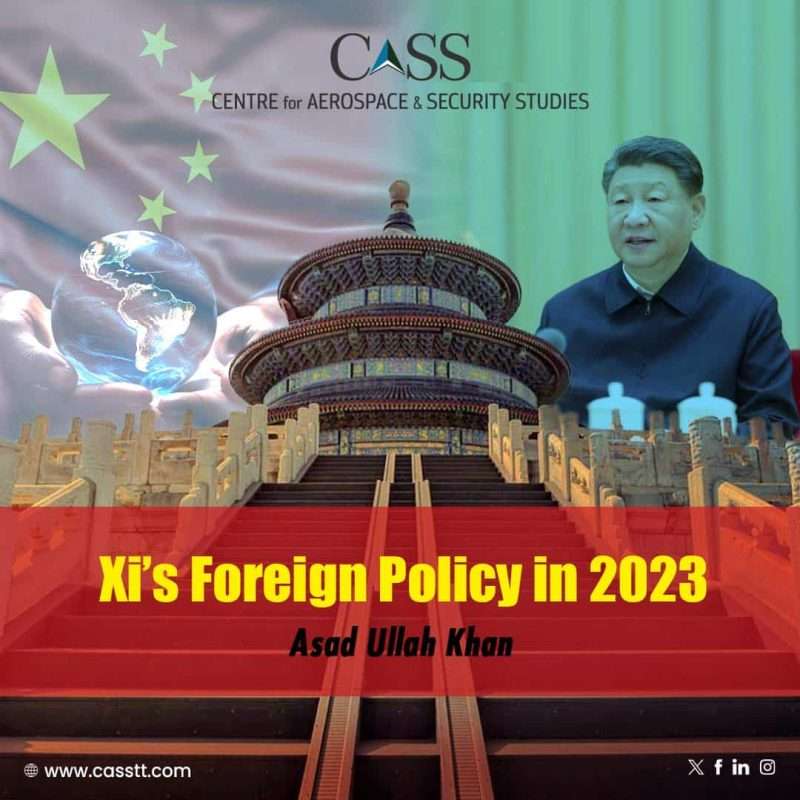
The year 2023 was very happening in terms of Chinese foreign policy as the country’s leadership followed a path of ‘great rejuvenation of the Chinese nation’ and introduced several concept papers on foreign policy initiatives. Late last year, Chinese President Xi Jinping presided over the ‘Central Conference on Work Relating to Foreign Affairs’ on 27-28 December 2023. Several members of the Chinese Communist Party’s Central Committee were also present. The forum carried out a systematic review of the objectives that China aims to achieve while pursuing its foreign policy.
Considering the evolving international dynamics, the current world order is in a state of flux. The Russo-Ukrainian conflict continues to exert profound geopolitical and economic repercussions globally. Likewise, upheavals in the Middle East and escalating tensions in the South China Sea have introduced additional layers of complexity for Chinese policymakers, mirroring challenges faced by governments worldwide. In this context, the increasing competition between the US and China is steering global dynamics towards a significant realignment, especially in Asia. This shift directly influences China’s foreign policy and external interests, reshaping its strategic priorities.
In this broader context, President Xi Jinping highlighted Chinese achievements, particularly strengthening of Chinese foreign policy and the country’s peaceful role in leading major foreign policy initiatives. These initiatives — such as Belt and Road Initiative (BRI), Global Security Initiative and Global Development Initiative — are likely to remain central to Chinese foreign policy in the coming decades. Upholding principles that stress self-reliance to foster global peace, prosperity, and stability, the conference advanced President Xi’s vision of ‘building a community with a shared future for mankind’. The evolution of diplomacy with Chinese characteristics was termed as ‘strategic guidance of head-of-state diplomacy’. While China is committed to prioritising peaceful co-existence within the international system, it also needs to carefully steer through the complexities arising from regional shifts and its interactions with other major powers, notably the US. This is also important because developing countries, especially those in Asia, have also been advocating for enhanced cooperation between Beijing and Washington to ensure peace and security throughout the continent.
Meanwhile, the conference was one of a series of occasions where the Chinese President put special focus on the need to reform the international system to make it more inclusive, fair and diverse without coercion, exclusion or partiality. It is important to understand that in recent years, China has emerged as a major player at the United Nations (UN) in advocating for the issues of developing states. It is now the second largest contributor to the UN’s budget which makes it a key player in any initiative for reforming UN organisations and the global governance system.
Besides external issues, President Xi vowed to strengthen China’s centralised leadership and a unified form of government under the CCP. This is meant to ensure timely decision-making and centralised oversight on the country’s global diplomatic efforts as it projects itself as a ‘responsible major power’ in the international arena.
However, there are potential challenges to these foreign policy initiatives.
While Beijing is expanding its footprints, there is growing uncertainty across the globe with relatively slow economic growth (from 3.4% in 2022 to 2.9% in 2023); debt issues in developing states; and impact of the ongoing conflicts in the Middle East and Europe; pushing regional and developing states to seek peace and stability through cooperation instead of competition. The West also harbours concerns that China aims to expand its influence within the current global order by prioritising trade in its renminbi (RMB) over the dollar, potentially displacing the dollar’s dominance with the RMB. Ironically, despite these apprehensions being viewed as an immediate threat, China has yet to establish military alliances akin to QUAD or AUKUS, revealing certain constraints in its foreign policy. Furthermore, despite initiatives such as the AIIB (Asian Infrastructure Investment Bank) and the SCO (Shanghai Cooperation Organization), China has not managed to overshadow the US-led International Financial Institutions such as the IMF and the World Bank, in steering the global economy.
China’s global ambitions and initiatives are rooted in the novel diplomatic philosophy introduced under Xi Jinping’s leadership, geared towards the rejuvenation of the Chinese nation. However, considering the global challenges outlined earlier, these strategies seem overly ambitious. A more pragmatic approach for China would be to engage in deeper dialogue and understanding of the policies and strategies pursued by Western nations, while also taking into account the uncertain global environment. This approach is likely to be more mutually beneficial and conducive to global stability and prosperity in line with Xi’s vision.
Asad Ullah Khan is a Senior Research Associate at the Centre for Aerospace & Security Studies (CASS), Islamabad, Pakistan. He can be reached at [email protected]



