
The war in Ukraine has transformed into a high-tech siege of attrition where diplomacy has proven futile. From direct Russia-Ukraine talks in 2022 to Alaska Summit in 2025, any attempt to broker a peace settlement has consistently ended in a deadlock. The present battlefield attrition is a demonstration of mutual mistrust that Russia and the West harbour towards each other and that is the fundamental reason why peace remains elusive.
The history of this mutual mistrust is rooted in the “fear of East” that Europe inherited from Huns, Mongols and later from Russian Tsars. Many countries in Europe view modern Russia as a continuation of Tsarist Russia with expansionist ambitions. They are threatened that, if Ukraine falls, Russia would expand towards Germany, France, Poland, Hungary and even to Central Europe. Similarly, Russian security perception is shaped by memories of invasion from the West. From Napoleonic incursions to German assaults, isolation from Europe to confrontation with United States in the Cold war, Russia found its security dilemma inescapable.
The current Russo-Ukraine impasse is not merely an unprovoked attack by Russia but a culmination of decades of imprudent US foreign policy. In 1994 NATO’s eastward expansion exacerbated this divide despite the pledge, “not one inch eastward.” Russian suspicions grew after Western involvement in Ukraine’s domestic politics. From the 2004-2005 “Orange Revolution” to 2013 “Euromaidan Revolution,” Russia witnessed external interference.
The final blow was dealt when Jake Sullivan, the US former National Security Advisor, promptly rejected the security ultimatum proposed by Russia on 15 December 2021 regarding “No NATO enlargement.” After this diplomatic fallout, satellite imagery of early 2022 showed largest deployment of Russian troops on border with Belarus. Putin announced the full-scale invasion of Ukraine in February 2022 to demilitarise it.
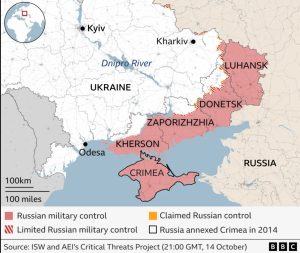
Source: Institute for the Study of War
The war being waged for three years now, has entered a dangerous strategic plateau. The illustration shows as of late 2025, Russian forces control more than 116000 sq km of majority of Donbas region (Donetsk and Luhansk) as well as 70 per cent of Zaporizhzhia and Kherson Oblast in the South, expanding into Somy, Dnepropetrovsk, Odesa and Kharkiv. According to BBC, Ukraine has also carried out strikes on Russian energy assets in Belgorod and Crimea with crucial military assistance from Europe. Moreover, President Trump showed willingness to provide Tomahawk cruise missile to Ukraine which he later denied preventing further entrenchment of status quo.
The war has inflicted devastating human and economic cost. Russia is losing 100-150 soldiers per sq mile in gained territory and has suffered 790,000 military casualties while Ukraine suffered 400,000 along with 14000 civilian deaths according to a report by then-SACEUR Cavoli. According to World Bank report, Ukrainian economy has shrunk by 22.6 per cent as 64 per cent of its power generation capacity is crippled while Russian oil refining capacity is diminished by 40 per cent however its GDP has grown 5.6 per cent since 2022. Nevertheless, Russian war objectives have remained unaltered.
On the other hand, Ukrainian President Zelensky is also facing political backlash at home. Corruption charges, and internal divisions along eastern flank have eroded his authority. Many people no longer see him as representing the entire Ukraine. His maximalist demands of ironclad security guarantees including NATO deployment are incongruent with the prevailing situation. Ukraine’s precarious military leverage precludes advantageous negotiations. According to professor Jeffery D. Sachs, a window for peace emerged early in the war in February 2022, when Ukraine signaled openness to meet with Russian counterparts for ceasefire. The deal was “blocked” by US and the Europe mainly Germany and France as corroborated by Former Israeli Prime Minister Naftali Bennett.
As per a report by CSIS, Russia can sustain war for another 3 years, turning the trajectory of war into a low intensity protracted conflict. Given its stark diplomatic leverage, Russia refuses a ceasefire without detailed political settlement, demanding a neutral Ukraine with no NATO ambitions and withdrawal of western troops from all four Russian annexed territories. On 20 October 2025, President Trump proposed a ceasefire premised on freezing the conflict along current battle lines, which President Zelensky called a “good compromise.” Russia rejected the proposal insisting on control over the entire Donbas region. Consequently, the conflicting demands delayed the Trump-Putin summit scheduled for 30 or 31 October 2025, in Budapest.
When the war broke out an estimated USD 335 billion of Russian assets were frozen. US also sanctioned two biggest Russian oil firms (Rosneft and Lukoil) on 23 October 2025. In response, Dimitry Medvedev stated “US is Russia’s adversary and peacemaker Trump is on a warpath.” Though Russia was hurt by the sanctions, it had already started revitalizing alliances and exploring new economic regimes to bypass the repercussions. This was evident at forums like SCO and BRICS. Given the circumstances, the stalemate might prolong because there is no unilateral power with significant leverage to coerce all the warring parties into a settlement. The UN’s incapacity as a mediator coupled with power asymmetry between Ukraine’s nascent leadership and Russia’s security-centric regime underscore the absence of a credible mechanism to achieve a peaceful settlement.
The situation has escalated enormously. Russia is suspicious that freezing the conflict is a tactic for rearmament hence, Moscow would not let go of its primary leverage in Ukraine. Therefore, any settlement would be premised on geopolitical compromise. Russian incursions may continue to persist until its de facto control is established in the whole Donbas region. President Zelensky might need to go, as his legitimacy is questioned at home and strong Russian preference for a neutral government in Ukraine. Russia would not back off until it eliminates the existential threat from its proximity and reasserts status quo. Until mutual suspicion gives way to strategic compromise, any peace attempt would end up in a frozen conflict.
Shafaq Zernab is a Research Assistant at the Centre for Aerospace & Security Studies, Islamabad. She can be reached at [email protected]



