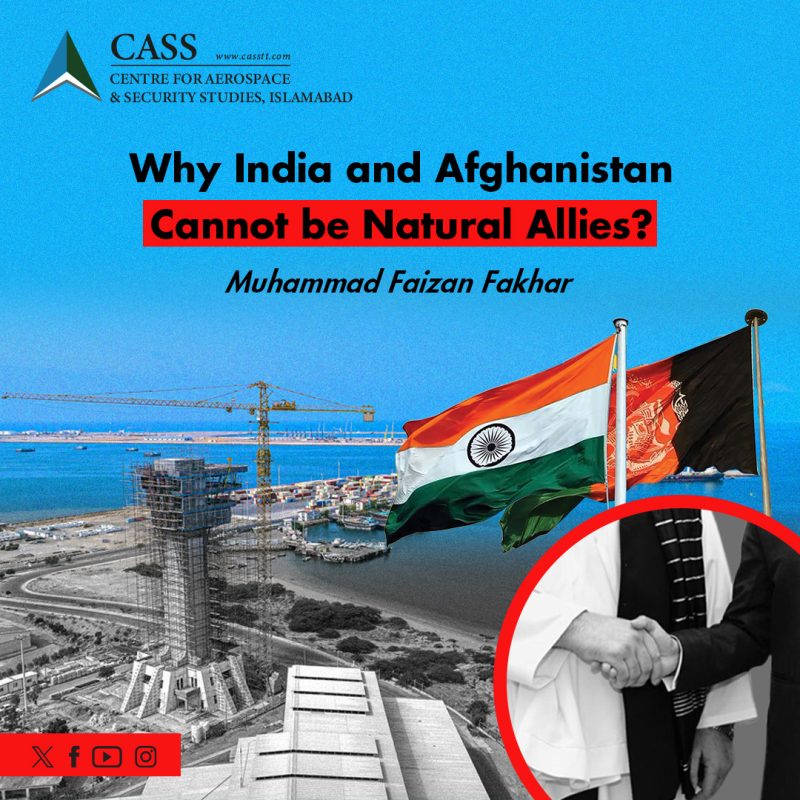
India and Afghanistan have recently warmed up marked by the official visit of Taliban’s foreign minister to India and New Delhi’s decision to reopen its embassy in Kabul. While the chatter about a renewed partnership in the region is only natural, a long term alliance between Taliban led Afghanistan and BJP’s India is anything but natural. A look at the geography, ideology and recent past of India and Afghanistan suggests that the re-engagement between the two sides is circumstantial at best with bleak prospects of leading towards a durable relationship.
India’s interest in Afghanistan is not without precedent. During the two decade long US presence in Afghanistan, India sought to establish influence in Kabul by pouring billions of dollars in the country. From 2001 to 2021, India is estimated to have spent a substantial amount of around $3 billion in Afghanistan. During this period, India invested in the construction of Afghan Parliament building in Kabul, Salma Dam in Herat, and Zaranj–Delaram Highway connecting western Afghanistan with Iran’s Chahbahar port. In addition to these mega projects, India also invested heavily in smaller projects including schools, hospitals and power lines. India also maintained a network of diplomatic and consular footprint across Afghanistan including an embassy in Kabul and four consulates in Jalalabad, Mazar-i-Sharif, Kandahar and Herat. Pakistan consistently maintained that these diplomatic missions were used by India to conduct covert intelligence activities targeting Pakistan.
Indian suppliers, contractors and consultants were largely able to operate in the region due to the secure transit lines provided by the allied forces. Therefore, the relationship between India Afghanistan rested on third-party support during this period. Consequently, as soon as the third party security scaffolding was removed after the US withdrawal, the influence, India had spent decades and billions of dollars to establish, collapsed almost overnight. This leads to the question of why India needs to rely on third-party mediation for engagement with Afghanistan and the answer is rooted in the geographical limitations.
Afghanistan is a landlocked country and India does not share any land border with the country. Therefore, a sustainable and large scale economic cooperation between the two either requires collaboration with Pakistan or an indirect alternative such as the Chahbahar port of Iran. India has been investing in Iran’s Chahbahar port precisely to circumvent Pakistan and to access Afghanistan and Central Asian region. However, this route faces many challenges including logistical complexity, lack of cost-effectiveness and most importantly its success is subject to the shifting geopolitical alliances and US sanctions on Iran. In 2018, US had granted a sanctions waiver to India for carrying out development activities at Chahbahar. In 2024, India announced a ten year deal with Iran to operate Chahbahar port, committing around US $370 million. However, with the recent revocation of the sanctions waiver by the Trump’s administration, Indian aims of developing Chahbahar as an alternative and achieving economic integration with Afghanistan without Pakistan has suffered a major setback. Therefore, any long-term economic cooperation between India and Afghanistan practically depends on Pakistan.
The third reason why the BJP led India and Taliban led Afghanistan cannot be natural allies is the massive gap of values and ideologies on both sides. BJP draws its political strength from a majoritarian and exclusionist ideology. This ideological foundation is built upon discrimination towards minorities of India, especially Muslims. The BJP government of India is often criticised for the ill treatment of the Indian Muslims as communal violence has become a regular occurrence in the country. On the other hand, the Taliban regime is based on strict implementation of their interpreted Sharia laws, gender segregation and conservative religious values. Even the historical figures revered by the Afghan Taliban are often villainized by the BJP forces as ‘Muslim Invaders’. For Taliban, rulers such as Mahmud of Ghazni, Muhammad Ghori, Zaheer ud Din Babur and Ahmad Shah Abdali are symbols Afghan identity who expanded Muslim rule across the subcontinent. Yet in BJP India, these figures are framed as foreign conquerors who desecrated temples and oppressed the Hindu population of the region. Therefore, in the presence of such steep ideological and historical divergence, any alliance between the both sides cannot be natural.
Pakistan needs to view the recent engagement of India and Taliban regime with strategic clarity. Circumstances dictate that a mutual hostility towards Pakistan might be a common ground for these diplomatic overtures, however, the odds of India and Afghanistan forming a sustainable strategic alliance appear slim. Nevertheless, Pakistan needs to continuously engage Kabul constructively with aims of efficient border management, smooth trade relations and joint efforts to curb cross border terrorism.
Muhammad Faizan Fakhar is a Senior Research Associate at the Centre for Aerospace & Security Studies (CASS), Islamabad, Pakistan. He can be reached at: [email protected]