
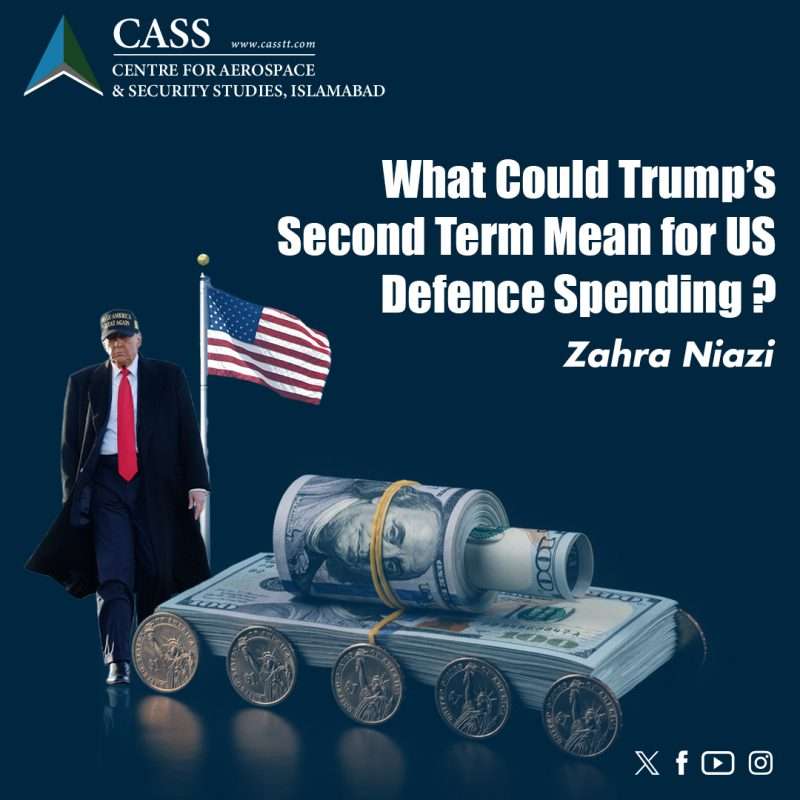
President-elect Donald Trump has clearly articulated his commitment to bringing an end to major international conflicts, with particular emphasis on resolving the Russia-Ukraine war, which he has repeatedly referred to as a drain on US resources. Moreover, and broadly connected, just days after the electoral victory, he announced his ambition to establish the Department of Government Efficiency (DOGE), which is intended to serve as an advisory organisation to provide recommendations on how to cut wasteful government spending. These policy approaches have sparked much debate on what a second Trump presidency could mean for the contours of US defence spending.
A substantial reduction in US military expenditure is improbable, given the United States’ established strategic priorities of strengthening its defence industrial base, ensuring military dominance, and maintaining global influence amidst intensifying geopolitical competition. During his first term in office, Donald Trump oversaw significant increases in the defence budget (despite giving speeches and statements to the contrary) and made a major push to sell weapons overseas. A second Trump term is also unlikely to significantly reduce military expenditure. Instead, it may aim to reallocate resources toward priorities that enhance American strategic dominance in great-power competition, particularly against China, while addressing long-term challenges such as technological modernisation and regional alliances.
Modernisation of military assets and capabilities, including integration of advanced technologies, could likely be one key focus. Tech firms were major recipients of defence contracts during Trump’s first term in office. With the second term, this trend is poised to accelerate. Project 2025, a collection of policy proposals developed by numerous conservative organisations, advocates for streamlining Pentagon technology procurement to enhance competitiveness. Although independent of Trump, the involvement of his key policy advisors and several individuals slated for high-ranking positions suggests these proposals could guide the priorities of his administration.
In the 2024 election, several prominent figures from Silicon Valley endorsed the Republican candidate, reflecting growing alignment between the technology sector and conservative policy priorities. Now, the incoming administration has appointed key individuals with extensive experience in technology to critical positions, further solidifying this connection. Vice President-elect JD Vance, for example, has been a venture capitalist with close relationships with influential tech figures, including the co-founders of Anduril Industries, an American defence technology company, and Palantir Technologies, which specialises in software platforms for big data analytics. More notably, entrepreneur Vivek Ramaswamy and tech titan Elon Musk, known for his key roles in Tesla and SpaceX, have been chosen to co-lead Trump’s brainchild–the newly coined DOGE. It has already been reported that the DOGE’s efficiency drive is expected to lead to more joint projects between smaller tech firms and big defence contractors.
Trump’s recent Cabinet appointments for National Security Advisor and Secretary of State, are known for their critical views on Beijing. This signals a more pre-emptive approach toward China, which could lead to a heightened focus on the Asia-Pacific theatre. Should an opportunity to redirect military spending occur, the second Trump administration is likely to demonstrate a preference for expanding military presence and capabilities in the Asia-Pacific and supporting key alliances in the region. As early as June this year, one of Trump’s associates, in one of his public writings, called on the Pentagon to deploy the ‘entire’ Marine Corps to the Pacific.
Implementing a shift in defence spending priorities may face challenges, particularly if the Trump administration fails to broker a truce between Putin and the Ukrainian President. Additionally, while the US’ focus on counterterrorism is expected to decline overall, affecting countries like Pakistan that have traditionally relied on such support, Syria’s instability following the ousting of President Bashar al-Assad could become an exception to this trend and a potential distraction from the administration’s broader strategic objectives. The US Central Command has already announced that it struck more than 75 targets to ensure that the Islamic State of Iraq and the Levant (ISIL) does not exploit the fall of the regime in Syria.
US defence spending priorities will have far-reaching implications, not just for the country’s security posture and global influence but also for the strategic calculus of allies and adversaries. As countries respond to the changing dynamics, they may be compelled to adapt their policies and strategies to maintain relevance and safeguard their interests in an increasingly competitive landscape.
Zahra Niazi is a Research Assistant at the Centre for Aerospace & Security Studies (CASS), Islamabad, Pakistan. She can be reached at [email protected].



