On the morning of January 3, 2026, the United States carried out an operation against Venezuela: deposing a sitting president Nicolás Maduro and his wife from the heartland of a heavily guarded capital. Although the legality and morality of this operation are highly contested, this article focuses on an equally important dimension, which is the employment of airpower in conflicts. From this point of view the operation in Venezuela is a glaring example of contemporary use of airpower as a decisive instrument of shaping political outcomes, well before any troop engagement.
Long before U.S. aircraft appeared over Caracas, there were already indications that the battlespace had been quietly shaped. Subsequent reporting suggests that CIA had been operating under unusually constrained conditions inside Venezuela for months, collecting information on leadership movements, security routines, and communications patterns in the absence of formal diplomatic cover. These efforts unfolded alongside a broader escalation pattern including drone activity, maritime strikes, and sustained pressure on Venezuelan security forces that, taken together, pointed to systematic preparation rather than improvisation The lack of timely Venezuelan reaction when military operations finally commenced raises a critical analytical question: to what extent had intelligence operations already narrowed the space for response before airpower was employed?
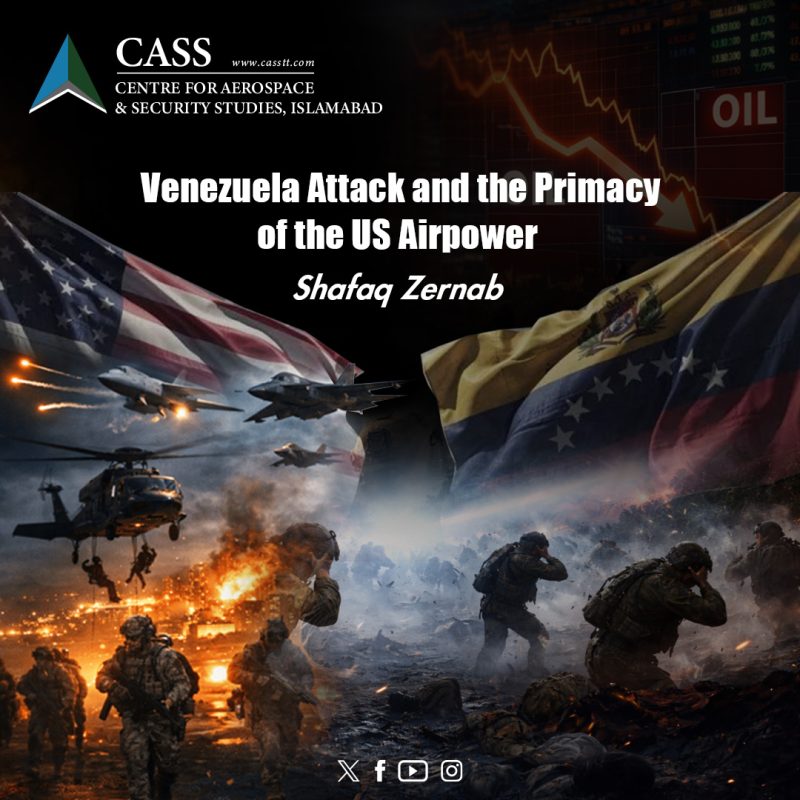
The Department of Defence issued a briefing on Operation Absolute Resolve, showcasing how the US achieved air dominance and executed a precise operation, deploying stealth fighters to control skies, jammers to cripple air defences and covert reconnaissance drones and satellites to feed data to commanders. A full arsenal of helicopters was also deployed along with refuelling aircraft, which resulted in a major coup in the Western Hemisphere.
The US carried out the operation with unmatched precision which overwhelmed modest Venezuelan air defences. Over the past two decades, Caracas had built a motley collection of Russian Air Defences such as S-300VM long-range surface-to-air-missiles (SAMs), S-125 Pechora batteries, Buk-M2 medium-range systems, ZU-23-2 anti-aircraft guns, Igla-S man-portable-air-defence-systems (MANPADS), and a fighter fleet comprising F-16s and Su-30MK2 multirole aircraft equipped with beyond visual range (BVR) missiles like R-77 and precision-guided ordnance, including Kh-31A. Ideally, this configuration should have inflicted massive cost during any hostile air operation against Venezuela, particularly one, involving helicopters with low-altitude ingress but what unfolded was quite the opposite.
Chairman of the Joint Chiefs Gen. Dan Caine told the operational details starting with the role of human intelligence that made a seamless air operation possible. Adhering to the classic yet refined airpower employment logic, US crippled enemy infrastructure before the air operation actually commenced. According to the Pentagon the aircraft included F/A-18E/F Super Hornet, EA-18G Growler, F-35 Lightning II, F-22 Raptor, Northrop Grumman’s, E-2D Advanced Hawkeye and B-1 bombers. Overall, more than 150 rotary-wing, fixed-wing, and unmanned aircraft were deployed.
Space-enabled jamming and cyber-electromagnetic effects degraded Venezuelan command and control (C2) establishing temporal dominance. A major cyberattack was executed to cut power to Caracas and paralyse military communication lines. EA-18 Growlers, spoofed Venezuelan radar systems, making them display clear skies even as 150 US aircraft were overhead. These air defences were sitting ducks employed in the open without any camouflage, reflecting organisational decay. Hollowed out readiness and technological inferiority due to years of sanctions and corruption quickly translated into operational vulnerabilities once the enemy was engaged.
Instead of targeting general forces or civilian systems, the US forces attacked missile defences, energy nodes tied to leadership shelters, and specific armoured units that could potentially strike back. This distinction is analytically significant: what mattered was not air defence destruction per se but air defence irrelevance. This carefully calibrated attack signalled how limited objectives achieved regime-level effects. The operation exposed that having air defences does not automatically confer the ability to deny the airspace. Venezuelan systems were neither integrated not resilient under a sustained multi-domain attack. Open-source imagery and post-operation analysis revealed that the US cyber command disabled the Venezuelan air defences instead of completely destroying them, leaving the enemy’s command chain dysfunctional.
The primacy of the US airpower established swiftly. US warplanes launched precision strikes hitting Fort Tiuna and Generalissimo Francisco de Miranda Air Base military installations across northern Venezuela, lasting approximately 30 minutes. Large explosions hit logistic hubs (La Guaira Port), radio towers and national power grids along with Buk-M2E SAM at Higuerote Airport. Advanced fifth-generation fighters such as the F-35 and F-22 Raptor were not deployed as shooters but as sensors infusing data across domain and feeding real-time intelligence to the operators. This precise detection and coordination rendered Venezuelan Su-30 ineffective. This shows that without intact datalinks, early warning and decision making, air combat ability remains latent. Hence, the victory was sealed well before any clash unfolded.
B-1B Lancer bombers provided long-range strike capability, delivering precision-guided munitions (PGMs) outside the range of air defences. KC-135 Stratotankers provided air refuelling to extend operational range. Northrop Grumman E-2D Advanced Hawkeyes-carrier-based airborne early warning aircraft provided battle management and threat detection via advanced intelligence, surveillance and reconnaissance (ISR) capabilities. RQ-170 Sentinel stealth drones, conducted covert reconnaissance, while additional satellites and unmanned aerial vehicles supplied real-time intelligence to ground commanders.
Then began the most decisive phase of the operation; extraction, which relied heavily on MH-60L Direct Action Penetrators assault helicopters, supported by Boeing Little Bird M/AH-6M light attack helicopters and CH-47 Chinook heavy-lift transport helicopters. According to defence industry executives who researched the raid, AH-64 Apache attack helicopters, armed with 30mm chain guns and Hellfire missile, provided a protective canopy of firepower to the elite delta forces necessary for establishing corridors for the extraction of President Maduro.
Despite the clarity with which airpower delivered strategic effects, publicly available data on the Venezuela operation still tells only one side of the story, and many questions about what preceded it remain unanswered. Who were these people who were killed and why the boats were attacked when the imagery showed that they were rerouting? None of the 11 people killed in a US military strike on a boat in the Caribbean last week were members of Venezuelan gang Tren de Aragua, Venezuela’s interior minister has said, while US media reported the attack came after the vessel had turned around and was heading back to shore. Nonetheless, What is clear is that the US entered the battle space with overwhelming situational awareness, informed not just by aerial ISR but by months of intelligence collection that mapped leadership movements and communication patterns a factor that likely reduced any coordinated Venezuelan response. Beyond this, a series of disputed claims have circulated about possible insider assistance or the employment of unconventional technology during the raid. For example, an account reshared by the White House press secretary on X described an eyewitness claim that an intense acoustic or “sonic” effect incapacitated defenders, leaving troops “bleeding from the nose” and unable to stand, though these reports remain unverified and have not been confirmed by Pentagon officials.
The very emergence of such narrative points to both the opacity of the preparatory phase and the perception whether grounded in fact or conjecture, that the US forces possessed not just superior intelligence but tools and planning so comprehensive that opposition forces were unable to mount resistance. The US sustained no reported losses, even as helicopters inserted commandos into heavily defended terrain, highlights the role that meticulous intelligence and synchronised effects played in shaping tactical surprise and operational success.
This approach highlights the evolution of airpower’s modus-operandi which has emerged as a tool of temporal domination, compressing decision making at immense speeds, leaving no time for the enemy to act. Venezuelan air defences were not defeated in battle but bypassed in time. This operation indicates how modern conflicts are decided in the air with associated space, cyber and electromagnetic domains. That is the fundamental reason why major powers rely on airpower as a policy tool for translating tactical outcomes into immediate political outcomes without any ground engagement. The Venezuelan episode signals the future application of airpower showing how swift integration of multiple domains can carry effect-oriented operations to paralyse a state authority, shape narratives and take control without engaging in protracted warfare.
Shafaq Zernab is a Research Assistant at the Centre for Aerospace & Security Studies (CASS), Islamabad, Pakistan. The article was first published in The News. She can be reached at [email protected]