The United States (US) Administration under President Donald Trump imposed a 10 percent tariff on all Chinese imports starting 4 February 2025, which was increased to 20 percent on 4 March 2025. In response, Beijing announced a 15 percent tariffs on US LNG and coal, a 10 percent tariff on crude oil and farm equipment, and imposed export controls on rare earth minerals—moves widely seen as retaliation, reigniting trade tensions between the world’s two largest economies.
Additionally, a 25 percent tariff was announced on most imports from Canada and Mexico, along with a 10 percent tariff on Canadian energy exports. While these tariffs were initially set to take effect on 4 March 2025, they were suspended for 30 days for goods compliant with the United States–Mexico–Canada Agreement (USMCA). However, a degree of uncertainty surrounding the future trajectory of these tariffs persists. Simultaneously, the Administration reinstated the full 25 percent tariff on all steel imports and raised tariffs on aluminium imports to 25 percent. President Trump also signed a directive instructing the administration to propose a new round of ‘reciprocal tariffs,’ signalling a further escalation in trade restrictions.
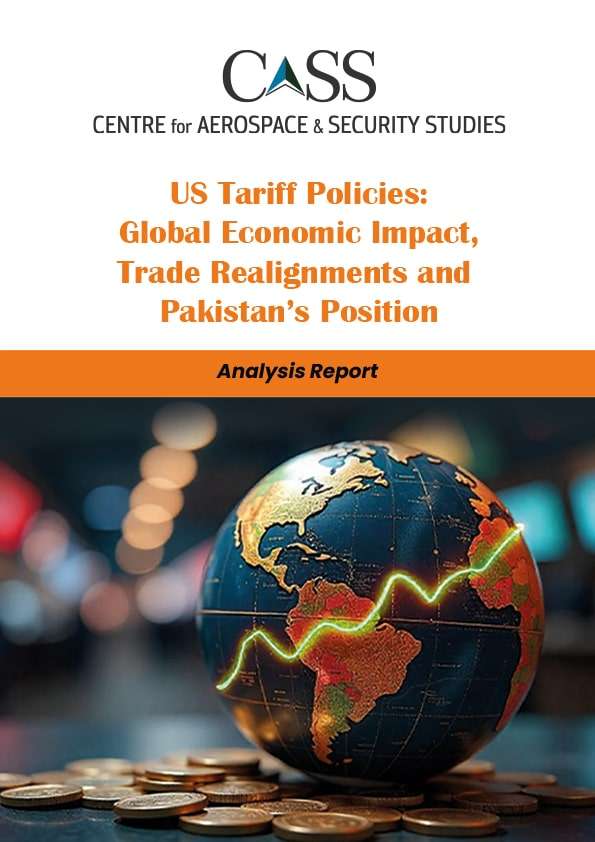
These evolving global trade dynamics necessitate close evaluation by countries, including Pakistan, to assess potential economic implications. Adopting a proactive approach and staying prepared for sudden shifts in global trade dynamics is imperative. In view of this, the Centre for Aerospace & Security Studies (CASS), Islamabad, organised a Zoom Webinar on 19 March 2025 on ‘US Tariff Policies: Global Economic Impact, Trade Realignments and Pakistan’s Positions.’
The discussion aimed to explore the effect of US tariff policies on global economic growth, trade stability, and global trade governance. It also aimed to analyse the challenges and opportunities for Pakistan amid shifting global trade policies and recommend proactive measures to safeguard the country’s economic interests and trade repositioning. Additionally, it aimed to explore how the US tariff policies were being used as a strategic policy tool to achieve broader economic and geopolitical objectives and the possible future direction of US trade policy.
The distinguished subject matter experts who spoke at the webinar included:
- Dr Manzoor Ahmad, Senior Fellow, Pakistan Institute of Development Economics (PIDE), Islamabad
- Mr Syed Ali Ehsan, Deputy Executive Director, Policy Research Institute of Market Economy (PRIME), Islamabad
- Dr Usman W. Chohan, Advisor (Economic Affairs and National Development), Centre for Aerospace & Security Studies (CASS), Islamabad
The discussion was moderated by Dr Usman W. Chohan, Advisor at CASS with Concluding Remarks by President CASS Air Marshal Javaid Ahmed (Retd).