Indo-pecific


Share this event

Facebook
Twitter
LinkedIn

Concept Note

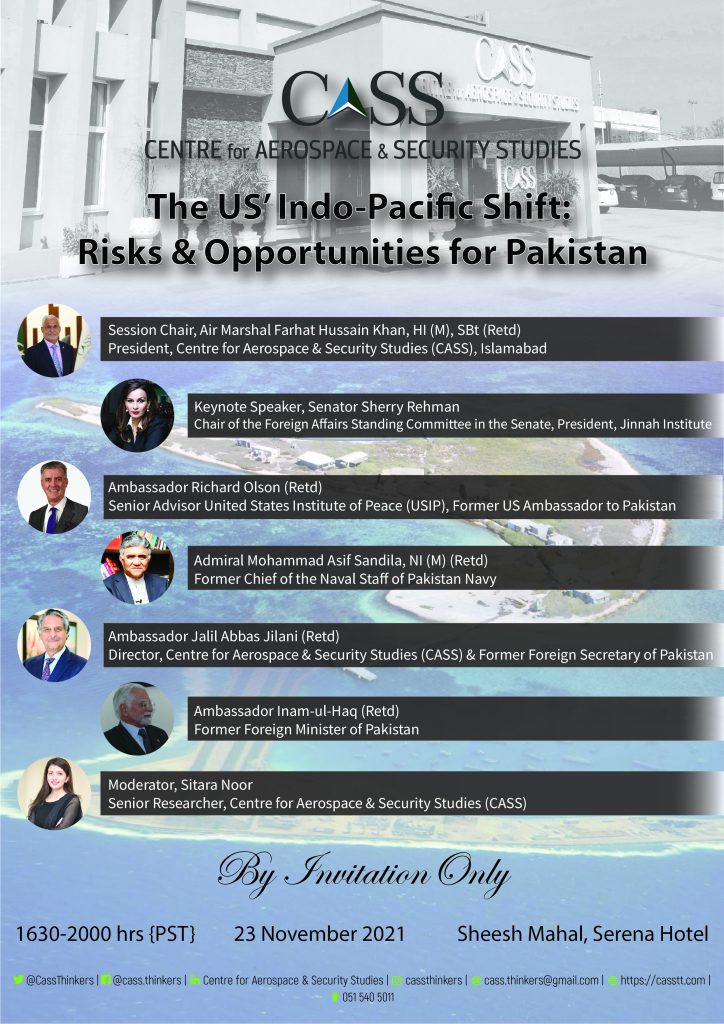
Since the announcement of the US “Pivot to Asia” policy, the strategic landscape of the region has undergone profound changes where the US-China competition has taken a centre stage. The bilateral relations of the US and China have evolved from being competitive to confrontational in the past few years. The rise of China in the economic and military domain is being perceived as a direct challenge to American supremacy. The recent developments in the strategic and political sphere along with recurring diplomatic altercations between the US and China over Taiwan and South China sea are indicative of a challenging path ahead. The growing antagonism is having a huge impact on regional security dynamics, forcing regional countries to assume more defined positions.

President Biden came to power with the promise of stabilizing the world and talked about ‘recalibrating priorities’ after two decades of wars. Nonetheless, with the announcement of ‘AUKUS’ – a trilateral security pact between Australia, the UK and the US, under which the UK and the US will help Canberra acquire nuclear-powered submarines, the situation on the ground is pointing at a rapidly intensifying strategic competition between Washington and Beijing and their respective allies. The competition is specifically on the rise in the Indo-Pacific region with the possibility of Quad taking a central role in standing up to the perceived Chinese expansion in the region.

Pakistan, as an important regional player, is directly affected by the developments in the region. After the US withdrawal from Afghanistan, Pak-US relations are once again at their lowest. While Pakistan should certainly continue to balance its relationship with both the US and China, it should prepare for a future situation where it may have to take a defined position. Despite the shrinking space for diplomacy, Islamabad must stay on the course and avoid being caught in the crossfire of this great power rivalry. 
Event Highlights

Event Press Release

Other Events

THE FUTURE OF THE INDUS WATER TREATY

For more than six decades, the Indus Water Treaty (IWT), signed in 1960 between Pakistan and India, remained as one of the most enduring transboundary water-sharing agreements in the world. Despite multiple wars, political crises, and prolonged periods of bilateral hostility, the treaty largely continued to govern the allocation and management of the waters of the Indus Basin

Read More »

Fiscal Survival or Economic Reform? Decoding Pakistan’s Budget Priorities

Pakistan’s annual budget is more than a fiscal document; it is a reflection of the country’s structural economic constraints, political choices, and shifting development priorities. The tension between fiscal survival and meaningful economic reform has become increasingly pronounced amid rising debt servicing obligations, limited fiscal space, and recurring dependence on external financing. In this context, budget-making often appears reactive—focused on stabilisation and compliance with short-term macroeconomic targets—rather than transformative, aimed at broad-based productivity, institutional reform, and sustainable growth.

Read More »

Nuclear Capability: Balancing Global Security and Energy Needs

Recent global developments—including geopolitical tensions, energy crises, and shifting power dynamics—have intensified discussions around nuclear capability. After the Russia-Ukraine conflict and the US-Israel-Iran war, nations are increasingly evaluating nuclear technology not only as a strategic defense mechanism but also as a reliable and large-scale energy source. These developments have brought nuclear capability back to the forefront of international debate.
The dual-use nature of nuclear capability—serving both military and civilian purposes—makes it a critical area of analysis. The ongoing war on Iran has introduced significant uncertainty into the future of Iran’s nuclear trajectory, particularly regarding

Read More »